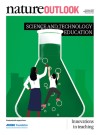
Credit: Sébastien Thibault
A strong background in science, technology, engineering and mathematics (STEM) is vital for more than budding scientists. Future jobs in a wide variety of areas will require skills in STEM subjects. This Outlook explores how science education is being modernized to prepare students for life in the twenty-first century.
The way science teachers are being trained is evolving to take account of new knowledge about how students learn. Trainee teachers can now use ‘design thinking’ to create active, hands-on lessons that keep students engaged.
Some science lessons now use virtual labs from companies such as Labster. These give students the freedom to experiment without the safety and financial constraints of the real world. But could virtual labs ever replace the real thing?
Art is often seen as separate from science, but drawing can be a valuable way to deepen students’ understanding of a subject. There are ways to bring drawing into science lessons even for those who think they can’t draw.
Science education is vital for the developing world as countries strive to modernize their economies and improve conditions for their citizens. Bringing innovations from the developed world, and adapting them to the local context, can help to close the gap between rich and poor nations.
The lack of diversity in science must be addressed at all levels of education. New initiatives in physics are helping to increase the proportion of women and scientists of colour, and may hold lessons for the rest of science.
Technology is being integrated into education at earlier ages, from the use of tablets in the classroom to lessons in coding. A digital-intelligence project aims to help students learn the skills they need to be safe online.
We are pleased to acknowledge the financial support of the Amgen Foundation in producing this Outlook. As always, Nature has sole responsibility for all editorial content.
 Part of Nature Outlook: Science and technology education
 Better teachers are needed to improve science education
 Simulated labs are booming
 Drawn to science
 Expanding the reach of science
 Boosting the number of students from under-represented groups in physics
 Making children safer online
 More from Nature Outlooks