Credit: Sam Falconer
One of the worst things about cancer — and there are many contenders for that distinction — is that the disease can be quite stealthy. Too often, tumours develop undetected. If cancer goes undiscovered long enough for it to take root in an organ or spread through the body, it becomes a formidable foe for even the most sophisticated therapies. The best that people in this situation can hope for is to survive for a few more years.
The inadequacy of diagnostics helps to explain why, despite huge leaps forward in treatment, cancer is still responsible for roughly one in six deaths. Fortunately, cancer diagnosis is in the midst of rapid and transformative change. Studies of the intricacies of cancer genetics are providing scientists with the more nuanced understanding that, in effect, every cancer is a rare cancer. And techniques for detecting tumours early are developing apace, as is other diagnostics research.
Part of Nature Outlook: Cancer diagnosis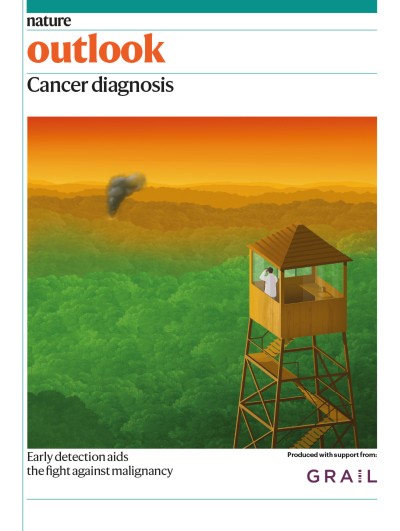
Liquid biopsies, for example, are revolutionizing the early detection of cancer by allowing physicians to monitor the blood, instead of taking a tissue sample; the task now is to put in place trials that will allow this technology to be used routinely in the clinic. Machine-learning algorithms are also starting to become indispensable aids in diagnosis — artificial intelligence can recognize patterns that are too subtle for the human eye to detect. Such technologies face their toughest test in pancreatic cancer, which is almost always caught too late to treat.
The ability to detect cancer early, when it can be hard to tell how great a threat it will go on to pose, does, however, present a challenge to those designing screening programmes. Researchers are testing approaches to cut down on overdiagnosis and treatment of low-risk cancers while maintaining the health benefits of check-ups for, in particular, cancers of the breast and prostate. Debates about screening protocols have led to widespread confusion about when and if testing should take place. Screening is especially problematic in low- and middle-income countries, where medical infrastructure is lacking.
We are pleased to acknowledge the financial support of GRAIL, Inc. in producing this Outlook. As always, Nature retains sole responsibility for all editorial content.
 The pros and cons of screening
 We need more evidence to answer questions about screening
 Could liquid biopsies help deliver better treatment?
 The future of liquid biopsy
 How cancer genomics is transforming diagnosis and treatment
 Will a test to detect early pancreatic cancer ever be possible?
 How AI is improving cancer diagnostics
 Better cancer screening in resource-poor nations
 Research round-up: Cancer diagnosis