Mpox is a zoonotic disease, meaning it can be transmitted to humans from an animal host. Although it is known to be caused by the monkeypox virus (MPXV;
Orthopoxvirus monkeypox), the reservoir for MPXV — the host, or hosts, that enables the pathogen to persist in nature — remains uncertain.
Writing in Nature, Riutord-Fe
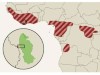
et al.1 report one of the most comprehensive investigations of wildlife disease outbreaks so far. They present several lines of evidence that a transmission event from fire-footed rope squirrels (
Funisciurus pyrropus) is the probable origin of an MPXV outbreak in a wild population of sooty mangabeys (
Cercocebus atys) in Taï National Park, Côte d’Ivoire. The study provides crucial insights into squirrel species as potential natural reservoirs, and emphasizes the ongoing risk of transmission at the human–animal interface, particularly in the wild meat trade.



 Transmission of MPXV from fire-footed rope squirrels to sooty mangabeys
 Viral genomes track the transmission of mpox in humans before 2017 outbreak
 A human protein that holds bird flu viruses at bay