
Figure 1
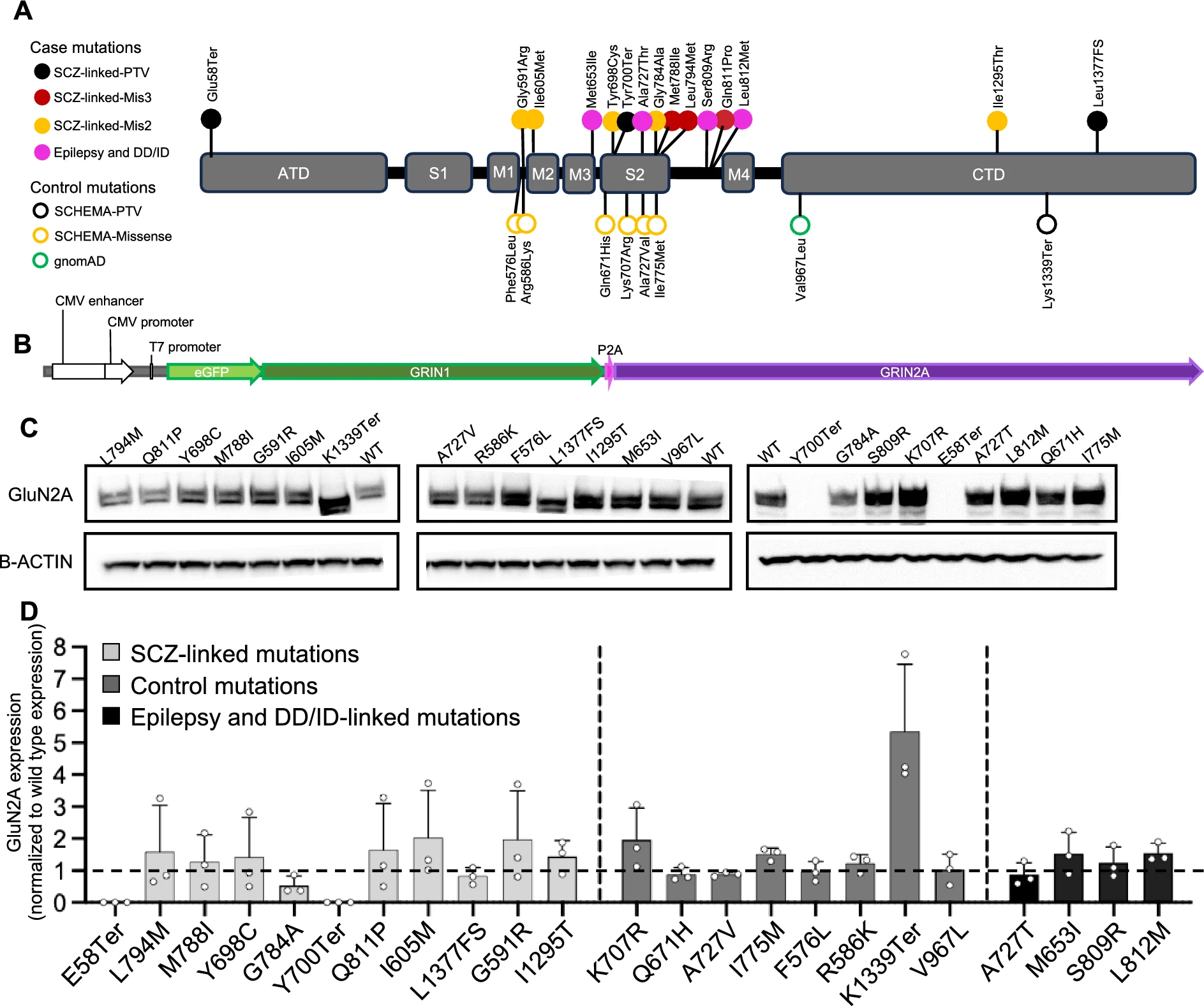
GRIN2A mutation selection, construct design, and validation of expression in HEK cells. (A) All pathogenic and non-pathogenic variants selected for characterization in this study, mapped on the domain structure of GluN2A. Missense variants from SCZ cases were colored according to the predicted impact (MPC score) on the function. PTV, protein-truncating variant; DD/ID, developmental delay/intellectual disability; FS, frameshift. (B) Diagram of the construct transfected into HEK 293-T cells for the functional characterization of GRIN2A variants. The plasmid was designed with a P2A sequence between the two genes to control the expression of both transcripts with one high efficiency promoter (CMV), and to assure equimolar protein production of GFP-tagged GRIN1 and wild-type or mutated GRIN2A for electrophysiological characterization. (C) Western blots probing for GluN2A and β-ACTIN in lysates of HEK cells transiently transfected with GRIN1-GRIN2A constructs to express wild-type or mutant NMDARs. The blots presented here are cropped, and the original blots are presented in Supplementary Fig. 2. (D) Quantification of GluN2A expression by Western blot. All values are normalized to wild-type GluN2A expression. Data are shown as mean + SD; n = 3 for each GluN2A variant. Statistical significance was assessed using Brown-Forsythe and Welch ANOVA with Dunnett’s T3 multiple comparisons test. With the exception of E58Ter and Y700Ter, no conditions were found to be significantly different from wild type.
