Volume 1
-
No. 12 December 2017
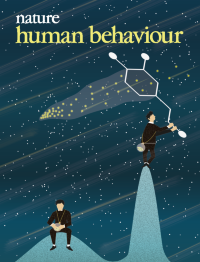
What underlies individual differences in people’s dislike of societal outliers? Across several studies, Gollwitzer and colleagues uncover an association between aversion toward non-social pattern deviancy (for example, a row of triangles with one triangle out of line) and aversion towards stigmatized individuals, social norm breakers, and racial minority individuals.
See Gollwitzer et al. and News & Views by Sigelman.
-
No. 11 November 2017
The US Food and Drug Administration requires direct-to-consumer advertisements of pharmaceutical drugs to mention not only severe side-effects, but also the most frequent, which can be minor. A series of experiments with more than 3,000 participants show that this practice dilutes consumers’ judgements of the overall severity of side effects.
See Sivanathan and Kakkar 1, 797–802 (2017)
-
No. 10 October 2017
Heritability estimates derived from genome-wide association studies are substantially lower than so-called SNP- or chip-based heritability estimates, raising questions about ‘hidden heritability’. A mega-analysis of whole-genome data from seven populations demonstrates substantial ‘hidden heritability’ for educational attainment and reproductive behaviour, which most likely reflects heterogeneity in phenotypic measurements or gene–environment interactions rather than genetic heterogeneity
See Tropf et al. 1, 757-765 (2017).
-
No. 9 September 2017
Global groundwater resources are threatened by over-extraction. Castilla-Rho et al. develop an agent-based model of irrigated agriculture based on cooperative and collective action theory, incorporating results from the World Values Survey. The model captures the cultural, socioeconomic, institutional and physical conditions that determine how likely people in different at-risk regions are to comply with regulations.
See Castilla-Rho et al 1, 0181 (2017)
See also Janssen 1, 0196 (2017)