Thank you for visiting nature.com. You are using a browser version with limited support for CSS. To obtain
the best experience, we recommend you use a more up to date browser (or turn off compatibility mode in
Internet Explorer). In the meantime, to ensure continued support, we are displaying the site without styles
and JavaScript.
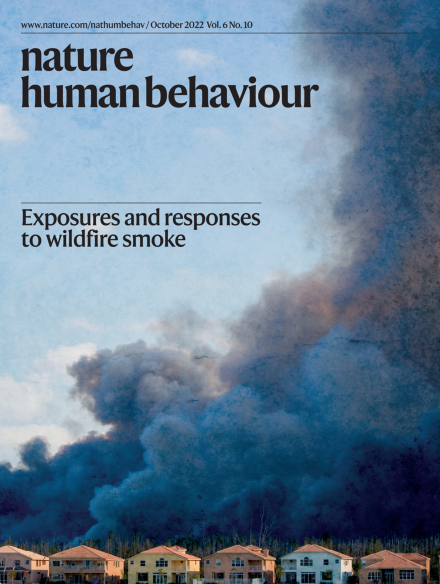
Are all communities equally vulnerable to wildfire-smoke exposure? Do government policies that rely on people to limit their own exposure to wildfire smoke work? Burke and colleagues address these questions in the context of Californian wildfires, using data from private pollution sensors, cell phones, social media posts and internet search activity. They find that wealthier households and lower-income households respond differently to smoke events when it comes to seeking health protection information or staying at home. They also find that indoor PM2.5 concentrations are well above health guidelines, with enormous variability among households. These findings suggest that government policies that rely on people’s initiatives alone are broadly ineffective, with unequal benefits for different socioeconomic groups.
In a recent editorial, we announced the adoption of new ethics guidance for research about human groups. In this follow-up editorial, we provide background and examples to clarify why we developed this guidance and how we will be using it.
The low representation of academics with disabilities is a longstanding problem on which progress has been slow. Drawing on my research on disability-related barriers and my experiences of disability, I make six practical suggestions for how academic staff and people with disabilities can help make academia more disability inclusive.
Why are some communities more vulnerable to wildfire smoke than others? Burke et al. study human behaviour during wildfire events by leveraging multiple non-traditional data sources, including internet search results, Twitter updates, and mobility and sensor data. Their results will help to inform better and more equitable policy.
Proposals to fight online misinformation range from gently encouraging users to consider the accuracy of information (‘nudges’) to bans and removing content. Using modelling techniques, we find that these interventions are unlikely to be effective in isolation, but that a combined approach can achieve a significant reduction in the spread of misinformation.
A study across 61 countries showed that, on a global scale, individuals are often inconsistent when choosing between immediate and future financial options. Although economic inequality is associated with this decision-making process, nearly everyone demonstrates these anomalies, and instability can lead to worse choices, even in wealthy individuals.
Danilo Bzdok and Robin I. M. Dunbar review the neurobiology of human and primate social behaviours and how the pandemic may have disrupted these systems.
Studying production, funding and consumption of science, the authors find a strong alignment between what the public consumes and what is impactful, as well as an alignment between funding and collective public use.
Burke et al. show that smoke exposure is associated with behavioural changes and worsening sentiment, with important differences by income. They document substantial infiltration of smoke into homes, suggesting that current policy reliance on self-protection could be ineffective.
Cash transfers are a popular anti-poverty strategy worldwide. In this study of 42 countries over 24 years, Richterman and Thirumurthy find that large cash transfer programmes were associated with improvements in a variety of HIV-related outcomes.
Using a mathematical model of viral spread and Twitter data, Bak-Coleman and coauthors show how a combination of interventions, such as fact-checking, nudging and account suspension, can help combat the spread of misinformation.
Berger et al. investigate green defaults under varying prices. Using field data from a flight compensation platform, they show that green defaults are effective. Their effectiveness, however, vanishes when costs become too high.
Ruggeri et al. find in a study of 61 countries that temporal discounting patterns are globally generalizable. Worse financial environments, greater inequality and high inflation are associated with extreme or inconsistent long-term decisions.
Koster, Balaguer et al. show that an AI mechanism is able to learn to produce a redistribution policy which is preferred to alternatives by humans in an incentivized game.
Goldenberg et al. show that we tend to overestimate the average intensity of a sequence of emotional expressions and that this is caused by increased memory for stronger expressions.
Van Bree et al. present the Brain Time Toolbox which warps electrophysiology data in line with the brain’s dynamics. This procedure overcomes the issue that the clock time format of brain data is out of synchrony with a dynamic brain that uses its own regime of time.