Thank you for visiting nature.com. You are using a browser version with limited support for CSS. To obtain
the best experience, we recommend you use a more up to date browser (or turn off compatibility mode in
Internet Explorer). In the meantime, to ensure continued support, we are displaying the site without styles
and JavaScript.
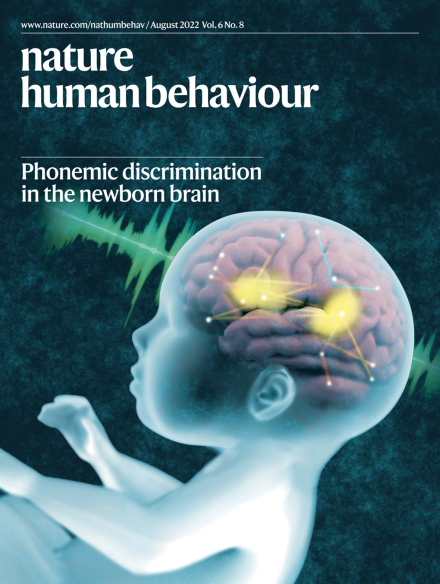
Newborn infants are able to perceive phonemes — the smallest units of speech — but it is unclear whether this is an innate ability or learnt after birth. Wu et al. show that the brains of newborns can rapidly learn to discriminate phonemes within the first few hours of life.
Marginalized scholars are often excluded from key scientific conferences owing to visa and travel restrictions, which increases inequity among academics.
Gender inequality in the workplace is a global problem. Segenet Kelemu describes how she has used her role as CEO of a research centre to create a more equitable workplace for all.
Data has tremendous potential to build resilience in government. To realize this potential, we need a new, human-centred, distinctly public sector approach to data science and AI, in which these technologies do not just automate or turbocharge what humans can already do well, but rather do things that people cannot.
A new algorithmic tool developed by Rotaru and colleagues can more accurately predict crime events in US cities. Predictive crime modelling can produce powerful statistical tools, but there are important considerations for researchers to take into account to avoid their findings being misused and doing more harm than good.
Human neonates discriminate vowel sounds played forward, as in normal speech, from their waveform reversal after five hours of exposure on the first day of their life. The neural dynamics supporting this rapid perceptual learning indicate a primitive brain mechanism similar to the language-processing network of adults.
Newberry and Plotkin show that the frequency of a cultural trait can influence its tendency to be copied. They develop a method to measure frequency-dependent selection and describe how it relates to the dynamics and diversity of first names and dog breed preferences, in different countries and cultures.
Rotaru et al. introduce a transparent crime forecasting algorithm that reveals inequities in police enforcement and suggests an enforcement bias in eight US cities.
Studying news supply and demand amidst the COVID-19 pandemic in Italy, Gravino and coauthors show that news production by unreliable sources is more sensitive to the public interest than reliable news.
Using a differences-in-differences approach, Lichand et al. estimate the effects of remote learning in São Paulo, Brazil, during the pandemic. Their findings suggest that middle- and high-school students learned only 27.5% of the in-person equivalent and that dropout risk increased by 365%.
Maheu et al. show that human probabilistic and deterministic sequence processing can be modelled under a hierarchical Bayesian inference model, with distinct hypothesis spaces for statistics and rules, linked by a single probabilistic currency.
Zhu et al. show using intracranial recordings that semantic and syntactic (grammatical) processing elicit distinct patterns of neural activity in speakers of Chinese, a language for which the distinction between syntax and semantics has been questioned.
In a series of mouse-tracking experiments, Callaway et al. show that people use planning strategies that strike a near-optimal balance between reward and computational cost.
Healthy volunteers and patients with obsessive-compulsive disorder learning a task from experience alone tend to repeat actions that lead to rewards. They are poor at learning predictive models, but their use of these models is strongly increased when explicit information is provided.
Prat-Carrabin and Woodford show that the bias and variance in participants’ estimates of numbers both depend on the numbers and on the prior, suggesting an optimal use of limited representational capacities through efficient coding and Bayesian decoding.