Volume 2
-
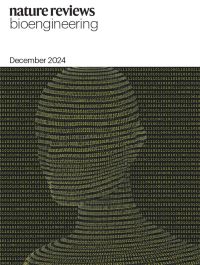
No. 12 December 2024
Deep generative models can generate synthetic data to tackle challenges inherent in real-world data within bioengineering and medicine. These challenges include concerns around privacy, biases in data, distributional shifts, underrepresentation of specific populations, and the scarcity of high-quality data. See Boris van Breugel et al
-
No. 11 November 2024
Viruses and virus-like particles can be repurposed as tools and carrier vehicles for intratumoural immunotherapy to elicit anti-tumour immunity and induce systemic anti-tumour responses at distant non-injected sites. See Anthony O. Omole et al
-
No. 10 October 2024
Biomaterials can be engineered to allow their minimally-invasive delivery by injection. Such injectable biomaterials face distinct design considerations, taking into account means of injection, geometry of the injection device, injection target, duration and force, and viscosity of the material. See Michael Nguyen et al
-
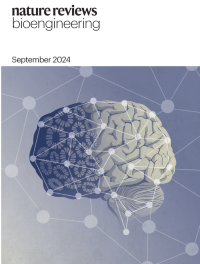
No. 9 September 2024
Human brain organoids can partly mimic the structure and function of the human brain and are being explored for the investigation of human brain development, biology and disease. With their increasing complexity and applications, ethical questions have arisen focused on how to classify, use and regulate these tissues. See Nathan A. Shlobin et al
-
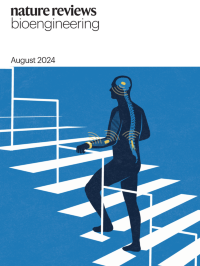
No. 8 August 2024
Brain-machine interfaces can be connected to the nervous system to decode neural signals and translate them into commands for the control of external devices, for example, to enable individuals with paralysis to restore movements. However, long-term stability and wireless transmission of neural data remain challenging. In addition, issues of hype, patient access, user-centred design and long-term support will need to be addressed. See reality check of brain-machine interfaces
-
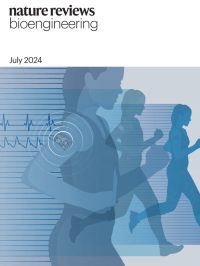
No. 7 July 2024
Soft bioelectronic systems can be interfaced with the body for the monitoring of human health and disease. However, motion artefacts caused by body movements or physiological activities can affect signal detection and interpretation in bioelectronic measurements, which can be addressed by various motion artefact management strategies. See Junyi Yin et al.
-
No. 6 June 2024
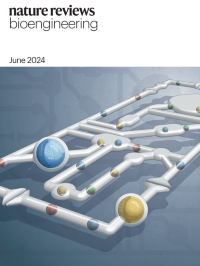
High-throughput microfluidic 3D cell culture systems can be designed with different biological complexity, cell sources and cell configurations to model aspects of human tissues and organs. Such microfluidic systems can thereby serve as non-clinical testing tools for drug development. See Jihoon Ko et al.
-
No. 5 May 2024
Prosthetic embodiment refers to the incorporation of a prosthesis into one’s sensory and functional body schema, requiring the consideration of a user’s sense of agency and ownership. This may be achieved by engineering bionic limbs that leverage a closed-loop mechanoneural-machine interface to allow bidirectional information transfer between the peripheral nervous system and external assistive devices. See Tony Shu et al.
-
No. 4 April 2024
Bioplastics are derived from renewable carbon sources and/or are degradable at their end-of-life stage, thereby providing a potential solution to plastics pollution. However, lengthy and expensive testing and certification processes, as well as greenwashing and public misconceptions currently hinder the widespread usage and adequate disposal of bioplastics. See Lam Tan Hao et al.
-
No. 3 March 2024
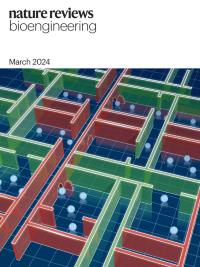
Nanoparticles can be systemically injected into the body for cancer diagnosis and treatment. Active transport mechanisms may enable nanoparticles to enter the tumour through active endothelial transport processes, retain in the tumour owing to interactions with tumour components, and exit the tumour through lymphatic vessels. See Luan N.M. Nguyen et al.
-
No. 2 February 2024
Single-cell RNA sequencing techniques and analysis methods can help improve our understanding of tissue injury responses and inform the design of new regenerative biomaterials and therapeutics. See Anna Ruta et al.
-
No. 1 January 2024
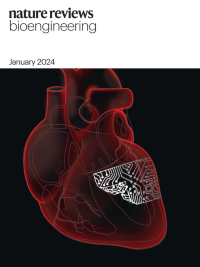
The motions of the heart are regulated by electrophysiological signals, which can be monitored and altered by bioelectronic devices for the diagnosis and treatment of cardiovascular diseases. In particular, soft bioelectronic devices, composed of deformable and conductive materials, can be implanted or designed as wearable devices to enable conformal contact with heart tissue or the skin for real-time and precise diagnosis and treatment. See Sung-Hyuk Sunwoo et al.