
Thank you for visiting nature.com. You are using a browser version with limited support for CSS. To obtain the best experience, we recommend you use a more up to date browser (or turn off compatibility mode in Internet Explorer). In the meantime, to ensure continued support, we are displaying the site without styles and JavaScript.

Volume 3 Issue 1, January 2021

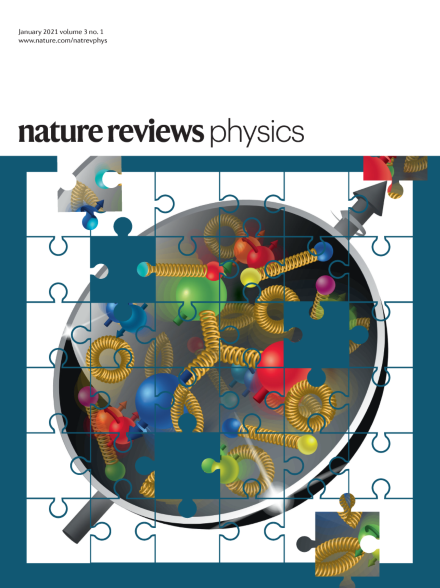
The cover of this issue illustrates the complex internal structure of the proton. See Xiangdong Ji et al.

Image: Courtesy of Brookhaven National Laboratory. Cover design: Charlotte Gurr.
Editorial

  • Over a century after its discovery, the proton still keeps physicists busy understanding its basic properties, but a new generation of experiments may help finally nail down its radius, stability and the origin of its spin.

    Editorial

    Advertisement

Top of page ⤴

Comment

  • As the construction of the Electron–Ion Collider (EIC) is starting, the EIC Project Director Jim Yeck shares his experience on the main ingredients for success of big science projects.

    • Jim Yeck
    Comment
Top of page ⤴

Research Highlights

  • A paper in Nature Physics images magnetic vortices using X-ray ptychography and finds that they are stable under high magnetic fields.

    • Ankita Anirban
    Research Highlight
  • A paper in Proceedings of the National Academy of Sciences shows that the ridges on finger pads promote grip by acting as a microfluidic array that maintains optimal moisture levels and by deforming when wet to block sweat pores.

    • Zoe Budrikis
    Research Highlight
  • A Nature paper reports on the conversion of microwave-frequency quantum excitations of a superconducting qubit into photons at optical telecommunication frequencies, a step closer to realizing a working quantum transducer.

    • Iulia Georgescu
    Research Highlight
Top of page ⤴

Year in Review

  • Whereas high-temperature superconductivity in cuprates has been studied for 30 years, during the past year it has been reported in nickelates. This raises new questions for physicists and chemists about the mechanism of superconductivity.

    • Warren E. Pickett
    Year in Review
Top of page ⤴

Reviews

  • Strong correlations may produce states of matter that do not have non-interacting counterparts, with new types of quantum criticality, superconductivity, and topological phases being recent highlights. This Review describes the physics underlying these correlated states and points to their potential for quantum applications.

    • Silke Paschen
    • Qimiao Si
    Review Article
  • Since the first measurement of the spin structure of the proton, there has been significant theoretical and experimental progress in understanding the origins of the proton spin. This Review discusses what we have learned so far, what is still missing and what to expect from the upcoming experiments.

    • Xiangdong Ji
    • Feng Yuan
    • Yong Zhao
    Review Article
Top of page ⤴

Technical Reviews

  • Understanding light–matter interactions in layered materials is crucial for applications in photonics and optoelectronics. This Technical Review discusses the optical spectroscopy techniques to access details of the electronic band structure, crystal quality, crystal orientation and spin–valley polarization, including key aspects of practical set-ups to perform experiments for a broad range of applications.

    • Shivangi Shree
    • Ioannis Paradisanos
    • Bernhard Urbaszek
    Technical Review
Top of page ⤴

Perspectives

Top of page ⤴

Amendments & Corrections

Top of page ⤴

Search

Quick links