Thank you for visiting nature.com. You are using a browser version with limited support for CSS. To obtain
the best experience, we recommend you use a more up to date browser (or turn off compatibility mode in
Internet Explorer). In the meantime, to ensure continued support, we are displaying the site without styles
and JavaScript.
In addition to the different types of review articles Nature Reviews Physics regularly publishes, readers can also find a wealth of comment, opinion and news articles in our pages. Here is a quick guide to our content.
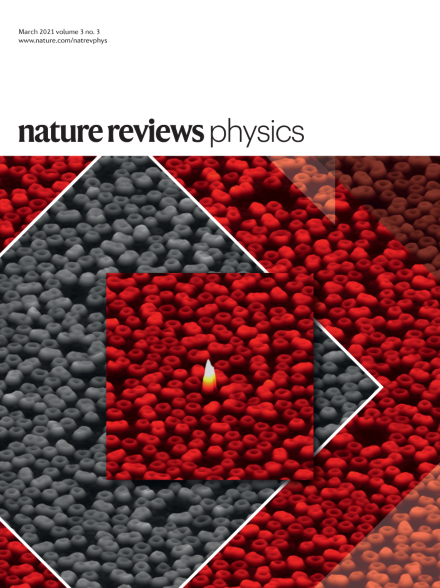
Advanced metallic alloys can benefit from clusters of dopant atoms and intermetallic particles to improve their performance. Suhas Eswarappa Prameela, Peng Yi, Michael Falk and Tim Weihs discuss how atomic-scale defects can be used to form these clusters and particles.
There are a number of lower risk opportunities to invest in quantum technologies, other than quantum computers, but to make the most of them both specialist knowledge and market awareness are required.
Two new maps of the sky were released in January 2021, as part of efforts to understand the distribution of ordinary matter and dark energy in the Universe.
A paper in Proceedings of the National Academy of Sciences reports on how an aquatic worm forms entangled blobs that move collectively, without the need for centralized control or even communication between the worms.
Filippo Vicentini introduces the open-source Python toolkit NetKet, which implements machine learning methods for the study of quantum many body physics.
Semiconductor qubits are expected to have diverse future quantum applications. This Review discusses semiconductor qubit implementations from the perspective of an ecosystem of applications, such as quantum simulation, sensing, computation and communication.
Conventional solar cells suffer from the thermalization energy loss of hot carriers, which sets the Shockley–Queisser limit. This Review highlights the insightful mechanisms of slow hot carrier cooling dynamics and efficient carrier transport/extraction in 2D van der Waals heterojunctions, following opportunities in practical hot carrier solar cells.
Symmetry breaking plays a significant role in the determination of the fascinating physical phenomena and quantum phase transitions in 2D materials. This Review discusses the state-of-the-art physical and chemical approaches to engineer the symmetry breaking of 2D materials and their heterostructures.
Fourier ptychography is an imaging approach that addresses the intrinsic trade-off between resolution and field of view in optical systems and provides computational correction of optical aberrations. This Technical Review surveys its implementations and applications.