Volume 4
-
No. 12 December 2022
The cover of this issue shows a visualization of the exotic topology of a non-Hermitian system. See Ding et al.
-
No. 11 November 2022
The cover of this issue illustrates the idea of challenging gender stereotypes in physics. See Wade
-
No. 10 October 2022
The cover of this issue illustrates the idea of approaching dark matter searches across the entire mass spectrum as casting a wide fishing net. See Hochberg et al.
-
No. 9 September 2022
The cover of this issue is an artistic representation of the design process for soft robotics that is enabled by computational modelling. See Mengaldo et al.
-
No. 8 August 2022
The cover of this issue depicts spatial self-organisation in termite mounds. See Strogatz et al.
-
No. 7 July 2022
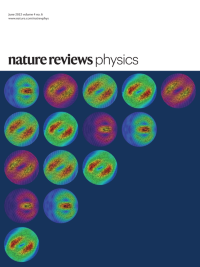
The cover of this issue uses experimental images of polaritons with orbital angular momentum adapted with permission from Sedov, E. S. et al Phys. Rev. Research 3, 013072 (2021), CC-BY 4.0 https://creativecommons.org/licenses/by/4.0/. See Kavokin et al.
-
No. 6 June 2022
The cover of this issue features topological defects in active matter. See Shankar et al
-
No. 5 May 2022
The cover of this issue illustrates a binary neutron-star merger ejecting material that gives rise to r-process elements. See Daniel Siegel
-
No. 4 April 2022
The cover shows numerical simulations of multi-scale reconnection in the upcoming experiment, Facility for Laboratory Reconnection Experiments (FLARE). Simulation by Adam Stanier & William Daughton, rendering by Jonathan Jara-Almonte. See Ji et al.
-
No. 3 March 2022
The cover illustrates a quantum photonic integrated circuit with its different components. See Pelucchi et al.
-
No. 2 February 2022
The cover shows a tiled microscopy image of a monolayer MoS2 sample, contacted with metal contacts. See Wang & Chhowalla
-
No. 1 January 2022
The cover depicts the subwavelength features that can be obtained by interference of 50 coherent plane waves, based on a result originally from Michael Berry. SeeZheludev & Yuan