Thank you for visiting nature.com. You are using a browser version with limited support for CSS. To obtain
the best experience, we recommend you use a more up to date browser (or turn off compatibility mode in
Internet Explorer). In the meantime, to ensure continued support, we are displaying the site without styles
and JavaScript.
Sarah Williams discusses the pressing need to involve the younger generations in the current discussions and decisions about future big projects in particle physics.
Today’s hopes and fears related to the use of AI systems echo familiar concerns about nuclear technology. What can be learned from the dual mission of the International Atomic Energy Agency to promote and control nuclear technologies?
Energy-recovery linacs are far more efficient than traditional linacs because they directly return the energy of an unused particle beam into RF power that can be used for acceleration. This Review surveys the opportunities and challenges for bringing energy-recovery linacs into the mainstream.
Optical computing has the potential to be faster and more energy-efficient than conventional digital-electronic computing for certain applications. This Perspective article surveys the differences between optics and electronics that could be exploited, and explores the physics and engineering challenges in realizing useful optical computers.
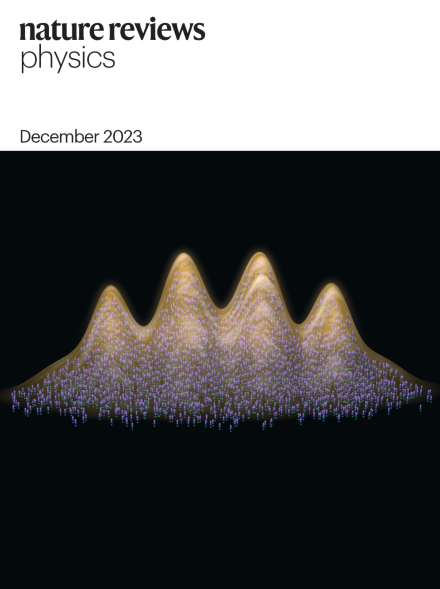
Supersolidity is an intriguing state of matter that combines superfluid and crystal features. Theoretically predicted in the 1960s, it has only recently been observed in atomic gases that exhibit typical supersolid properties such as spontaneous density modulations combined with coherence effects and the occurrence of new Goldstone modes.
Klaus Hasselmann’s viewpoint has had enormous influence in climate science, both in its theoretical and practical aspects. This Perspective provides a review of Hasselmann’s scientific programme and proposes ways forward for advancing our knowledge on the multiscale behaviour of the climate system, and on the relationship between its forced and free variability.