Thank you for visiting nature.com. You are using a browser version with limited support for CSS. To obtain
the best experience, we recommend you use a more up to date browser (or turn off compatibility mode in
Internet Explorer). In the meantime, to ensure continued support, we are displaying the site without styles
and JavaScript.
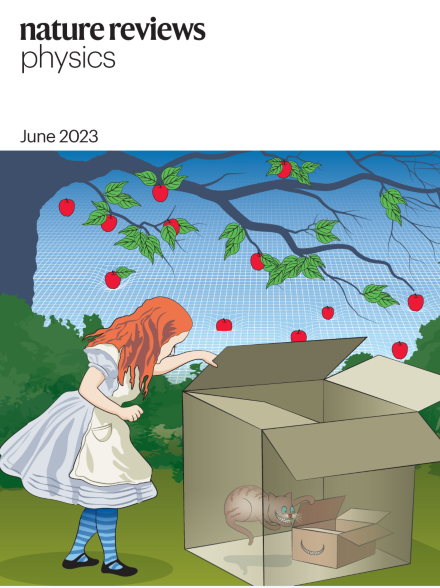
The cover of this issue illustrates two open questions in the foundations of quantum mechanics: the quantum measurement problem and a quantum theory of gravity. See Cavalcanti et al.
One hundred years ago, Louis de Broglie posed a question: could matter particles behave like waves? This duality was already known for light; extending it to electrons and indeed all matter had huge implications, especially for the development of quantum mechanics.
100 years ago, Arthur Compton measured a wavelength shift in an X-ray scattering experiment, which provided direct evidence for the particle theory of light. Today, Compton scattering continues to be a useful tool for research and medical applications.
As we are at the beginning of the second century of quantum physics, we asked four researchers to share their views on new research directions trying to answer old, yet still open, questions in the foundations of quantum theory.
This Review overviews the application of single photons in quantum communication and quantum computation discussing specific needs and requirements and achieved milestones and outlining future improvements.
As one of the most important protocols in quantum information technology, quantum teleportation enables the nonlocal transmission of unknown quantum information. This Review discusses the latest developments in the quantum teleportation of complex quantum states and applications to quantum communication and computing.
This Review overviews the application of single photons in quantum metrology, quantum biology and the foundations of quantum physics, discussing specific needs and requirements, achieved milestones and an outline for future improvements.