Thank you for visiting nature.com. You are using a browser version with limited support for CSS. To obtain
the best experience, we recommend you use a more up to date browser (or turn off compatibility mode in
Internet Explorer). In the meantime, to ensure continued support, we are displaying the site without styles
and JavaScript.
Many physicists are sceptical of hype, but there are also benefits to envisioning the future possibilities enabled by science. We explore the need for scientists to engage with visionary rhetoric.
Understanding what cutting-edge AI models are doing ‘under the hood’ requires not just theoretical research but also well-controlled computational experiments. Savannah Thais explains why physics datasets may be the testing ground that AI developers need and how physicists can play a critical role in developing trustworthy AI.
Sociotechnical visions of the future can motivate researchers to create a better world, but as social scientist Benjamin K. Sovacool argues, they can also blind the scientific community to potential downsides.
Claims that artificial intelligence will usher in a new scientific and social era have been attracting funding for decades, but the changes they’ve achieved have not been as advertised. Historian James Sumner considers the limits of science’s ability to plan a revolution.
20 years on from the isolation of graphene, over 150,000 graphene-related patents have been filed. Yet despite early promises of integration into semiconducting and photonic devices, the biggest applications to date have been in energy storage and polymers. This article analyses graphene commercialization over the past two decades and discusses the role of graphene in applications towards net-zero carbon.
Petahertz electronics uses sub-cycle currents from tailored optical waveforms for high-speed signal processing. This Review discusses progress towards the analogue age of petahertz electronics for optical waveform analysis and communication and provides an outlook toward digital petahertz electronics for classical and quantum computing.
This Perspective explores the potential of using tailored fields to investigate chiral matter and ultrafast chiral dynamics. Light fields with well-defined symmetry properties can open new opportunities for research in chiral light–matter interactions.
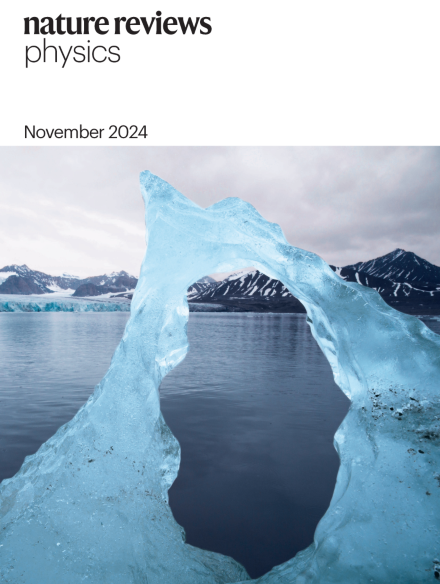
The dynamics of water freezing and ice melting in natural environments involves many intricate fluid mechanics processes. To tackle these complexities, examining them in well-controlled laboratory settings proves highly advantageous.
Attosecond science is a versatile discipline for studying ultrafast dynamics in matter on the microscopic scale. This Perspective explores the theoretical and experimental developments in this field focusing on distinguishing genuinely quantum observations from classical phenomena.