Thank you for visiting nature.com. You are using a browser version with limited support for CSS. To obtain
the best experience, we recommend you use a more up to date browser (or turn off compatibility mode in
Internet Explorer). In the meantime, to ensure continued support, we are displaying the site without styles
and JavaScript.
This month, we say farewell to our founding Chief Editor, Iulia Georgescu and greet our new Chief Editor, Nina Meinzer. We also thank our first Advisory Board members (2023–2024) and welcome our next Advisory Board.
With more public and private funding in fusion, the expectations in terms of spillover benefits are increasing, but these can only happen through enhanced cross-sector collaboration.
In 2021, physicist and writer, Carlo Rovelli, helped launch an open letter to the world’s politicians calling for a small proportion of military funding to address climate change, poverty and pandemics — the Global Peace Dividend. He discusses the pressing need for global cooperation on common interests.
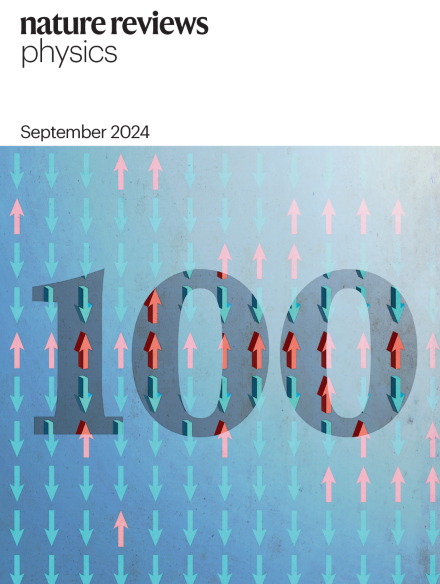
In 1924, Ernst Ising thought he showed a simple model for ferromagnetism couldn't work. 100 years later, that model, now named for him, is used across all of physics.
An article in Nature Communications uses an Ising-like model to determine the interactions between monomers in a component of the cyanobacterial circadian clock.
This Expert Recommendation provides a guide to setting up machine learning projects that are less time-consuming and more likely to lead to robust and useful scientific insights.
Advances in artificial-intelligence-assisted mathematical investigations suggest that human–machine collaboration will be an integral part of future theoretical research.
This Perspective summarizes the recent progress of topological physics in thermal metamaterials and thus proposes a new research field, ‘topological thermotics’, which is inspired by topological photonics and topological acoustics in wave metamaterials.
The Rydberg atomic array is an emerging quantum many-body physics platform, exhibiting rich physical phenomena, such as quantum spin liquids and quantum scar states. This Perspective analyses the latest progress in this system through a unified theoretical framework — lattice gauge theory — providing new insights for quantum simulation.