Volume 26
-
No. 12 December 2008
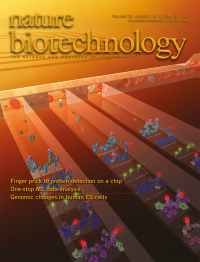
Artist's impression of an integrated blood barcode chip for rapid, multiplexed detection of biomarkers. Fan et al. separate plasma from whole blood in a microfluidic device that captures proteins of interest using antibodies immobilized by DEAL technology and detects them using fluorophore-labeled antibodies (p 1373). Credit: Ken Eward ©BioGrafx.
-
No. 11 November 2008
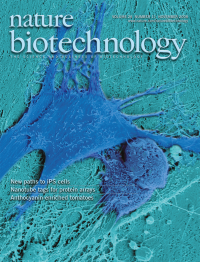
A scanning electron micrograph of induced pluripotent stem cells derived from plucked human hair. Two papers in this issue describe advances in the reprogramming of human somatic cells to pluripotency (p 1269 and p 1276). Credit: Merce Marti
-
No. 10 October 2008
'Stairs #2-Greece' by Wally Gilbert (http://wallygilbert.artspan.com; http://wallygilbert.30art.com; http://www.lulu.com/wallygilbert). A focus on next generation sequencing is presented on p 1097.
-
No. 9 September 2008
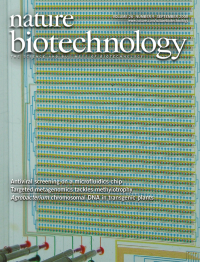
A microfluidic affinity analysis device with > 7,000 valves is capable of performing thousands of parallel experiments. Einav et al. use this device to isolate a small molecule against the HCV target NS4B (p 1019). Credit: Doron Gerber.
-
No. 8 August 2008
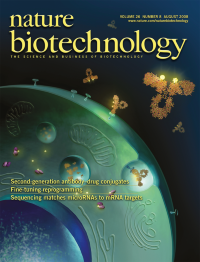
An artist's impression of targeted delivery of cytotoxic drugs to a cancer cell by internalization of the complex formed between antibody-drug conjugate (AD C) and its antigen. Junutula et al. produce near-homogenous AD Cs that are better tolerated than conventional AD Cs without any loss of anti-tumor activity (p 925). Credit: Allison Bruce, Genentech, Inc.
-
No. 7 July 2008
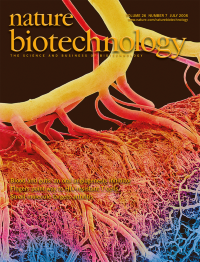
Colored scanning electron micrograph of a resin cast of blood vessels that supply the small intestine. Benny et al. show that an oral formulation of an anti-angiogenic drug is absorbed by the intestine, inhibits tumor growth and prevents liver metastasis (p 799). Credit: Susumu Nishinaga and Photo Researchers, Inc.
-
No. 6 June 2008
A Nomarski image of a live zebrafish embryo at 16.5 hours post-fertilization. The rainbow effect was created by slightly pulling out the differential interference contrast slider. Meng et al. and Doyon et al. demonstrate targeted genetic modification of the zebrafish germ line using zinc-finger nucleases. (pp 695 and 702) Credit: Sharon L. Amacher
-
No. 5 May 2008
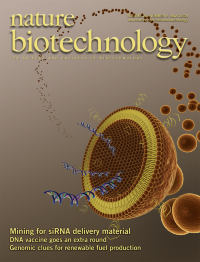
An artist's rendering of lipidoid-siRNA delivery nanoparticles. Akinc et al. (p 561) describe the development of a combinatorial library of new lipidlike materials for the delivery of RNAi therapeutics. Credit: Scott Dixon.
-
No. 4 April 2008
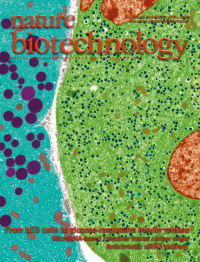
Transmission electron micrograph of pancreatic tissue showing an islet of Langerhans cell (right) containing hormone secretory granules (small blue dots) and an acinar cell (left). Baetge and colleagues (p 443) describe the generation of glucose-responsive insulin-secreting cells from human embryonic stem cells. Credit: Steve Gschmeissner, Science Photo Library.
-
No. 3 March 2008
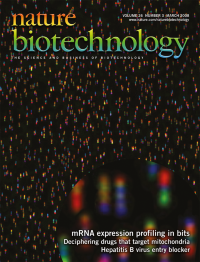
Image of color-coded tags hybridized to individual mRNA molecules and attached to a surface.The fluorescent tags consist of a single-stranded DNA scaffold annealed to a series of seven complementary in vitrotranscribed RNAs each labeled with one of four fluorophores.The linear order of the different colors defines a unique code for each gene of interest.The molecular tags are linked to gene-specific probes and used to measure directly the levels of over 500 different mRNA species in a single reaction by counting the number of times each hybridized code is detected.See Geiss et al.(p 317).
-
No. 2 February 2008
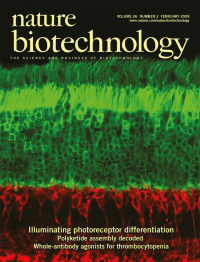
The adult mouse retina imaged by confocal microscopy, with photoreceptor cells stained green and bipolar cells stained red. Takahashi and colleagues describe methods for differentiating mouse, monkey and human embryonic stem cells toward photoreceptor cells (p 215).
-
No. 1 January 2008
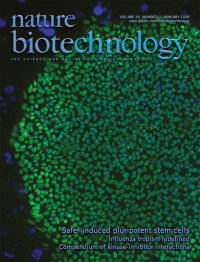
Human induced pluripotent stem cells expressing NANOG, a marker of embryonic stem cells. Yamanaka and colleagues generate induced pluripotent stem cells from mouse and human adult fibroblasts without using the c-Myc oncogene (p 101).