Volume 32
-
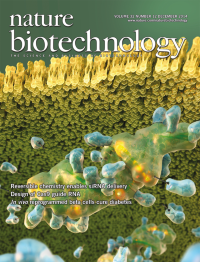
No. 12 December 2014
Artists impression of an SATE - modified siRNA in the process of being deprotected by cellular thioesterases after entering the cytosol (p 1256). Credit: Peter Allen, UCSB College of Engineering
-
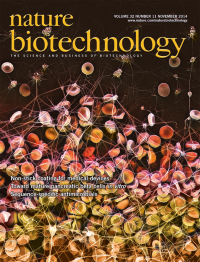
No. 11 November 2014
Polychromatic scanning electron micrograph of the edge of a blood clot that has formed on the surface of a biomaterial. Leslie et al. describe a surface coating for medical devices that prevents the formation of this type of surface-mediated thrombosis. Credit: James Weaver and Anna Waterhouse
-
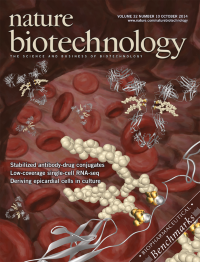
No. 10 October 2014
An artistic rendition of stabilized antibody-drug conjugates in the blood. Lyon et al. describe a linker chemistry that increases the stability and efficacy of antibody-drug conjugates in vivo (p 1059). Credit: Kenneth Eward
-
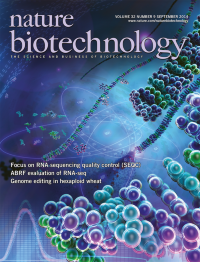
No. 9 September 2014
RNA-seq five ways. Research in this Focus issue evaluates the performance of RNA sequencing with an emphasis on large-scale studies involving data generated using multiple sequencing sites, platforms or protocols (pp 903, 915, 926, 888 and 896). Credit: Sam Shlomo Spaeth.
-
No. 8 August 2014
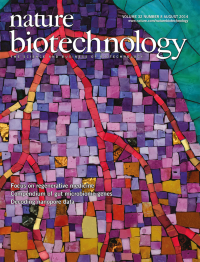
Artwork by Pamela Goode.
-
No. 7 July 2014
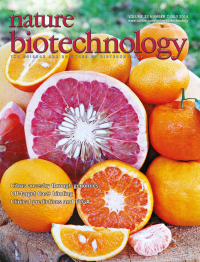
Oranges, pummelos, clementines and mandarins. Wu et al. generate a highquality reference haploid genome of a clementine and resequence eight related species to reveal the ancestry of citrus varieties (p 656). Credit: Toni Siebert
-
No. 6 June 2014
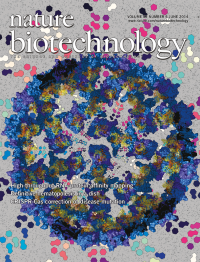
Illustration of diverse RNA hairpins (yellow and orange) binding to coat proteins (blue) inside an assembling MS2A viral capsid. Buenrostro et al. repurpose an Illumina sequencer (yielding raw black and white fluorescence images in background) for high-throughput measurement of RNA-protein binding affinities to study structure-function relationships (represented by the hexagonal RNA hairpin diagrams) (p 562). Credit: Carlos L. Araya
-
No. 5 May 2014
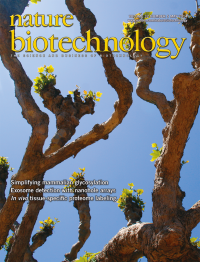
Pollarded tree representing pruned glycan structures. Meuris et al. describe a glycoengineering strategy that simplifies the N-glycosylation pathway, resulting in the expression of proteins with short, less heterogeneous glycans (p 485). Credit: Mary Muers
-
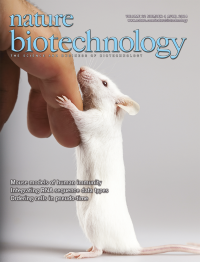
No. 4 April 2014
New mouse models of human immunity will enable a variety of research and clinical applications (p 335). Humanized mice described by Rongvaux et al. (p 364) can be used to study the influence of human immune cells on disease pathology and response to therapy. The mice presented by Lee et al. (p 356) may be used to evaluate the efficacy of candidate vaccines, and to rapidly produce human antibodies having high affinity for therapeutic targets. Credit: © tiripero iStock.
-
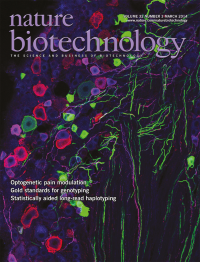
No. 3 March 2014
The dorsal root ganglion of a mouse injected intrasciatically with a virus encoding a light-sensitive opsin (green); nociceptive markers are shown in blue and red. Iyer et al. use optogenetics to control pain in freely moving nontransgenic mice (p 274). Credit: Shrivats Iyer and Kate Montgomery.
-
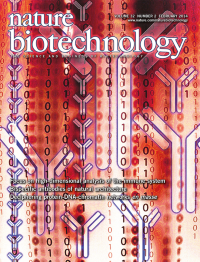
No. 2 February 2014
A more detailed and comprehensive analysis of the immune system will reveal basic and translational insights and may lead to development of new therapeutic strategies. In this months joint Focus with Nature Immunology, featured articles describe the new technologies and computational approaches that enable this sort of high-dimensional characterization of components of the immune system. www.nature.com/focus/ high_dimensional_immune_analysis Artwork by Lewis Long.
-
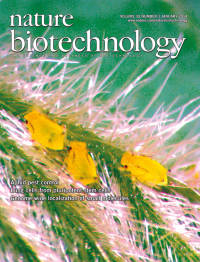
No. 1 January 2014
Soybean aphid nymphs (Aphis glycines) navigating trichomes on the underside of a soybean leaf. Bonning et al. use a plant virus coat protein to deliver an insect-specific neurotoxin from the aphid gut into the body cavity, providing a new strategy for managing sap-sucking agricultural pests (p 102). Credit: Greg VanNostrand