
Thank you for visiting nature.com. You are using a browser version with limited support for CSS. To obtain the best experience, we recommend you use a more up to date browser (or turn off compatibility mode in Internet Explorer). In the meantime, to ensure continued support, we are displaying the site without styles and JavaScript.

Volume 42 Issue 11, November 2024

CAR T cells eradicate solid tumors

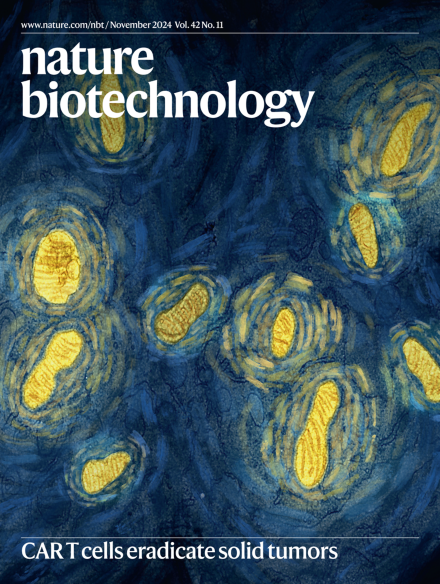
An illustration of intact mitochondria (yellow) in IL-10-expressing CAR T cells. Zhao et al. show that expressing IL-10 in CAR T cells improves their mitochondrial function and therapeutic efficacy in multiple solid-tumor models.

See Zhao et al.

Image: Yiling Li, Li Tang, Yugang Guo. Cover design: Erin Dewalt
Editorial

  • Advertisement

Top of page ⤴

News

Top of page ⤴

Correspondence

Top of page ⤴

Features

  • Patents

    • Recent patents relating to retroviruses, transposons and other virus-like elements for use in gene transfer and gene therapy.

      Patents
Top of page ⤴

Research Highlights

Top of page ⤴

News & Views

Top of page ⤴

Research Briefings

  • Chimeric antigen receptor (CAR) T cells in the solid tumor microenvironment enter a partially dysfunctional state called T cell exhaustion. Interleukin (IL)-10-producing CAR T cells retain their metabolic fitness, resist T cell exhaustion and display unprecedented antitumor activity indicated by high cure rates and durable responses in mice. Clinical studies of IL-10-producing CAR T cells are underway.

    Research Briefing
  • We developed synthetic serum markers that can be expressed in the brain but are transported into the blood, enabling minimally invasive monitoring of gene expression in the brain with a simple blood test.

    Research Briefing
Top of page ⤴

Research

Top of page ⤴

Amendments & Corrections

Top of page ⤴

Careers & Recruitment

  • Career Feature

  • People

    • Recent moves of note in and around the biotech and pharma industries.

      People
Top of page ⤴

Search

Quick links