Volume 16
-
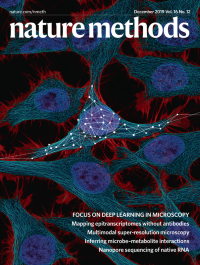
No. 12 December 2019
Focus on Deep Learning in MicroscopyArtwork representing the application of deep learning methods in microscopy.
-
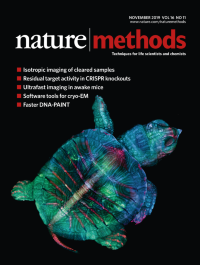
No. 11 November 2019
Winner of the 2019 Nikon Small World photomicrography contest.Fluorescence image of a turtle embryo. This image was the winner of the 2019 Nikon Small World photomicrography contest.
-
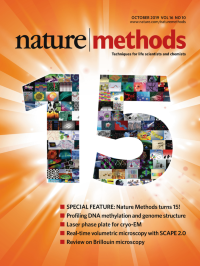
No. 10 October 2019
Special Feature: Nature Methods turns 15!This month we celebrate the fifteen-year anniversary of Nature Methods. The cover artwork comprises images from previous covers of Nature Methods throughout the years.
-
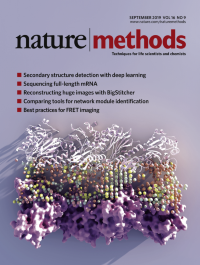
No. 9 September 2019
Secondary structure detection with deep learningThe deep-learning-based tool, Emap2sec, detects protein secondary structures in intermediate-resolution cryo-EM maps, as illustrated for the archaeal 20S proteasome.
See Maddhuri Venkata Subramaniya et al.
-
No. 8 August 2019
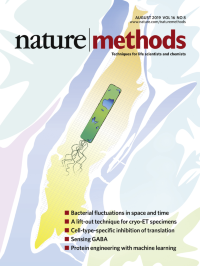
Bacterial fluctuations in space and timeThe DIVERS approach was used to analyze bacterial spatiotemporal fluctuations from the gut microbiome and a soil bacterial community in Manhattan’s Central Park. The cover image is an artistic representation of a bacterium on a map of New York City.
See Ji et al.
-
No. 7 July 2019
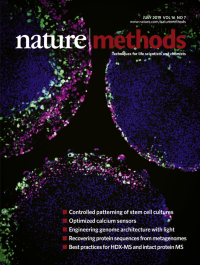
Controlled patterning of stem cell culturesArtificial signaling centers control cell fate patterning in embryonic organoids.
See Manfrin et al.
-
No. 6 June 2019
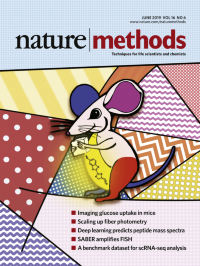
Imaging glucose uptake in miceThe image shows a colorful mouse eating a sugar cube. The shining light from the belly area is the result of luciferin reacting with luciferase.
See Maric et al.
-
No. 5 May 2019
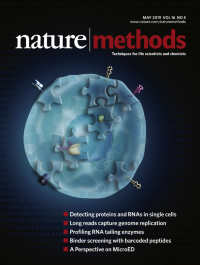
Detecting proteins and RNAs in single cellsArtistic rendition of a high-content single-cell CRISPR screen enabled by a multimodal phenotyping tool.
See Mimitou et al.
-
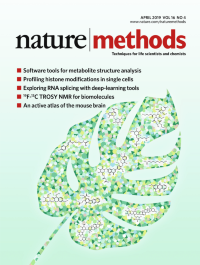
No. 4 April 2019
Tools for metabolomicsA computational tool facilitates molecular formula, metabolite class and structure assignment of plant metabolites from LC-MS data.
See Tsugawa et al.
-
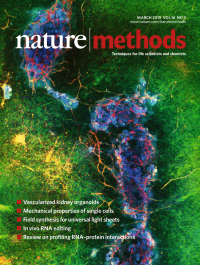
No. 3 March 2019
Vascularized kidney organoidsKidney organoids cultured under flow create vascular networks that link to nearby organoids.
See Homan et al.
-
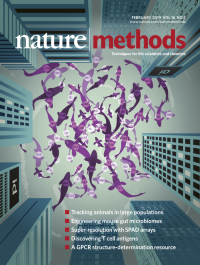
No. 2 February 2019
Tracking animals in large populationsArtistic representation of the idtracker.ai method for tracking individual animals in large collectives using video analysis and convolutional network algorithms.
See Romero-Ferrero et al.
-
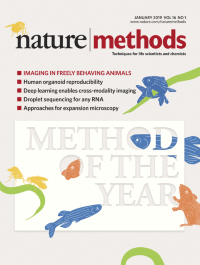
No. 1 January 2019
Method of the Year 2018Imaging in freely behaving animals is our Method of the Year 2018 for the possibilities this approach opens up in investigations of complex behaviors, including social interactions in a naturalistic environment.