Thank you for visiting nature.com. You are using a browser version with limited support for CSS. To obtain
the best experience, we recommend you use a more up to date browser (or turn off compatibility mode in
Internet Explorer). In the meantime, to ensure continued support, we are displaying the site without styles
and JavaScript.
Findings from an observational study suggest that the frequency of uveitis in patients with spondyloarthritis has declined since the introduction of biologic DMARDs.
In a subset of monocytes in systemic lupus erythematosus, internalization of mitochondria-retaining red blood cells leads to type I interferon-mediated IL-1β release.
Immune health has been considered impossible to assess through the use of traditional biomarkers. The newly devised immune health metric (IHM) integrates diverse biological data to quantify immune function, offering a comprehensive indicator for the evaluation of immune health. The potential of the IHM to distinguish healthy individuals from patients with monogenic or polygenic immune-mediated diseases might lead to revolutionary changes in treatment strategies for rheumatic diseases.
Type I interferon has a crucial role in the immunopathogenesis of systemic lupus erythematosus (SLE). Analysis of CD4+ T cells from individuals with SLE now shows that type I interferon intervenes with the transcriptional regulators AHR and JUN to downregulate expression of IL-22, which promotes tissue regeneration, and upregulate the expression of CXCL13, which supports lymphoid structure formation.
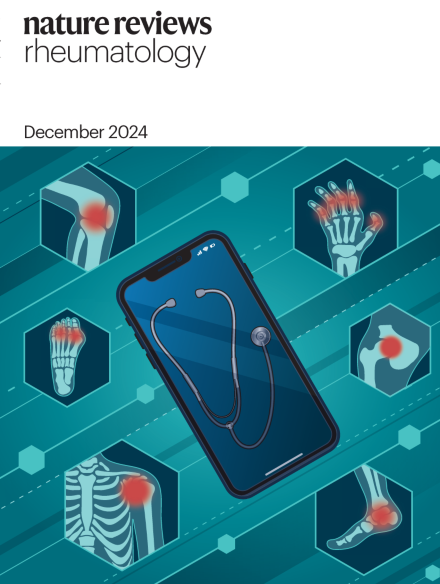
Digital health has the potential to improve patient care in rheumatology and alleviate strain on the health-care system. This Review explores the current status of the transition from traditional health care to a model that harnesses the potential of digital health technologies, including discussion of the main benefits and barriers.
Despite the availability of numerous treatment options, the management of rheumatoid arthritis remains suboptimal. In this Review, Konzett and Aletaha discuss strategies to advance clinical decision-making from trial-and-error to an informed process that considers more than just drug efficacy, and appropriately balances effort and success.
BCR-independent memory B cell reactivation via TLR7 or TLR8 activation, type I interferon production, immune complex formation and T helper cell signalling is central in SLE pathogenesis. Dörner and Lipsky discuss the potential of targeting these pathways to eliminate autoreactive memory B cells and plasma cells in SLE.
In this Review, López and Gualillo discuss the complex interrelationships between rheumatic diseases and the hypothalamic and autonomic mechanisms that regulate metabolism, and explore the therapeutic potential of targeting central regulators of energy balance.
This Review provides an overview of the pathogenesis, classification and diagnosis of and treatment strategies for adult and paediatric rheumatology patients with uveitis. The authors highlight the importance of collaborations between ophthalmologists and rheumatologists to provide optimal treatment of uveitis, improve patient care and enhance future research.