
Fig. 3: Most relevant elements of DA21/17-01-01 and silhouette showing their positions (see also Supplementary Figs. 1–5).
From: Early–middle Permian Mediterranean gorgonopsian suggests an equatorial origin of therapsids
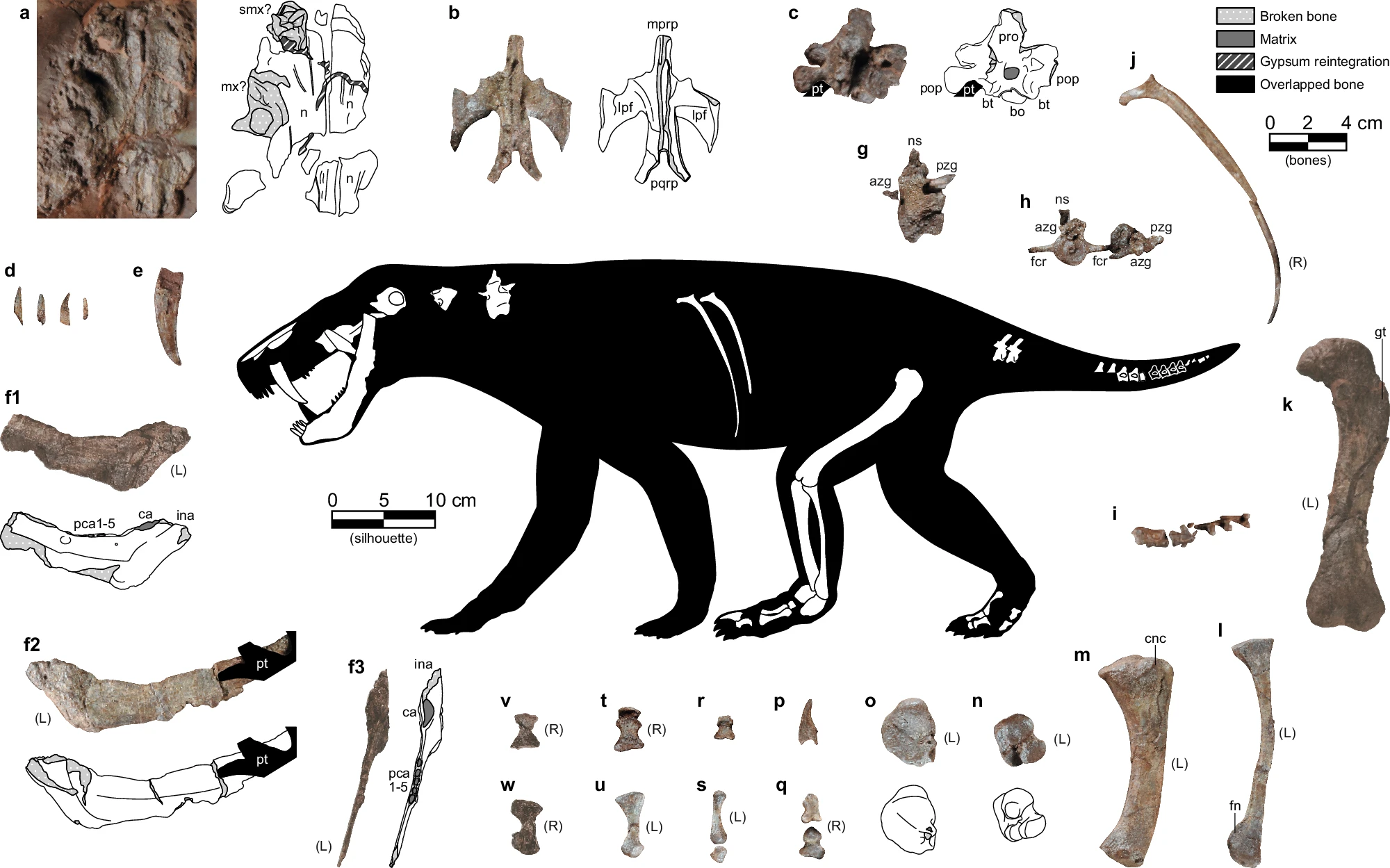
a Snout fragment. b Pterygoid. c Basicranium. d Incisors. e Canine. f1-3 Left dentary. g Cervical? vertebra. h Proximal caudal vertebrae. i Distal caudal vertebrae. j Right dorsal rib. k Left femur. l Left fibula. m Left tibia. n Left astragalus. o Left calcaneum. p Ungual. q First metatarsal (below) and first phalanx of right digit I (above). r Penultimate phalanx. s Distal tarsal (below) and metatarsal (above) of left digit III. t First (below) and second (above) phalanges of right digit IV. u Left fourth tarsal. v First phalanx of right digit V. w Right fifth metatarsal. azg = prezygapophysis, bo = basioccipital, bt = basal tuber, ca = alveolus of canine, cnc = cnemial crest, fcr = fused caudal ribs, ina = alveoli of incisors, lpf = lateral pterygoid flange, mprp = median palatal ramus of the pterygoid, mx = maxilla, n = nasal, ns = neural spine, pca = alveoli of postcanines, pop = paroccipital process (opisthotic), pqrp = pterygoid posterior quadrate rami, pro = prootic, pt = pterygoid, pzg = postzygapophysis, smx = septomaxilla, tp = transverse process, fn = fibular notch, gt = greater trochanter. (L) and (R) next to the elements refer to the left and right sides of the skeleton, respectively.
