
Fig. 1
From: Early hominin arrival in Southeast Asia triggered the evolution of major human malaria vectors
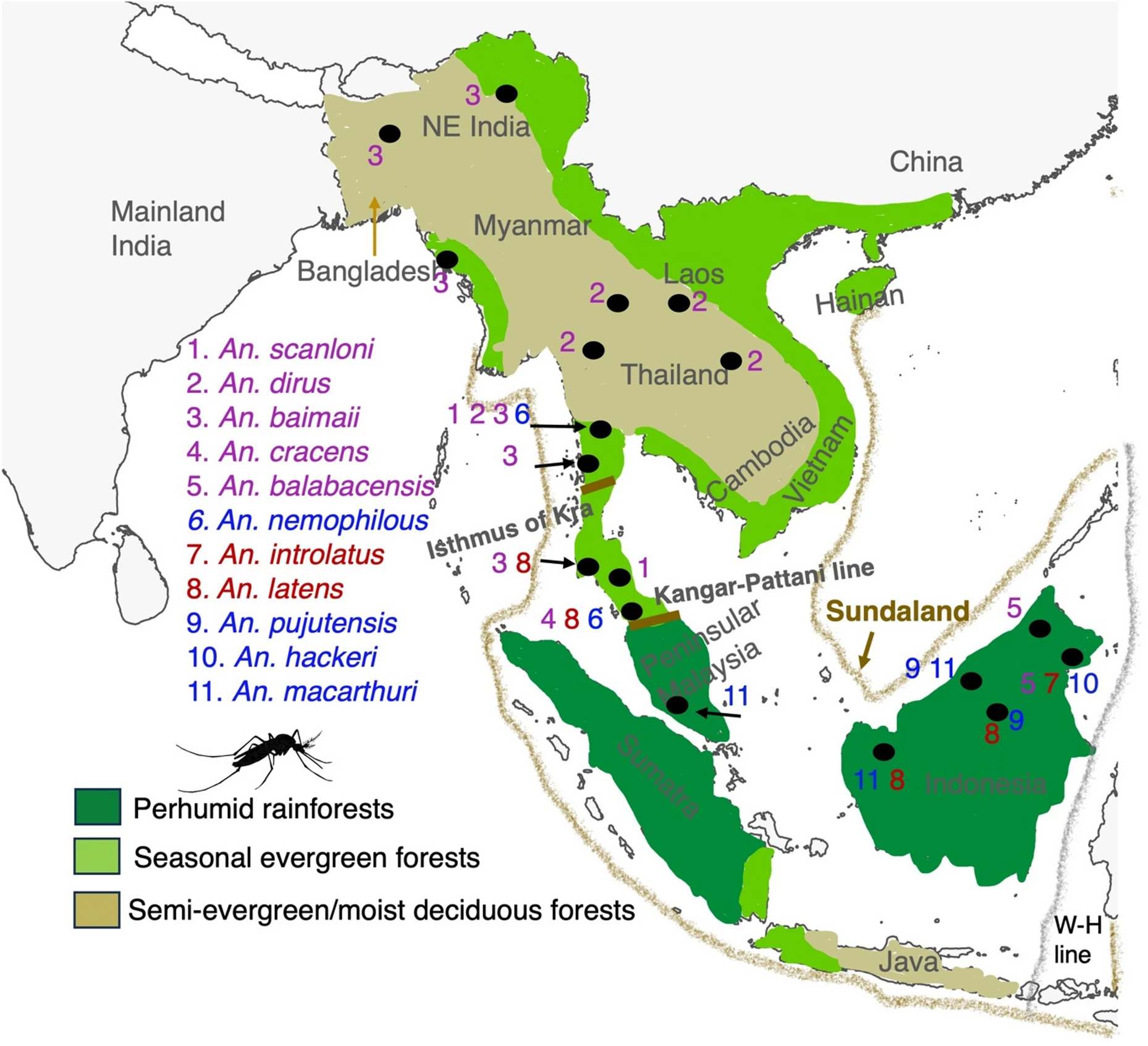
Map representing the distributions of specimens collected in Southeast Asia. Shading indicates the present-day distributions of forest types in mainland and insular Southeast Asia, adapted from Morley55. Black dots on the map represent collection sites. The number adjacent to the dots represents individual species collected from that site according to the species list on the left. The color of the numbers and species names indicate distinct blood-feeding behaviors; blue–NHP feeding, red–mixed-feeding, purple–human feeding, derived from published literature (listed in Supplementary Table S1). The brown outer line represents the outline of the exposed Sunda Shelf at the Last Glacial Maxima (currently 120 m below sea level)57. The two short brown lines represent biogeographic barriers: the Kangar-Pattani line in the south and the Isthmus of Kra in the north. The Isthmus of Kra and the W-H (Wallace-Huxley) line (grey line) in the east mark the boundaries of Sundaland. The map was created using QGIS v.3.28 (http://www.qgis.org).
