Thank you for visiting nature.com. You are using a browser version with limited support for CSS. To obtain
the best experience, we recommend you use a more up to date browser (or turn off compatibility mode in
Internet Explorer). In the meantime, to ensure continued support, we are displaying the site without styles
and JavaScript.
Electrical Engineering in South Korean Universities
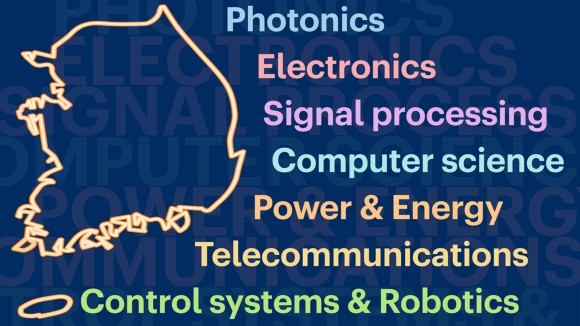
In this Series, researchers from leading institutions offer an overview on South Korean Universities’ contributions to the field of electrical engineering. Highlighting technological advances and innovative and impactful research, the goal of the series is to not only celebrate scientific excellence but also promote new, cross-regional collaborations. Academic strategies adopted by South Korean universities to prioritize diversity and internationalization and foster environments that welcome researchers from diverse cultural and geographical backgrounds will also be discussed.
Professors at Kyung Hee University connect artificial intelligence, communications and quantum science with clinical and industrial partners. In this Viewpoint, four professors discuss how uniting intelligence initiatives with trauma centres in healthcare, quantum computing and 6G technologies improves predictive models for patient outcomes.
Research at the Department of Battery Engineering at Hanyang University focuses on lithium-ion and next-generation battery technologies. In this Viewpoint, two professors discuss how strong industry–university partnerships enable the department to offer practical research opportunities and specialized education to nurture battery experts, bridging cutting-edge academic research and real-world industrial applications.
In this Viewpoint, four professors at Yonsei University discuss next-generation communications and networking at the university through world-class faculty, cutting-edge research infrastructure and strong global partnerships. By integrating computing, communications and artificial intelligence (AI), Yonsei University fosters pioneering research, real-world prototyping, and active student engagement, shaping the future of AI-native 6G networks in Korea and worldwide.
Electronics and photonics research at Pohang University of Science and Technology (POSTECH) spans from metasurface flat optical devices to quantum and stretchable electronics. In this Viewpoint, five professors discuss how POSTECH, with strong industry ties and interdisciplinary collaborations, aims to redefine nanoscale electronic and photonic materials and devices, quantum electronics and photonics, future information technology and computing.
In this Viewpoint, five professors at Korea Advanced Institute of Science and Technology (KAIST) discuss how this university, with world-class faculty, state-of-the-art research infrastructure and strong partnerships with global industry leaders, drives innovation across the entire semiconductor ecosystem — shaping the future of semiconductors in South Korea and beyond.
South Korea has a burgeoning semiconductor industry, representing about one-fifth of the country’s exports by value. In this Viewpoint, three professors at Seoul National University discuss how their departments work in close partnership with the semiconductor industry, sharing the training of graduates and engineers and collaborating on cutting-edge projects.
Sang Il Seok talks to Nature Reviews Electrical Engineering about research and education at the School of Energy and Chemical Engineering at Ulsan National Institute of Science and Technology (UNIST), including work to advance perovskite solar cells by pioneering inorganic–organic hybrid heterojunction solar cells that contain perovskite compound and polymeric hole conductors.
Choon Ki Ahn talks to Nature Reviews Electrical Engineering about research and education in Korea University’s School of Electrical Engineering, including work to advance physical artificial intelligence (AI) for autonomous systems by pioneering new control strategies and learning under uncertainty, to create machines that can operate independently and safely in dynamic, unpredictable and often adversarial real-world environments.