Volume 9
-
No. 12 December 2025
High-altitude occupation in ice age AustraliaAustralia’s Eastern Highlands have long been considered a barrier to human movement during the Late Pleistocene (about 35,000–11,700 years ago), with evidence of occupation previously limited to lower elevations. In this issue, Way et al. report evidence from Dargan Shelter, a high-altitude (1,073 m above sea level) cave in the Blue Mountains. Their excavations reveal hearths and stone artefacts dating to about 20,000 years ago, which makes this the oldest-known high-altitude site in Australia. These findings indicate repeated use of this cold-climate landscape, challenging assumptions that high-altitude landscapes restricted human mobility.
See Way et al.
-
No. 11 November 2025
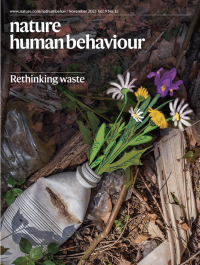
Rethinking wasteWaste is more than a material problem — it’s a social one. In this issue, we feature a Focus that explores the human dimensions of waste management. Our authors uncover the global inequalities embedded in waste flows; the hidden, yet crucial, role of the informal economy; and the innovative ways that the waste crisis can be transformed into opportunity. This collection challenges us to confront the attitudes and actions that shape waste management — and rethink what it could become.
See Focus
-
No. 10 October 2025
Charting political polarizationHas political polarization in the USA increased over time, or are partisan divides explained by sorting? Ojer et al. tackle this question by using data from the American National Election Studies to embed voters within an ideological space and track changes in both polarization and partisan sorting over time. They find that both Republicans and Democrats have moved away from the ideological centre, at different rates, while partisan sorting has declined.
See Ojer et al.
-
No. 9 September 2025
Development of viewing behaviourThe way in which we view the world changes over time. Linka et al. examine data from 6,720 individuals aged 5–72, who freely viewed 40 natural scenes, to examine the development of scene viewing throughout the lifespan. Their results suggest that scene viewing behaviour is not established in young childhood as previously thought, but instead continues to develop throughout adolescence and young adulthood. Visual exploration is more individual in adolescents, and becomes more convergent in adulthood. Scene viewing patterns stabilize in the mid-20s.
See Linka et al.
-
No. 8 August 2025
Infrastructure access and human healthInfrastructure services, such as transportation, energy, sanitation, education and health, are essential for human well-being. Tu et al. examine access to infrastructure and its associations with human health across 166 countries. They report that people in Global South countries have substantially less access to infrastructure services than people in the Global North and also experience greater levels of inequality in access. Both lower access and greater inequality in access are associated with poorer health outcomes, especially with respect to economic infrastructure (for example, telecommunications, energy and transportation).
See Tu et al.
-
No. 7 July 2025
Genetic variation in onset of walkingThe age at which children begin to walk independently is a crucial developmental milestone. Gui et al. address the genetic underpinnings of age at onset of walking, revealing it is a heritable polygenic trait with links to later health-related outcomes. The authors identified 11 significant loci in a genome-wide association study that involved more than 70,000 infants of European ancestry. They further showed that single-nucleotide-polymorphism-based heritability is 24.13% and that age at onset of walking exhibits genetic overlap with attention deficit hyperactivity disorder and a range of brain phenotypes. The study highlights the potential for using genetic information to improve early identification of developmental conditions.
See Gui et al.
-
No. 6 June 2025
Handwriting in the brainHow does the brain encode complex movement sequences, such as those involved in handwriting? Qi et al. reveal that the brain decomposes sequences into temporal states, each corresponding to a small movement fragment, with motor cortex neurons dynamically altering their encoding across states.
See Qi et al. See also Research Briefing
-
No. 5 May 2025
Human flourishingThe Global Flourishing Study is a longitudinal panel study that is collecting multifaceted nationally representative well-being data from more than 200,000 people in 22 geographically and culturally diverse countries. To mark the publication of results from the first wave of the study, a Perspective by VanderWeele and Johnson argues that flourishing is fundamentally multidimensional. In a research article, Bialowolski et al. analyse financial well-being indicators from the Global Flourishing Study. They find that demographic factors (for example, age) and early-life conditions (for example, childhood finances) correlate with key financial outcomes. Visit The Global Flourishing Study – Wave I collection for more research from the project.
See VanderWeele and Johnson
See Bialowolski et al.
See also The Global Flourishing Study – Wave I collection
-
No. 4 April 2025
Adaptation in visuospatial cognitionAdaptation in motor control is well-documented, but its role in cognitive functions such as working memory remains unclear. Brissenden et al. reveal that spatial cognition adaptively shifts to counteract visual attention errors, which suggests that error-driven learning mechanisms extend beyond motor control to influence visual cognitive processes, with broad implications for understanding cognitive adaptability.
See Brissenden et al.
-
No. 3 March 2025
Youth-led climate activismChildren and youth who are too young to vote have the highest stakes in climate action, but cannot influence political decision making directly. Can young people’s environmental activism affect citizen political behaviour, politicians and the media? Fabel et al. report that youth participation in the Fridays for Future climate movement relates to Green Party vote shares in Germany through the transmission of pro-environmental attitudes, social media presence and media coverage of environmental issues.
See Fabel et al.
-
No. 2 February 2025
Hierarchical organization in working memoryWorking memory is constructive in nature. In three electroencephalography–magnetoencephalography studies, Fan et al. provide converging behavioural and neural evidence that a one-dimensional sequence of syllables is automatically reorganized into a two-dimensional representation in working memory, which reflects the hierarchical organization of language.
See Fan et al.
-
No. 1 January 2025
Pupil literacy in LMICsAlthough school enrolment has expanded rapidly around the world since the 1950s, enrolment does not necessarily translate to meaningful increases in literacy. Crawford et al. report data from over half a million pupils from 48 low- and middle-income countries (LMICs) that show that pupils across the first three instructional years are failing to acquire the most basic skills that underpin reading comprehension. The authors suggest that systematic phonics programmes are needed to reach literacy goals.
See Crawford et al. See also News & Views by Kaffenberger