Thank you for visiting nature.com. You are using a browser version with limited support for CSS. To obtain
the best experience, we recommend you use a more up to date browser (or turn off compatibility mode in
Internet Explorer). In the meantime, to ensure continued support, we are displaying the site without styles
and JavaScript.
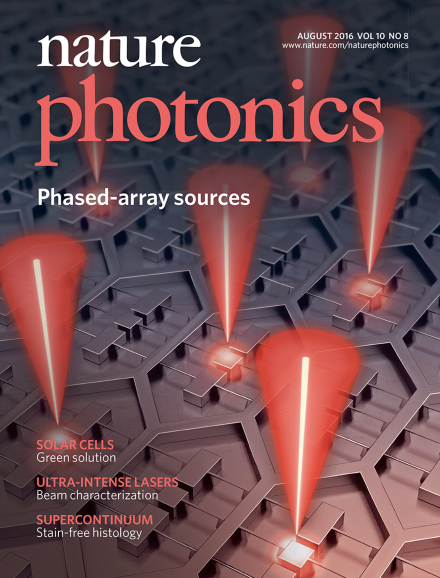
Phase locking of a 2D array of coupled surface-emitting terahertz quantum cascade nanolasers results in an output beam with diffraction-limited divergence and high power.
Following the UK's decision to leave the European Union, we asked scientists and industrialists working in the optics sector for their reaction to the news and how it may affect photonics research in the UK.
Uncompromised performance of micro-optical compound lenses has been achieved by high-fidelity shape definition during two-photon absorption microfabrication. The lenses have been made directly onto image sensors and even onto the tip of an optic fibre.
High-harmonic generation is an established method to significantly upshift laser photon energies. Now, researchers at the SLAC National Accelerator Laboratory have used echo concepts to generate coherent high-harmonic output from an electron-beam light source.
The challenges of applying super-resolution imaging to live cells and providing meaningful information about real problems in biology were discussed in detail at ICON Europe in Basel.
Coherent transfer of an optical photon polarization state to a single nuclear spin in a nitrogen–vacancy defect centre in diamond is demonstrated without a high-finesse cavity. A storage time of 10 s is achieved with a transfer fidelity of 98%.
Echo-enabled harmonic generation has been used to seed a free-electron laser and has been demonstrated up to the 75th harmonic, producing 32 nm light from a 2,400 nm laser.
Direct f–2f self-referencing of a microresonator-based optical frequency comb is demonstrated at a repetition rate of 16.4 GHz. The carrier envelope offset frequency and repetition rate are stabilized to a hydrogen maser-based atomic clock.
A single-source multimodal nonlinear optical imaging system has been developed to probe different endogenous biomolecules. Rapid, stain-free imaging of fresh tissue specimens is possible with short turnaround times for disease diagnosis.
Two-dimensional arrays of short-cavity surface-emitting THz quantum cascade lasers are phase-locked to each other via mutual coupling. A directive beam on the order of 10° divergence and a maximum slope efficiency of 450 mW A−1 is achieved.
The complete spatiotemporal characterization of a 100-TW laser beam highlights distortions that must be taken into account for present and future generations of ultra-intense lasers.