Volume 9
-
No. 12 December 2015
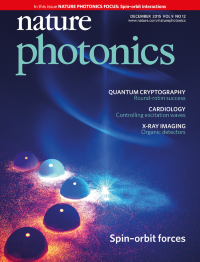
Artist's illustration of a new type of transverse force that small dielectric particles, which are located at the interface between air and water, experience on exposure to circularly polarized light. The force originates from the exchange of spin and orbital angular momenta in the optical domain, which is the focus of this issue of Nature Photonics.
Letter p809
IMAGE: ANDRII PSHENYCHNYI
COVER DESIGN: BETHANY VUKOMANOVIC
Focus
-
No. 11 November 2015
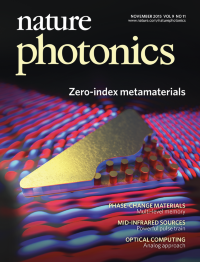
Artist's impression of a zero-index metamaterial that is composed of an array of silicon pillars embedded in a polymer and sandwiched between two gold films. The structure exhibits a refractive index of zero at a wavelength of 1,570 nm.
Article p738
IMAGE: ERIC MAZUR
COVER DESIGN: ALEX WING
-
No. 10 October 2015
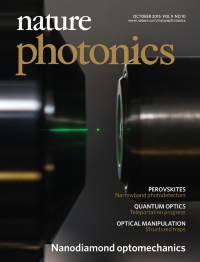
Photograph of a levitated nanodiamond held in an infrared optical trap. The nanodiamond features a nitrogenvacancy colour centre that is being excited by a green laser beam. Modulation of the optical trap potential controls the mechanical state of the nanodiamond.
Letter p653; News & Views p633
IMAGE: J. ADAM FENSTER/UNIVERSITY OF ROCHESTER
COVER DESIGN: ALEX WING
-
No. 9 September 2015
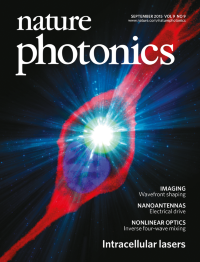
The cover shows an artistic illustration of light emission from a whispering gallery mode laser resonator inside a living cell. Such lasers have been made by incorporating an oil droplet or polystyrene microsphere treated with a fluorescent dye into a cell. The laser emission from the cell can be arranged to have a unique signature, thus making the scheme suitable for cell labelling and tracking.
Letter p572; News & Views p559
IMAGE: MATJAŽ HUMAR AND SEOK HYUN YUN
COVER DESIGN: ALEX WING
-
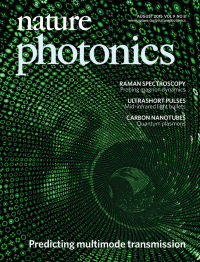
No. 8 August 2015
It is a common historical view that coherent light transport in multimode fibres is chaotic and unpredictable. Scientists now demonstrate that the propagation of light, and thus images, can be predicted over a distance of hundreds of millimetres. The findings could have important implications for endoscopy employing multimode fibres.
Article p529
IMAGE: MAIN, TOMAS CIZMAR; MONA LISA, JOHN BARAN/ALAMY
COVER DESIGN: ALEX WING
-
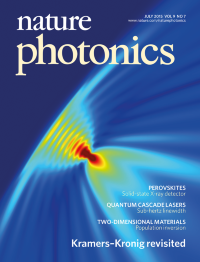
No. 7 July 2015
The Kramers-Kronig relations, which link the real and imaginary parts of a complex function, are routinely applied in optics to model the frequency response of a material's permittivity. An analysis applied to the spatial distribution of permittivity now suggests the existence of a family of materials that can be perfectly non-reflecting. The image shows the time-averaged electric field profile of a dipole emitter embedded within such a material.
Letter p436
IMAGE: SIMON HORSLEY
COVER DESIGN: ALEX WING
-
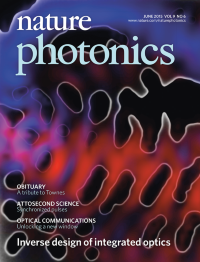
No. 6 June 2015
The cover image shows the flow of light with two different wavelengths (1,300 nm and 1,550 nm) through a silicon-chip wavelength demultiplexer. The device has been computationally designed using an inverse algorithm that determines the required spatial distribution of its permittivity.
Letter p374; News & Views p353
IMAGE: ALEXANDER Y. PIGGOTT
COVER DESIGN: ALEX WING
-
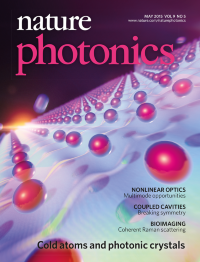
No. 5 May 2015
Specially engineered two-dimensional photonic crystals can provide a platform to both trap atoms and engineer their interactions, enabling the exploration of new forms of quantum many-body matter.
Article p320; News & Views p285
IMAGE: ALEJANDRO GONZALEZ-TUDELA AND PACO MARTINEZ TOMAS
COVER DESIGN: ALEX WING
-
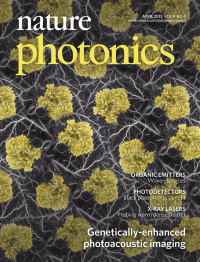
No. 4 April 2015
A tessellation of a photoacoustic image of a bundle of growing cells that has been genetically modified so as to greatly increase its optoacoustic signature when probed with light.
Article p239; News & Views p216
IMAGE: PAUL BEARD
COVER DESIGN: SAMANTHA WHITHAM/ALEX WING
-
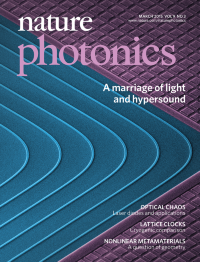
No. 3 March 2015
Scanning electron microscope image of a portion of a centimetre-long spiral silicon nanowire. Inside the nanowire, infrared light strongly couples to microwave sound. The waveguide confines light by total internal reflection and confines sound by impedance mismatch.
Article p199; News & Views p144
IMAGE: LIESBET VAN LANDSCHOOT, RAPHAËL VAN LAER AND AMIN ABBASI, GHENT UNIVERSITY-IMEC
COVER DESIGN: SAMANTHA WHITHAM
-
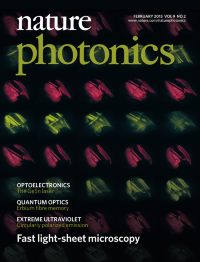
No. 2 February 2015
A series of in vivo images, captured at different moments in time and at different depths, of the internal parts of moving Drosophila larvae using a new form of fast light-sheet microscopy.
Article p113; News & Views p80
IMAGE: ELIZABETH HILLMAN,
COLUMBIA UNIVERSITY
COVER DESIGN: SAMANTHA WHITHAM
-
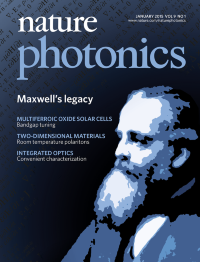
No. 1 January 2015
Artistic image of James Clerk Maxwell, the nineteenth-century physicist whose equations unified electricity and magnetism and explained the existence of electromagnetic waves. It is now 150 years since the equations were formulated and to celebrate the anniversary we have compiled several articles on the topic.
Editorial p1; Commentary p2; Interview p5; Review Article p15
IMAGE: © PICTORIAL PRESS LTD/ALAMY
COVER DESIGN: SAMANTHA WHITHAM
Focus