Thank you for visiting nature.com. You are using a browser version with limited support for CSS. To obtain
the best experience, we recommend you use a more up to date browser (or turn off compatibility mode in
Internet Explorer). In the meantime, to ensure continued support, we are displaying the site without styles
and JavaScript.
Neuroscientists must engage with climate change now because its effects on their research are and will continue to be widespread and because neuroscience itself is a contributor to climate change. As evidence-driven, ethically concerned scientists, we have important roles to play in tackling this global challenge to health and wellbeing.
People with chronic pain often also have anxiety and/or depression; here, the authors show that psilocybin, the psychoactive component of ‘magic mushrooms’, produces rapid and sustained improvement in both pain and anxiodepressive-like behaviours in mice.
Both full-collapse fusion and the more transient ‘kiss-and-run’ fusion are shown to occur at hippocampal synapses, with the kiss-and-run form involving vesicle shrinkage in between ‘kissing’ and ‘running’.
In this Journal Club, Matthew Kraushar discusses a study published in 1996 that found a role for local protein translation in hippocampal synaptic plasticity.
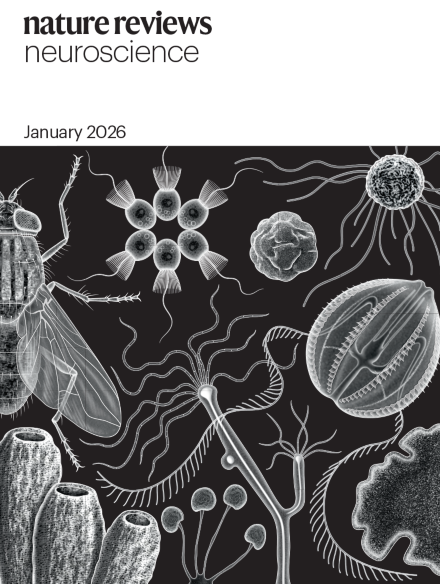
Recent studies have shed further light on the evolutionary origins of chemical synapses, In this Review, Colgren and Burkhardt explore how ancient proteins were co-opted into functional assemblies and propose events that gave rise to true synapses from early sensory-secretory cells.
In this Review, Saef Izzy and colleagues examine the therapeutic potential of stem cells in stroke, with a focus on neural and mesenchymal stem cells. They explore how these stem cells interact with brain immune cells to modulate the inflammatory microenvironment, restore blood–brain barrier integrity and promote tissue repair following a stroke.
Programmed axon degeneration (PAxD) is activated by axotomy to execute the self-destruction of a severed distal axon. It may also be activated by some non-axotomy insults, suggesting it has a role in some neurodegenerative diseases. Here, Loreto and Neukomm review the molecular mechanisms of PAxD, its involvement in disease and its potential as a therapeutic target.
Understanding how the brain represents experienced time and how representations of space and time are integrated to form episodic memories has been a goal of much neuroscientific research. In this Perspective, Buzsáki discusses classical and contemporary ideas about time perception and proposes that a hierarchy of brain–body rhythms contributes to our subjective experience of time.