
Thank you for visiting nature.com. You are using a browser version with limited support for CSS. To obtain
the best experience, we recommend you use a more up to date browser (or turn off compatibility mode in
Internet Explorer). In the meantime, to ensure continued support, we are displaying the site without styles
and JavaScript.
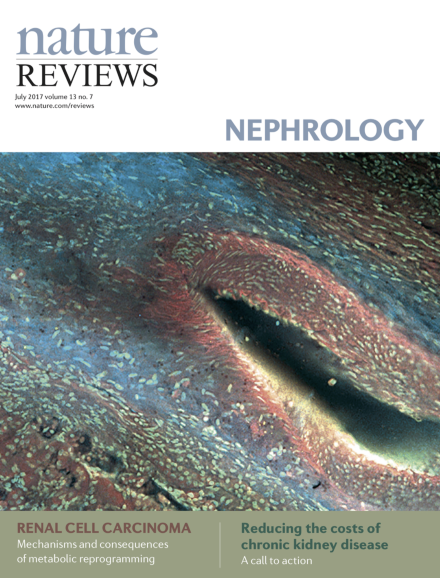
MUSE (microscopy with UV surface excitation) image of fixed unsectioned kidney, showing a renal artery with elastic lamina surrounded by collagen with renal tubules on either side. Cover image supplied by Richard Levenson, Department of Pathology and Laboratory Medicine, University of California Davis Medical Center at Sacramento, California, USA.
The Oxford Classification of IgA nephropathy (IgAN) is the most widely accepted system for assessing histologic findings in IgAN. A new publication refines this classification by adding a crescent score, reassessing the segmental sclerosis score, and contextualizing the clinical relevance of the histologic lesions.
A new study of mortality of children on renal replacement therapy in 32 European countries demonstrates that 67% of the variance between countries can be explained by disparities in public health expenditure. Investment in health care is critical and has demonstrable benefits for the most vulnerable populations.
A new study reports that a heart–brain–kidney network involving renal and cardiac macrophages is required for the adaptive response to cardiac stress. As well as highlighting the importance of inter-organ communication in complex pathological syndromes, the findings raise important questions with implications for the treatment of heart failure.
Encouraging preliminary data from the NEFIGAN trial suggest that a novel oral formulation of budesonide might reduce disease progression in IgA nephropathy. This formulation releases corticosteroid in the distal small intestine and colon, so is thought to directly target the mucosal element of the pathogenesis of the disease.
The treatment of chronic kidney disease (CKD) and end-stage renal disease (ESRD) is associated with immense societal costs, with particularly high expenditure for renal replacement therapy. This Review addresses the economic aspects of CKD and ESRD with a focus on approaches to prevent the conditions that contribute to CKD and its progression.
Clear cell renal cell carcinoma is associated with reprogramming of metabolic pathways including glucose and fatty acid metabolism and the tricarboxylic acid cycle. Here, the authors discuss these reprogrammed pathways and the opportunities they provide for new therapies, imaging modalities and biomarkers.
To ensure suitability for living kidney donation, donor candidates must be thoroughly evaluated. This Review describes current approaches to the assessment of renal function, haematuria, and cardiac risk in living kidney donor candidates as well as strategies to improve efficiency in the evaluation process, focusing on additional investigations that are commonly ordered by transplant centres rather than the minimum initial screening requirements.
Alkaline phosphatase (ALP) drives skeletal mineralization and has a role in vascular calcification and resulting cardiovascular disease in patients with CKD. Here, the authors describe the mechanisms of ALP-mediated vascular calcification and discuss the therapeutic potential of targeting ALP to improve cardiovascular outcomes in these patients.