Thank you for visiting nature.com. You are using a browser version with limited support for CSS. To obtain the best experience, we recommend you use a more up to date browser (or turn off compatibility mode in Internet Explorer). In the meantime, to ensure continued support, we are displaying the site without styles and JavaScript.

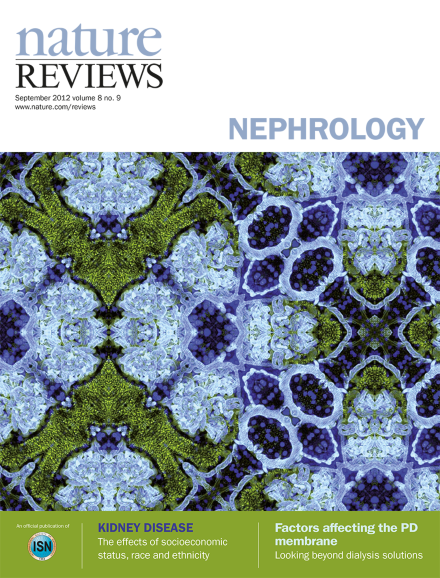
Volume 8 Issue 9, September 2012

Research Highlight

Top of page ⤴

In Brief

Top of page ⤴

Research Highlight

Top of page ⤴

In Brief

Top of page ⤴

Research Highlight

Top of page ⤴

News & Views

  • A survey of seven countries has found a striking difference in dialysis reimbursement policies, even when data were adjusted for gross domestic product per capita. Although increased reimbursement is perceived to be a valuable incentive for certain treatments, this perception is not supported by current data and alternative strategies to promote home-based dialysis should be pursued.

    • Kai Ming Chow
    • Philip Kam-Tao Li
    News & Views
  • Several immunosuppressive treatments have demonstrated their efficacy in idiopathic membranous nephropathy, but spontaneous remission does develop in more than 30% of patients. The availability of a validated biomarker that is easy to measure and able to accurately predict long-term outcomes would be very helpful for tailoring treatment of the disease to the individual.

    • Manuel Praga
    • Jorge Rojas-Rivera
    News & Views
  • A study by Bojan et al. of neonates and infants who received peritoneal dialysis for the treatment of acute kidney injury following cardiac surgery revealed that the early initiation of dialysis was associated with a significantly decreased mortality rate compared with delayed dialysis.

    • Bradley A. Warady
    News & Views
  • The American College of Rheumatology recently published guidelines for the screening, treatment, and management of lupus nephritis. How will or should these guidelines impact our current daily practice?

    • Hans-Joachim Anders
    • Gerald B. Appel
    News & Views
  • Dialysis, particularly haemodialysis, is associated with an increased risk of cardiovascular disease. A new study confirms that hypokalaemia confers an excess cardiovascular risk and contributes disproportionately to the high risk of death in patients on peritoneal dialysis, which may partially account for the fact that observed cardiac risk is similar for patients on peritoneal dialysis and haemodialysis.

    • Bonnie Ching-Ha Kwan
    • Cheuk-Chun Szeto
    News & Views
  • In a new study, Schwartz and colleagues have investigated the best way to estimate glomerular filtration rate (GFR) in children. Having already improved GFR estimation with the use of creatinine-based equations, the investigators now propose a more precise method for cystatin C measurement. The precision of a GFR equation will strongly depend on the analytical precision of the biological variables included.

    • Pierre Delanaye
    • Natalie Ebert
    News & Views
Top of page ⤴

Review Article

  • Lupus nephritis is the most common severe manifestation of the autoimmune disease systemic lupus erythematosus. Although conventional immunosuppressive therapy can increase survival, this approach is associated with considerable adverse effects. In this Review, Gregersen and Jayne discuss the available and future approaches to deplete B-cell populations and the current evidence for the therapeutic use of B cell depletion therapies in lupus nephritis, derived from case studies and clinical trials.

    • Jon W. Gregersen
    • David R. W. Jayne
    Review Article
  • In the past decade there has been renewed interest in the benefits of intensive home haemodialysis over conventional in-centre dialysis and specialist units. The authors of this Review highlight some of the hurdles that need to be overcome in order for home-based therapy to be a more widely available treatment option for end-stage renal disease.

    • Karthik K. Tennankore
    • Christopher T. Chan
    • Simon P. Curran
    Review Article
  • Antineutrophil cytoplasmic antibody-associated systemic vasculitides (AASVs) are a group of inflammatory disorders that largely affect the pulmonary and renal vascular beds. Although the advent of effective immunosuppressive therapies has markedly improved patient survival, current immunosuppressive therapies used for AASV incur substantial short-term and long-term toxic effects. This Review outlines currently recommended treatment options for AASV and describes the long-term adverse effects of immunosuppression along with strategies for prophylaxis and monitoring.

    • Nadezhda Wall
    • Lorraine Harper
    Review Article
  • Socioeconomic status, race and ethnicity contribute to the variability in incidence and progression of kidney disease, access to treatment and health outcomes. In this Review, Patzer and McClellan discuss the multifactorial associations between poverty, race and kidney disease at the individual and community level that are fundamental to the occurrence and outcomes of disease.

    • Rachel E. Patzer
    • William M. McClellan
    Review Article
  • The deterioration of the peritoneal membrane during peritoneal dialysis is a serious problem as it leads to technique failure. The factors that have attracted the most attention as culprits in peritoneal membrane deterioration are those related to the peritoneal dialysis fluid itself, such as pH, glucose, and glucose degradation products. This Review focuses on the other factors-many of them modifiable-that can affect peritoneal membrane quality and could be targeted to preserve the peritoneal membrane.

    • Anneleen Pletinck
    • Raymond Vanholder
    • Wim Van Biesen
    Review Article
Top of page ⤴

Search

Quick links