
Thank you for visiting nature.com. You are using a browser version with limited support for CSS. To obtain
the best experience, we recommend you use a more up to date browser (or turn off compatibility mode in
Internet Explorer). In the meantime, to ensure continued support, we are displaying the site without styles
and JavaScript.
This issue includes Reviews on cellular rewiring in prostate cancer, genomic heterogeneity in bladder cancer and liquid biopsy, as well as a Comment from urologists on the front line of the COVID-19 response in Italy.
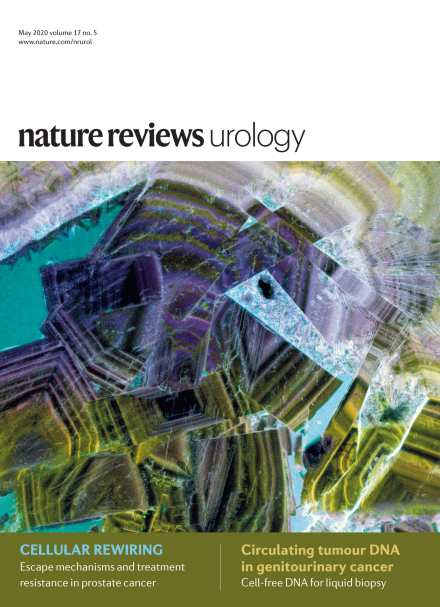
Image shows an SRAF image of a kidney stone thin section. The Image supplied by Bruce Fouke, University of Illinois Urbana-Champaign. Cover design: Patrick Morgan.
The world is currently in the grip of the COVID-19 pandemic. Rapid changes in medical priorities are being enforced across all health-care systems. Urologists have had to reduce or halt their clinical activity and assist on COVID-19 wards. The repercussions on urological patient outcomes for delayed treatments and diagnosis remain to be defined.
A new study reports the 5-year patient-reported outcome data from a population-based cohort of men with localized prostate cancer. These findings in conjunction with data on survival, treatment burden and treatment cost can assist clinicians in explaining to newly diagnosed patients the likely effects of modern management options on quality of life.
In this Review, Meeks et al. summarize heterogeneity in bladder cancer and how it affects tumour biology and clinical care. They describe current knowledge of tumour evolution, genomic heterogeneity and different tumour subtypes, as well as morphological heterogeneity seen in variant bladder cancer histology. They also discuss the influence of heterogeneity on treatment decision making, drug development and clinical trial design.
Liquid biopsy techniques, especially the use of plasma circulating tumour DNA (ctDNA) analysis, are a convenient, fast and non-invasive approach to the diagnosis and monitoring of urological cancers, and could enable selection of targeted therapy before clinical and radiographic changes occur. In this Review, the authors discuss the uses of liquid biopsy and plasma ctDNA analysis in particular, and consider how it could be used in clinical practice now and in the future.
Management strategies used to treat prostate cancer often lead to treatment resistance, which can arise via a mechanism of cellular rewiring, whereby the tumour cell alters its signalling to escape the effects of therapy. Understanding these mechanisms could enable the development of improved and combination treatment regimens, to minimize treatment failures and improve outcomes.