
Thank you for visiting nature.com. You are using a browser version with limited support for CSS. To obtain the best experience, we recommend you use a more up to date browser (or turn off compatibility mode in Internet Explorer). In the meantime, to ensure continued support, we are displaying the site without styles and JavaScript.

Volume 17 Issue 9, September 2020

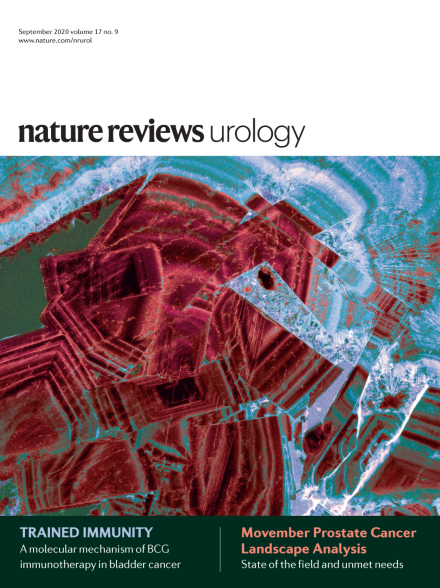
The September issue includes Perspectives on trained immunity as a mechanism for BCG immunotherapy in bladder cancer and on prostate cancer screening using MRI, as well a Consensus Statement from Movember considering the current landscape of prostate cancer research and identifying unmet research needs in the field.

Image shows an SRAF image of a kidney stone thin section. The Image supplied by Bruce Fouke, University of Illinois Urbana-Champaign. Cover design: Patrick Morgan.
Comment

  • Technology for the treatment of stone disease has rapidly advanced, but a common nomenclature to communicate research and high-quality studies to assess treatment outcomes are lacking. Thus, guidelines are based on low-grade evidence and cannot make definitive recommendations in many scenarios. To improve clinical practice and patient outcomes, the endourology community must unite to address these inadequacies.

    • Charles Upshur Nottingham
    • Amy Elizabeth Krambeck
    Comment

    Advertisement

Top of page ⤴

Research Highlights

Top of page ⤴

News & Views

  • Bladder cancer outcomes differ between men and women. Elucidating this sexual dimorphism, genomic analyses found differing molecular subtype distributions and androgen response activities in muscle-invasive bladder cancer in men and women. Together with knowledge of cancer driver genes, biomarkers and clinical characteristics, these findings will hopefully lead to sex-based personalized research and management of bladder cancer.

    • Benjamin Pradere
    • Shahrokh F. Shariat
    News & Views
  • A subgroup analysis of the RTOG 9601 trial, which stratified participants according to their pretreatment serum PSA levels, suggests disparate responses to therapy and potentially concerning cardiac and neurological effects in some men. However, subgroup analyses are notoriously difficult to interpret and the data should be considered with caution before changes are made to clinical practice.

    • Alan Dal Pra
    • Alan Pollack
    News & Views
  • Anti-PD1 and anti-PDL1 immunotherapy has transformed urothelial carcinoma treatment. Pembrolizumab is the only immunotherapy agent shown to have survival benefit compared with standard chemotherapy after progression on platinum-containing chemotherapy. Initial National Institute for Health and Care Excellence (NICE) approval was based on efficacy data, but the final appraisal report rejected use of pembrolizumab owing to treatment cost.

    • Shilpa Gupta
    • Ashish M. Kamat
    News & Views
Top of page ⤴

Viewpoint

  • On 11 March 2020, the World Health Organization declared SARS-CoV-2 and its associated disease, COVID-19, a global pandemic. Across the world, governments took action to slow the spread and hospitals rushed to accommodate an influx of patients with this highly infectious and lethal disease. The urology departments in Ann Arbor, Michigan, USA, and Herlev and Gentofte, Copenhagen, Denmark — which are linked by the pre-existing CopMich Collaborative — had to respond with massive changes to the organization, staffing and workload of their teams. In this Viewpoint, authors from different urological subspecialties and at different career stages reflect on their experiences during the pandemic. Although their countries’ responses to the COVID-19 pandemic differed radically, the similarities between the responses in Copenhagen and Michigan demonstrate the universal characteristics of medicine and the value of teamwork, flexibility and collaboration.

    • Juan J. Andino
    • James M. Dupree
    • Daniela Wittmann
    Viewpoint
Top of page ⤴

Consensus Statement

  • The Movember global Landscape Analysis Committee (LAC) was established to act as an independent group of experts across urology, medical oncology, radiation oncology, radiology, pathology, translational research, health economics and patient advocacy to identify the highest priority research needs across the prostate cancer biomedical research domain. Findings from the landscape analysis illustrate the research priorities in prostate cancer and will enable Movember to focus on specific needs, with particular investment in research to reduce disease progression and improve therapies for advanced prostate cancer.

    • Michelle M. Kouspou
    • Jenna E. Fong
    • Mark Buzza
    Consensus Statement Open Access
Top of page ⤴

Perspectives

  • The precise mechanism of action by which BCG acts in bladder cancer therapy is unclear. BCG induces a non-specific enhancement of the biological function of innate immune cells, creating an immunological memory known as trained immunity. In this Perspective, the authors propose that trained immunity could be an important mechanism mediating BCG immunotherapy and could contribute to a personalized approach to BCG therapy in patients with bladder cancer.

    • Jelmer H. van Puffelen
    • Samuel T. Keating
    • Sita H. Vermeulen
    Perspective
  • Here, the authors describe the characteristics of an ideal screening test for prostate cancer and examine why PSA fails to meet these attributes. They discuss whether an abbreviated MRI protocol could be an alternative or additional screening test for prostate cancer and explore its inherent challenges and potential solutions.

    • David Eldred-Evans
    • Henry Tam
    • Hashim U. Ahmed
    Perspective
Top of page ⤴

Amendments & Corrections

Top of page ⤴

Search

Quick links