Thank you for visiting nature.com. You are using a browser version with limited support for CSS. To obtain
the best experience, we recommend you use a more up to date browser (or turn off compatibility mode in
Internet Explorer). In the meantime, to ensure continued support, we are displaying the site without styles
and JavaScript.
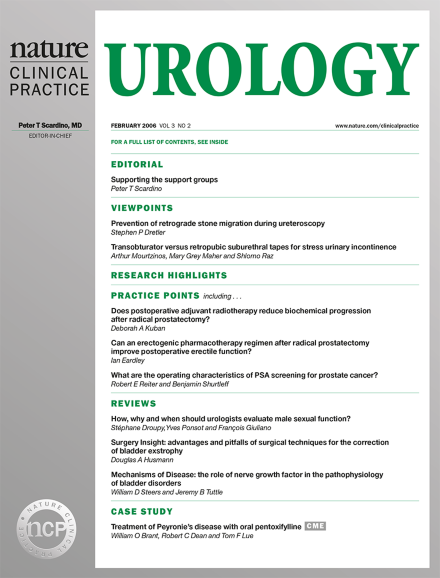
Retrograde stone migration during ureteroscopy leads to longer operating times, more-invasive endoscopy, and an increase in residual stones and the need for secondary procedures. In this Viewpoint, the author describes his experience with the various devices developed to prevent stone migration, focusing on the Stone Cone.
This Viewpoint provides a concise overview of transobturator and retropubic techniques for the surgical treatment of female stress urinary incontinence. The authors focus on a new generation of minimally invasive devices for sling placement, including the transvaginal tape and their own distal urethral polypropylene sling.
A goal-directed approach to managing men with male sexual dysfunction is important in order to fully understand the biological and psychological dimensions of each patient's condition. The evaluation and management of men presenting with symptoms of sexual dysfunction, and those with urologic problems and comorbid conditions that are associated with sexual problems, are discussed in this Review.
Patients with bladder exstrophy present a challenge to urologists specializing in reconstruction. There are several different techniques by which repair can be achieved, each with their own associated success rates and morbidities. This article compares the techniques of staged reconstruction and complete primary repair of bladder exstrophy, highlighting the relative advantages and disadvantages associated with each method.
Elevated levels of nerve growth factor (NGF) in the bladders of patients with idiopathic overactive bladder syndrome, interstitial cystitis and benign prostatic hyperplasia has pointed to a role for NGF in the pathogenesis of lower urinary tract diseases. This article discusses the biology of NGF, its production in the bladder, and the mechanisms underlying its role in disorders of the lower urinary tract.