Thank you for visiting nature.com. You are using a browser version with limited support for CSS. To obtain
the best experience, we recommend you use a more up to date browser (or turn off compatibility mode in
Internet Explorer). In the meantime, to ensure continued support, we are displaying the site without styles
and JavaScript.
Carl Wunsch is a visiting professor of oceanography and climate at Harvard University, and professor emeritus at the Massachusetts Institute of Technology, Cambridge, USA. He met Walter Munk at MIT in 1964, becoming friends and collaborators on diverse subjects over the next 55 years.
Oceanographer Walter Munk in 1963 with a tide capsule, which was dropped to the sea floor to measure deep-sea tides.Credit: Ansel Adams, University of California
Walter Munk revolutionized our understanding of the ocean and of Earth’s rotation. He synthesized observations, theory and empirical rules to solve problems both fundamental and practical — about waves, tides, mixing, circulation and more. His early work aided Allied beach landings in the Second World War, and from 1968 he was part of JASON, the elite group of scientists that advises the US government on military matters.
Gregarious and intuitive, he anticipated crucial, just-ripening questions — almost to the end of his long life. Decades later, many of them remain the focus of huge efforts across almost all of physical oceanography and much of geophysics. It is doubtful that anyone will again have such a generalist’s career. He loved going to sea, was adroit with mathematics, had a deep understanding of statistical significance and had a feeling for the ocean that, more than once, led him to the right answer despite mistakes along the way.
Born in Austria in 1917, Munk came from a Viennese banking family. After working in a New York bank, his story as a scientist began when he followed a girlfriend to La Jolla, California, in 1939. There, he discovered physical oceanography — in particular, the man who became his mentor and friend, Harald Sverdrup, who was director of the Scripps Institution of Oceanography, where Munk spent his career.
In the early years, he was best known for his work with Sverdrup on predicting ocean-wave conditions. Shortly before Pearl Harbor was bombed in December 1941, Sverdrup had Munk released from the US Army and ultimately sent as a civilian to the Pentagon. Months before the coastal invasion of North Africa in November 1942, the pair feared huge waves would spell disaster for the essential beach landings of Allied troops. Combining theory and empiricism, the Sverdrup–Munk method of wave prediction was first used successfully during the North African invasion. Developed further, it aided the Normandy and Pacific landings.
In 1950, Munk produced the first of a few extremely fertile papers on the large-scale (general) circulation of the oceans (W. H. Munk J. Meteorol. 7, 79–93; 1950). He reconciled the disparate ideas of Sverdrup and of physical oceanographer Henry Stommel into a foundational theory of wind-driven ocean circulation. With the applied mathematician George Carrier, he linked ocean currents such as the Gulf Stream to the much wider field of mathematical fluid dynamics. And in 1951, he published a paper pointing out that his own theory would fail in the Southern Ocean because of ocean-bottom topography (W. H. Munk and E. Palmén Tellus3, 53–55; 1951). Implications of these ideas are a current major focus of research.
Walter Munk (left) on a research vessel with an oceanographic instrument during the 1952–53 Capricorn Expedition run by the Scripps Institution of Oceanography, which mapped parts of the Pacific sea floor.Credit: UC San Diego/Scripps Institution of Oceanography
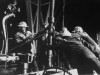
Meanwhile, Munk turned his attention to geophysics. He showed that a research area thought of as the junkyard of astronomy — variations in Earth’s polar motion and rotation rate — was a fount of information across an extraordinary range of Earth sciences. With collaborator Gordon MacDonald, he wrote the classic textbook The Rotation of the Earth (1960). In the 1950s, he was a key player in Project Mohole — an audacious attempt to drill through Earth’s crust to obtain a sample of the mantle at the boundary, the Mohorovičić discontinuity. Munk never hid the fact that the project was a failure. He wrote that he had not given it sufficient attention; historians would say that it was snared in oil-industry politics. Undaunted, he moved on.
He returned to the large-scale ocean with his 1966 “abyssal recipes” paper, explaining the gross structure of temperature and salinity in the deep ocean as a balance of upwelling and mixing, an idea also embraced by chemists and biologists (W. H. Munk Deep Sea Res. Oceanogr. Abstr.13, 707–730; 1966). By about 2000, this picture was replaced by a mixing regime involving sea-floor topography — an outcome that led Munk to simply shrug. His mantra was that the right questions were much more important than the right answers.
In the 1960s and 1970s, he and UK collaborator David Cartwright revived the study of tides, a subject that had become mostly moribund in the twentieth century and which is now centre-stage in understanding ocean mixing. By about 1970, oceanographers had begun to accumulate measurements of temperature interpreted as ‘internal waves’. Munk and postdoc Chris Garrett assumed that these, unlike wind-driven waves on the surface, do not have periods of storm and calm, nor predominant propagation directions. The Garrett–Munk (GM) spectrum of internal waves united a vast array of otherwise mystifying motions in one comparatively simple framework. There followed a flowering of theory and global observations.
Enjoying our latest content?
Log in or create an account to continue
Access the most recent journalism from Nature's award-winning team
Explore the latest features & opinion covering groundbreaking research



 Journey to the mantle of the Earth