Thank you for visiting nature.com. You are using a browser version with limited support for CSS. To obtain
the best experience, we recommend you use a more up to date browser (or turn off compatibility mode in
Internet Explorer). In the meantime, to ensure continued support, we are displaying the site without styles
and JavaScript.
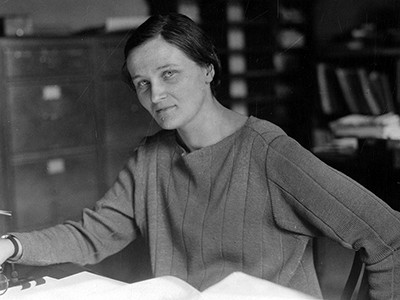
Margaret Burbidge was the director of the Royal Greenwich Observatory from 1972 to 1973.Credit: Emilio Segre Visual Archives/American Institute of Physics/SPL
In 1957, a landmark paper brought together theoretical and observational studies supporting the idea that all the heavier elements in the Universe, from carbon to uranium, were synthesized in stars through nuclear fusion. The first author alphabetically was the observational astronomer Eleanor Margaret Burbidge (née Peachey), always known as Margaret, who has died aged 100.
Her co-authors were her husband Geoffrey Burbidge, the nuclear physicist William Fowler and the astronomer Fred Hoyle, proponent of the steady-state model of the Universe. The paper was so influential that generations of astrophysicists called it B2FH for short, quipping that the early Universe made hydrogen and helium, but Burbidge, Burbidge, Fowler and Hoyle made all the rest.
Burbidge, often working with Geoffrey, also measured the rotation and masses of spiral galaxies, documented the very large redshifts of quasars and contributed to the development of the Faint Object Spectrograph, an instrument launched aboard the Hubble Space Telescope in 1990.
One of the Burbidges’ collaborators on the galaxy-rotation studies, Vera Rubin, later detected motion in the far outskirts of spiral galaxies, and so discovered evidence for dark matter. This was only one of the many ways in which Margaret Burbidge blazed a trail for female astronomers. Having once been refused access to observatories because of her gender, she later became the first female president of the International Astronomical Union’s commission on galaxies, director of the Royal Greenwich Observatory in London and president of the American Astronomical Society.
Burbidge was born in Davenport, near Manchester, UK, the daughter of a chemistry lecturer and his former student. Her parents encouraged her interest in science with gifts of a telescope, suitable books and a chemistry set. After attending all-girl schools, she entered University College London, where she completed a PhD in 1943 on the spectrum of the star Gamma Cassiopeiae. She enjoyed greater scientific independence and responsibility at the University of London Observatory than she might have otherwise, because many of the male academic staff were engaged in war work.
Geoffrey turned up as a fellow student in 1947, and they married the following year. They bounced between several US and UK institutions, looking for somewhere that would give them both jobs and access to telescopes. At this time, they analysed the spectra of many stars with unusual surface compositions. These sometimes came from upward mixing of the products of nuclear reactions and so became some of the raw material for the B2FH analysis.
They met Hoyle and Fowler while in Cambridge, UK, for one year in the mid-1950s. Hoyle had started thinking about the products of nuclear reactions in stars before the Second World War. Fowler’s nuclear-physics group at the California Institute of Technology (Caltech) in Pasadena had already measured cross-sections for many of the reactions needed to build heavy elements from hydrogen and helium; Geoffrey Burbidge wrote most of the 100-page 1957 paper. Astrophysicist Alastair G. W. Cameron simultaneously identified nearly the same processes, but tends to get left out of the story because his paper was initially classified.
During the Burbidges’ first stay in southern California, Geoffrey the theorist had an appointment at Mount Wilson Observatory, entitling him to apply for observing time, which women could not. Margaret the observer had a theory position at Caltech. He applied, and she did the observing. Later, after they settled at the University of California, San Diego (UCSD), she had unquestioned access to the Lick Observatory and its 3-metre telescope. After the 1963 discovery of quasars, she used much of her time to study their spectra, contributing to the discovery of absorption lines indicating the presence of intergalactic gas clouds, and measuring the record redshifts of some of the most distant objects then known.
Enjoying our latest content?
Log in or create an account to continue
Access the most recent journalism from Nature's award-winning team
Explore the latest features & opinion covering groundbreaking research
Join us to pioneer solutions for global environmental & energy challenges at a world-class institute in China‘s innovation hub, Shenzhen.
Peking University Shenzhen Graduate School in the heart of the Guangdong-Hong Kong-Macao Greater Bay Area, China’s most dynamic economic and innovation region.
School of Environment and Energy (SEE), Peking University Shenzhen Graduate School
Sign up for the Nature Briefing newsletter — what matters in science, free to your inbox daily.




 The woman who explained the stars
 Vera Rubin (1928–2016)
 Maria Mitchell at 200: a Pioneering astronomer who fought for women in science
 Fred Hoyle (1915–2001)