Thank you for visiting nature.com. You are using a browser version with limited support for CSS. To obtain
the best experience, we recommend you use a more up to date browser (or turn off compatibility mode in
Internet Explorer). In the meantime, to ensure continued support, we are displaying the site without styles
and JavaScript.
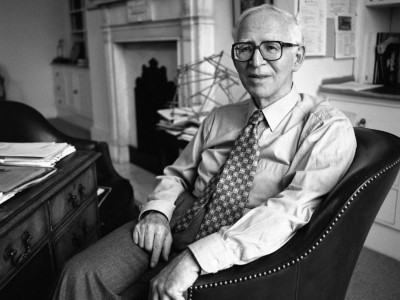
Lee Makowski is professor and chair of bioengineering and professor of chemistry and chemical biology at Northeastern University in Boston, Massachusetts. He worked with Caspar for many years.
Donald Caspar defined the rules that govern the self-assembly of simple viruses. This laid the foundations for a new way of thinking about the molecular systems that regulate and drive all living cells. These rules made it straightforward to characterize other viruses, and then to design strategies to combat them. The same rules are also essential in designing viral vectors to deliver gene therapy.
Viruses typically consist of a strand of genetic material — DNA or RNA — enclosed in a coat of protein molecules. Using the laws of thermodynamics and the constraints of symmetry, Caspar catalogued the ways in which proteins can come together to form the icosahedral shells of spherical viruses (these include rhinovirus and poliovirus) and the helical lattices of rod-shaped viruses (such as Ebola).
In the mid-twentieth century, few protein structures had been solved at atomic resolution. Caspar used limited data from X-ray crystallography, electron microscopy and fibre diffraction to tease out features of prototypical viruses. With an artist’s eye, unbounded curiosity and a passion for ‘connecting the dots’, he created exquisite sketches of virus structures and membranes, which still grace the pages of many texts.
Caspar was born in 1927 in Ithaca, New York, when his father was a graduate student in chemistry at Cornell University. When he was ten years old, a family friend, the crystallographer Isidor Fankuchen, told him of the recent discovery that particles of the rod-shaped tobacco mosaic virus (TMV) had a semi-crystalline structure, suggesting that the virus comprised many identical units. This set him on a lifelong journey to understand its structure and behaviour. At the Polytechnic Institute of Brooklyn in New York City, he was the youngest student on a two-week course on X-ray crystallography run by Fankuchen. After graduating in physics at Cornell, Caspar did his PhD on the structure of TMV at Yale University in New Haven, Connecticut. He then held postdoc positions at the California Institute of Technology in Pasadena, and at the MRC Laboratory of Molecular Biology in Cambridge, UK.
At Cambridge in 1956, he set out to prove the theory advanced by James Watson and Francis Crick that spherical virus particles had cubic symmetry (in other words, that the protein coat was made of identical subunits arranged in equivalent ways). He demonstrated that tomato bushy stunt virus had icosahedral symmetry. It soon became clear that other viruses were also icosahedral. This, the most complex of the cubic symmetries, requires 60 identical subunits. But biochemical data indicated that many virus particles had a lot more.
Caspar resolved this paradox in the late 1950s, working with Aaron Klug at Birkbeck College in London, and taking a clue from architect Buckminster Fuller’s geodesic domes. He introduced quasi-equivalence — the idea that equivalent protein subunits could vary slightly in conformation to tightly seal the viral shells. This opened up a universe of possibilities for the controlled assembly and disassembly of everything inside a living cell. Twenty years later, Caspar’s own lab demonstrated that viral proteins can switch between non-equivalent conformations where necessary.




 Aaron Klug (1926–2018)
 How the coronavirus infects cells — and why Delta is so dangerous