Thank you for visiting nature.com. You are using a browser version with limited support for CSS. To obtain
the best experience, we recommend you use a more up to date browser (or turn off compatibility mode in
Internet Explorer). In the meantime, to ensure continued support, we are displaying the site without styles
and JavaScript.
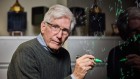
Edward Stone was a pre-eminent space scientist with an exceptional record of leading space missions and building ground-based astronomical facilities. The public face of NASA’s Voyager missions for the launch of the two probes in 1977, he served as project scientist for 50 years. Stone introduced the world to the wonders of the gas-giant planets (Jupiter, Saturn, Uranus and Neptune) in multiple press conferences, from Voyager 1’s encounter with Jupiter in 1979 to Voyager 2’s fly-by of Neptune in 1989. He also oversaw the probes entering interstellar space — the first in 2012 and the second in 2018. They continue to transmit data to Earth today.
At the helm of the California Association for Research and Astronomy in the 1990s, Stone was involved in the development of the twin 10-metre Keck telescopes on Maunakea in Hawaii, two of the most productive ground-based astronomical facilities ever built. And as the executive director of the Thirty Meter Telescope, for eight years he oversaw the huge international collaboration that plans to build one of the world’s largest optical–infrared telescopes on the same mountain — land that is sacred to Native Hawaiians, leading to years-long protests and controversy. The telescope aims to capture light from the earliest galaxies in the Universe and search for habitable planets. Stone’s involvement was a service to the astronomy community, because his observational interests were focused on cosmic rays.
Stone was born in Knoxville and grew up in Burlington, both in Iowa. His father was a construction supervisor who communicated his curiosity about how things worked to his son. Stone studied physics at the University of Chicago, Illinois, for a master’s degree and PhD. Soon after he started studying there, in 1957, the Soviet Union launched Sputnik 1 — the first artificial Earth satellite — starting the space race. Stone took notice, and was at a good place to get involved. His thesis adviser, cosmic-ray-research pioneer John Simpson, was deploying instruments attached to high-altitude balloons as well as using ground-based neutron monitors. Instruments on rockets soon followed. Stone’s thesis experiment was on a now-declassified US spy satellite, Discoverer 31, flown in 1961.
After earning his doctorate in 1964, Stone joined Rochus ‘Robbie’ Vogt, whom he studied alongside at Chicago, at the California Institute of Technology (Caltech) in Pasadena, as a research fellow. Together, they formed the Space Radiation Laboratory, where I work. They focused on observations of cosmic rays, with instruments first carried on balloons and later launched into space. Stone moved up the academic ranks at Caltech, becoming a professor of physics in 1976. In 1972, he was appointed project scientist for NASA’s MJS77 mission, later renamed Voyager. Stone was also directly involved in developing an instrument for use aboard the Voyagers — the Cosmic Ray Subsystem — helping to design its cosmic-ray telescopes and draw up the calibration procedures.
The Voyager missions capitalized on a rare alignment of the four gas-giant planets — a once-in-176-years opportunity that allowed a single spacecraft to visit all four. It required a launch between 1976 and 1980 to succeed. For budget reasons, only a two-spacecraft mission to Jupiter and Saturn was initially approved. Voyager 2 was later re-programmed to visit Uranus and Neptune as well.
Enjoying our latest content?
Log in or create an account to continue
Access the most recent journalism from Nature's award-winning team
Explore the latest features & opinion covering groundbreaking research



 The Milky Way is ‘less weird’ than we thought
 159 days of solitude: how loneliness haunts astronauts
 Fifty years after astronauts left the Moon, they are going back. Why?
 Space science: Voyager at 40
 The most powerful cosmic ray since the Oh-My-God particle puzzles scientists
 How the fight over a Hawaii mega-telescope could change astronomy