Thank you for visiting nature.com. You are using a browser version with limited support for CSS. To obtain
the best experience, we recommend you use a more up to date browser (or turn off compatibility mode in
Internet Explorer). In the meantime, to ensure continued support, we are displaying the site without styles
and JavaScript.
A picture taken by the Artemis II crew on 6 April shows Earth setting behind the Moon.Credit: NASA
NASA Johnson Space Center
Breathtaking photos are coming down to Earth from NASA’s historic Artemis II mission after its four astronauts flew around the far side of the Moon on 6 April — at distances farther from Earth than any humans have ever travelled.
One image shows ‘Earthset’ — a crescent Earth, glimmering blue and white, just before it disappeared behind the lunar horizon as seen from the Integrity spacecraft. Another shows an ethereal solar eclipse, with the Sun’s wispy outer atmosphere radiating out from behind the Moon.
Both are unique views enabled by the journey into deep space. The extraordinary, six-plus-hour fly-by saw the astronauts marvelling at the celestial panorama of the Moon, Earth and Sun.
“The Moon really is its own unique body in the Universe,” said astronaut and mission specialist Christina Koch. “It’s not just a poster in the sky that goes by — it’s a real place.”
The Earthset image, released by NASA on the morning of 7 April, is framed similarly to the iconic ‘Earthrise’ image taken by the Apollo 8 astronauts on humanity’s first flight around the Moon, in 1968. “No one likes to think of the Earth setting, so it’s presented as an Earthrise,” says Robert Poole, a historian at the University of Lancashire in Preston, UK, and author of the 2008 book Earthrise.
An actual Artemis II Earthrise image shows the crescent Earth emerging from behind the Moon’s disk, its illuminated tips pointing away from the Moon like the horns of a bull.
‘Earthrise’ was captured by the Artemis II crew during its historic fly-by of the Moon. The bright surface of Earth is obscured (top) by the Moon.Credit: NASA
The Artemis II eclipse image was taken as the Moon moved in front of the Sun from the astronauts’ perspective. During the nearly 54-minute eclipse, the astronauts observed the solar atmosphere from a vantage point few humans have had access to. “There’s no adjectives,” said commander Reid Wiseman about the eclipse. “I’m going to need to invent some new ones to describe what we are looking at out this window.”
The Moon fully eclipsed the Sun during the Artemis II fly-by.Credit: NASA
Other images show the lunar terminator, the ever-shifting boundary between the hemisphere that is illuminated by sunlight and the one that is dark. Pilot Victor Glover seemed particularly taken with the view of the terminator, speaking eloquently of how craters dramatically changed appearance as the sunlight hitting them changed. “What it does to the features of the Moon, to the terrain,” he said. ”There’s just so much magic in the terminator: the islands of light, the valleys that look like black holes [where] you’d fall straight to the centre of the Moon if you stepped in some of those.”
Mission scientists said they were thrilled with the descriptions sent down by the astronauts, who are not scientists by profession but have had scientific training. “You really brought the Moon closer to us today, and we cannot thank you enough,” Kelsey Young, the mission’s science officer, told the astronauts at the close of the lunar fly-by.
The terminator, the boundary between lunar day and night, crosses the Moon’s South Pole–Aitken basin.Credit: NASA
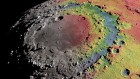
The flight path carried Integrity, as the crew has named the Orion crew capsule, over features never before seen in sunlight by human eyes, including the entire 930-kilometre-wide Orientale basin created by a massive impact 3.8 billion years ago. Mission scientists were thrilled as the astronauts reported seeing variations in colour in the different parts of Orientale and in other regions, including many shades of brown as well as some greens. The crew also observed at least five ‘impact flashes’, bursts of light created when micrometeorites hit the lunar surface.
At its greatest distance from Earth, Integrity had travelled 406,771 kilometres from the planet, breaking the record set by the Apollo 13 mission in 1970. “We most importantly choose this moment to challenge this generation and the next to make sure this record is not long-lived,” said mission specialist Jeremy Hansen, of the Canadian Space Agency, as Integrity sailed past the distance record. In other records, Glover became the first person of colour and Koch the first woman to go to the Moon. And Hansen became the first person from a nation other than the United States to do so.
Enjoying our latest content?
Log in or create an account to continue
Access the most recent journalism from Nature's award-winning team
Explore the latest features & opinion covering groundbreaking research
Clarification 09 April 2026: In an earlier version of this story, the caption for a picture of the Moon eclipsing the Sun implied that the solar corona was directly visible in the image. That wording has now been removed.



 Historic Artemis II Moon fly-by: Nature’s live coverage as it happened
 What Artemis II’s astronauts will look for on the Moon’s far side
 China is planning to land people on the Moon — and might beat the United States to it
 Lift off! Artemis II mission sends humans to the Moon — opening a new era of exploration
 Artemis II mission is about to fly humans to the Moon — here’s the science they’ll do