
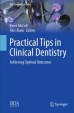
 Practical Tips in Clinical Dentistry
Edited by: 
- Ewen McColl &
- Aws Alani
This Springer book is a very useful compilation of articles which were published in the BDJ from 2021 onwards. The distilled wisdom of many years of invaluable clinical experiences has been skilfully edited into a highly organised and accessible textbook by two highly respected clinicians from Peninsula Dental School. It includes pearls of clinical wisdom from many senior teaching staff there, but also many others from various practitioners from across the UK, as well as from the armed services.
This high-quality hardback book is divided into eight logical parts. The first part has 11 sub-sections on various aspects of restorative dentistry including how to assess prognosis and use dental materials more effectively. It has separate snappy chapters on minimally invasive dentistry, direct posterior restorations, crowns, resin retained bridges and a particularly thoughtful chapter on immediate replacement of teeth. It then moves on to offering practical advice about implants and how to try to manage the increasing problems of implant complications in primary care.
The section on digital dentistry extols the alleged virtues and benefits, but it does not emphasise adequately the unnecessary dental destruction that is frequently involved in making indirect restorations for problems that would be dealt with more appropriately with more sound-tooth-preserving direct restorations.
The second part is on endodontics and has ten chapters with the first two being devoted to the perennial problems of attempting to manage fractures, cracks and chips cost-effectively. There are then two really useful chapters about assessing endodontic complexity in advance of attempting any intervention with the radiographic check-list containing some real gems. The next chapters describe the various ‘laws' governing the identification of the pulp chamber and root canal orifices and will probably be incredibly useful for the majority of dentists who often struggle with that critical aspect of endodontics.
The chapter on minimally invasive technique for treating endodontically treated teeth contains some useful information, but also some mildly contentious statements about inside/outside bleaching and restoring access cavities in anterior teeth using composite. The chapter on posts and post crowns is laid out logically and contains many useful nuggets which will be of great help to most clinicians.
There are many sensible statements in the chapter on restoring broken down root-filled posterior teeth. Sadly, those sound biological messages then are undermined badly by Fig. 19 which showed gross mutilation of a scarcely-visible root-filled lower second molar – possibly to use scanning and/or some daft ‘digital work flow' – which resulted in a massively over-contoured allegedly ‘tooth coloured' crown with marginal ridges that were far too high and with both contact zones being far too wide, thereby producing almost un-cleansable cols and, almost inevitably, later structural and/or biologic problems.
The two chapters on assessing endodontic prognosis are nicely laid out and are very well-referenced.
The chapters on dental trauma were authored by the Dundee team and are divided into early and later management and both sections cover the really important issues in a readily accessible way.
The communication tips about motivating patients to use different sizes of interdental brushes effectively are among the highlights of the two sensible chapters on periodontology along with helpful hints about effectively using different periodontal instruments and their essential maintenance.
Some traditional oral surgical tips are included in the four chapters on oral surgery.
However, the three short chapters on removable prosthodontics by Blakely, Beare and McColl are really stunningly good and probably worth the cost of the entire book on their own.
The paediatric dentistry and orthodontic sections that follow contain many helpful and timeless clinical tips and are particularly relevant given the current fashion for fashion-driven ‘alignerodontics'.
The final part of this terrific book is devoted to practice management, governance and well-being.
In summary, this book provides more than enough practical clinical tips for all practitioners to justify its modest cost. It is also highly recommended for all dental students who, unfortunately, are being swamped by a tidal wave of disinformation on social media, and for whom this book would be a very sound investment for their sanity and as a helpful guide for safer and happier future practice.
Author information
Authors and Affiliations
Corresponding author
Rights and permissions
About this article

Cite this article
Kelleher, M. Practical Tips in Clinical Dentistry. Br Dent J 239, 758 (2025). https://doi.org/10.1038/s41415-025-9443-3
Published:
Version of record:
Issue date:
DOI: https://doi.org/10.1038/s41415-025-9443-3
