
Abstract
Background
Home parenteral nutrition (HPN) is indicated for patients with intestinal failure, but its use in cancer patients requires careful consideration due to the unique challenges and complexities involved.
Methods
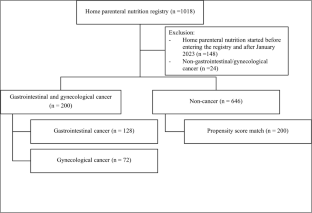
This prospective cohort study analyzed data from cancer patients receiving HPN, recorded in the Canadian HPN Registry from 2003 to 2022. Patients were divided into two groups: those with gastrointestinal or gynecologic cancer and a propensity score-matched cohort of non-cancer patients. The objective was to assess survival rates by performance status and prescription decade in both groups. Secondary objectives were to compare complications between the groups.
Results
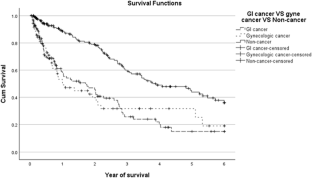
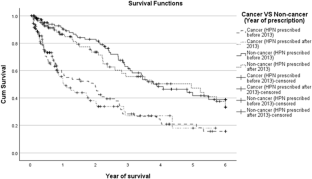
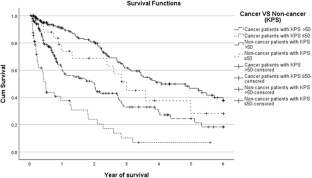
A total of 400 HPN patients were enrolled: 200 cancer patients (128 gastrointestinal, 72 gynecologic) and 200 matched non-cancer patients. Median age (interquartile range) was 58 (16) years for cancer and 56 (19) for non-cancer groups, with 71.5% and 66.5% female, respectively. Median survival was 1.71 years (95% confidence interval (CI), 0.81–2.61) for gastrointestinal cancer, 0.99 years (95% CI, 0.36–1.6) for gynecologic cancer, and 3.89 years (95% CI, 2.72–5.06) for non-cancer patients (p-value < 0.001). Survival showed no improvement over two decades. Patients with Karnofsky Performance Scale (KPS) ≤ 50 had shorter survival. Catheter complications and HPN-related hospitalizations were similar, but HPN-related liver disease was more common in non-cancer patients (16.5% vs. 9%, p-value = 0.025).
Conclusion
Survival for patients with gastrointestinal and gynecologic cancer and co-existing intestinal failure has not improved over the past two decades, with poorer outcomes observed in those with low KPS. Complication rates were similar in both groups.

Graphical abstract: Created in BioRender. Unhapipatpong, C. (2025) https://BioRender.com/l25d998.
This is a preview of subscription content, access via your institution
Access options
Subscribe to this journal
Receive 12 print issues and online access
$259.00 per year
only $21.58 per issue
Buy this article
- Purchase on SpringerLink
- Instant access to the full article PDF.
USD 39.95
Prices may be subject to local taxes which are calculated during checkout
Data availability
Data described in the manuscript, code book, and analytic code will be made available upon request pending application and approval. Supplementary files are available online.
References
Pironi L, Boeykens K, Bozzetti F, Joly F, Klek S, Lal S, et al. ESPEN guideline on home parenteral nutrition. Clin Nutr. 2020;39:1645–66. https://doi.org/10.1016/j.clnu.2020.03.005.
Pironi L, Boeykens K, Bozzetti F, Joly F, Klek S, Lal S, et al. ESPEN practical guideline: Home parenteral nutrition. Clin Nutr. 2023;42:411–30. https://doi.org/10.1016/j.clnu.2022.12.003.
O’Hanlon FJ, Fragkos KC, Fini L, Patel PS, Mehta SJ, Rahman F, et al. Home parenteral nutrition in patients with advanced cancer: a systematic review and meta-analysis. Nutr Cancer. 2021;73:943–55. https://doi.org/10.1080/01635581.2020.1784441.
Silva FR, de Oliveira MG, Souza AS, Figueroa JN, Santos CS. Factors associated with malnutrition in hospitalized cancer patients: a croos-sectional study. Nutr J. 2015;14:123. https://doi.org/10.1186/s12937-015-0113-1.
Mariean CR, Tiucă OM, Mariean A, Cotoi OS. Cancer cachexia: new insights and future directions. Cancers 2023;15. e-pub ahead of print 20231126; https://doi.org/10.3390/cancers15235590
Altun G, Akansu B, Ugur Altun B, Azmak D, Yilmaz A. Deaths due to hunger strike: post-mortem findings. Forensic Sci Int. 2004;146:35–38. https://doi.org/10.1016/j.forsciint.2004.03.022.
Naghibi M, Smith TR, Elia M. A systematic review with meta-analysis of survival, quality of life and cost-effectiveness of home parenteral nutrition in patients with inoperable malignant bowel obstruction. Clin Nutr. 2015;34:825–37. https://doi.org/10.1016/j.clnu.2014.09.010.
Vashi PG, Dahlk S, Popiel B, Lammersfeld CA, Ireton-Jones C, Gupta D. A longitudinal study investigating quality of life and nutritional outcomes in advanced cancer patients receiving home parenteral nutrition. BMC Cancer. 2014;14:593. https://doi.org/10.1186/1471-2407-14-593.
Bouleuc C, Anota A, Cornet C, Grodard G, Thiery-Vuillemin A, Dubroeucq O, et al. Impact on health-related quality of life of parenteral nutrition for patients with advanced cancer cachexia: results from a randomized controlled trial. Oncologist. 2020;25:e843–e851. https://doi.org/10.1634/theoncologist.2019-0856.
Fearon KC. The 2011 ESPEN Arvid Wretlind lecture: cancer cachexia: the potential impact of translational research on patient-focused outcomes. Clin Nutr. 2012;31:577–82. https://doi.org/10.1016/j.clnu.2012.06.012.
Bozzetti F, Mori V. Nutritional support and tumour growth in humans: a narrative review of the literature. Clin Nutr. 2009;28:226–30. https://doi.org/10.1016/j.clnu.2009.02.006.
Deshayes E, de Forges H, Fraisse J, Eberlé M-C, Guillemard S, Fallières A, et al. Artificial nutrition in patients with cancer has no impact on tumour glucose metabolism: Results of the PETANC study. Clin Nutr. 2019;38:2121–6. https://doi.org/10.1016/j.clnu.2018.08.033.
Crosby D, Bhatia S, Brindle KM, Coussens LM, Dive C, Emberton M, et al. Early detection of cancer. Science. 2022;375:eaay9040. https://doi.org/10.1126/science.aay9040.
Hortencio TDR, Arendt BM, Teterina A, Jeejeebhoy KN, Gramlich LM, Whittaker JS, et al. Changes in home parenteral nutrition practice based on the canadian home parenteral nutrition patient registry. JPEN J Parenter Enter Nutr. 2017;41:830–6. https://doi.org/10.1177/0148607115609289.
Dreesen M, Foulon V, Spriet I, Goossens GA, Hiele M, De Pourcq L, et al. Epidemiology of catheter-related infections in adult patients receiving home parenteral nutrition: a systematic review. Clin Nutr. 2013;32:16–26. https://doi.org/10.1016/j.clnu.2012.08.004.
Kopczynska M, Teubner A, Taylor M, Abraham A, Bond A, Clamp A, et al. Home parenteral nutrition in patients with advanced cancer. Clin Nutr ESPEN. 2023;54:590. https://doi.org/10.1016/j.clnesp.2022.09.385.
Vashi PG, Virginkar N, Popiel B, Edwin P, Gupta D. Incidence of and factors associated with catheter-related bloodstream infection in patients with advanced solid tumors on home parenteral nutrition managed using a standardized catheter care protocol. BMC Infect Dis. 2017;17:372. https://doi.org/10.1186/s12879-017-2469-7.
Cotogni P, Pittiruti M, Barbero C, Monge T, Palmo A, Boggio Bertinet D. Catheter-related complications in cancer patients on home parenteral nutrition: a prospective study of over 51,000 catheter days. JPEN J Parenter Enter Nutr. 2013;37:375–83. https://doi.org/10.1177/0148607112460552.
Clement D, Brown SE, Naghibi M, Cooper SC, Tesselaar MET, van Leerdam ME et al. Feasibility of home parenteral nutrition in patients with intestinal failure due to neuroendocrine tumours: a systematic review. Nutrients 2023;15. e-pub ahead of print 20230830; https://doi.org/10.3390/nu15173787.
Tran V, Bielawska B, Jeejeebhoy KN, Gramlich LM, Raman M, Whittaker JS, et al. Variations in practice patterns for adult cancer patients on home parenteral nutrition in Canada. Nutrition. 2019;65:27–32. https://doi.org/10.1016/j.nut.2019.01.021.
Scolapio JS, Fleming CR, Kelly DG, Wick DM, Zinsmeister AR. Survival of home parenteral nutrition-treated patients: 20 years of experience at the Mayo Clinic. Mayo Clin Proc. 1999;74:217–22. https://doi.org/10.4065/74.3.217.
Freedman LS. Tables of the number of patients required in clinical trials using the logrank test. Stat Med. 1982;1:121–9. https://doi.org/10.1002/sim.4780010204.
IBM Corp IBM SPSS Statistics for Windows. Armonk, NY: IBM Corp; 2023. Version 29.0.2.0.
Bossi P, De Luca R, Ciani O, D’Angelo E, Caccialanza R. Malnutrition management in oncology: An expert view on controversial issues and future perspectives. Front Oncol. 2022;12:910770. https://doi.org/10.3389/fonc.2022.910770.
Aoyagi T, Terracina KP, Raza A, Matsubara H, Takabe K. Cancer cachexia, mechanism and treatment. World J Gastrointest Oncol. 2015;7:17–29. https://doi.org/10.4251/wjgo.v7.i4.17.
Bosaeus I. Nutritional support in multimodal therapy for cancer cachexia. Support Care Cancer. 2008;16:447–51. https://doi.org/10.1007/s00520-007-0388-7.
Fletcher J, Woodham D, Dera M, Cooper SC. Home parenteral nutrition in patients receiving palliative care: a curriculum-based review. Frontline Gastroenterol. 2019;10:421–6. https://doi.org/10.1136/flgastro-2018-101113.
Wright JD, Chen L, Tergas AI, Patankar S, Burke WM, Hou JY, et al. Trends in relative survival for ovarian cancer from 1975 to 2011. Obstet Gynecol. 2015;125:1345–52. https://doi.org/10.1097/aog.0000000000000854.
Maharjan U, Kauppila JH. Survival trends in gastric cancer patients between 1987 and 2016: a population-based cohort study in Finland. Gastric Cancer. 2022;25:989–1001. https://doi.org/10.1007/s10120-022-01326-5.
Cotogni P, Stragliotto S, Ossola M, Collo A, Riso S, On behalf of the Intersociety Italian Working Group for Nutritional Support in Cancer. The role of nutritional support for cancer patients in palliative care. Nutrients 2021;13. e-pub ahead of print 20210122; https://doi.org/10.3390/nu13020306.
Theilla M, Cohen J, Kagan I, Attal-Singer J, Lev S, Singer P. Home parenteral nutrition for advanced cancer patients: contributes to survival?. Nutrition. 2018;54:197–200. https://doi.org/10.1016/j.nut.2017.03.005.
Cotogni P, Monge T, Passera R, Brossa L, De Francesco A. Clinical characteristics and predictive factors of survival of 761 cancer patients on home parenteral nutrition: a prospective, cohort study. Cancer Med. 2020;9:4686–98. https://doi.org/10.1002/cam4.3064.
Kopczynska M, Teubner A, Abraham A, Taylor M, Bond A, Clamp A et al. Home parenteral nutrition in patients with advanced cancer: quality outcomes from a centralized model of care delivery. Nutrients 2022;14. e-pub ahead of print 20220817; https://doi.org/10.3390/nu14163379.
Bond A, Chadwick P, Smith TR, Nightingale JMD, Lal S. Diagnosis and management of catheter-related bloodstream infections in patients on home parenteral nutrition. Frontline Gastroenterol. 2020;11:48–54. https://doi.org/10.1136/flgastro-2018-101094.
Lafuente Cabrero E, Terradas Robledo R, Civit Cuñado A, García Sardelli D, Hidalgo López C, Giro Formatger D, et al. Risk factors of catheter-associated bloodstream infection: Systematic review and meta-analysis. PLoS One. 2023;18:e0282290 https://doi.org/10.1371/journal.pone.0282290.
Hon K, Bihari S, Holt A, Bersten A, Kulkarni H. Rate of catheter-related bloodstream infections between tunneled central venous catheters versus peripherally inserted central catheters in adult home parenteral nutrition: a meta-analysis. JPEN J Parenter Enter Nutr. 2019;43:41–53. https://doi.org/10.1002/jpen.1421.
Daoud DC, Cartagena EMS, Schwenger KJP, Somlaw N, Gramlich L, Whittaker S, et al. Home parenteral nutrition in older vs younger patients: clinical characteristics and outcomes. JPEN J Parenter Enter Nutr. 2022;46:348–56. https://doi.org/10.1002/jpen.2117.
O’Grady NP, Alexander M, Burns LA, Dellinger EP, Garland J, Heard SO, et al. Guidelines for the prevention of intravascular catheter-related infections. Clin Infect Dis. 2011;52:e162–193. https://doi.org/10.1093/cid/cir257.
Kelly DA. Intestinal failure–associated liver disease: What do we know today?. Gastroenterology. 2006;130:S70–S77. https://doi.org/10.1053/j.gastro.2005.10.066.
Nowak K. Parenteral nutrition-associated liver disease. Clin Liver Dis. 2020;15:59–62. https://doi.org/10.1002/cld.888.
Zametkin E, Guyer D, Tarshish Y, Bash K, Almhanna K. Total parenteral nutrition for patients with gastrointestinal cancers: a clinical practice review. Ann Palliat Med. 2023;12:1072–80.
Klek S, Szczepanek K, Scislo L, Walewska E, Pietka M, Pisarska M, et al. Intravenous lipid emulsions and liver function in adult chronic intestinal failure patients: results after 5 y of home parenteral nutrition. Nutrition. 2021;82:111029. https://doi.org/10.1016/j.nut.2020.111029.
Acknowledgements
Participating programs of the Canadian Home Parenteral Nutrition Registry: 1. Toronto General Hospital, University of Toronto, Toronto, ON, Canada, PI: Johane P. Allard,MD; Celeste Arca, RN; Patricia Kim, PharmD; Ann MacGillvray, RD; Katherine Schwenger RD, MAN, PhD. 2. Northern Alberta Health Services, University of Alberta, Edmonton, AB, Canada, PI: Leah Gramlich, MD; Jennifer Jin, MD; Adela Delgado, RD, Nicole Anderson RN, Kimberly Johnston RN, Bianca Spark RN, Loretta Vogt RN. 3. University of British Columbia, Vancouver, BC, Canada, PI: Dr Scott Whittaker, MD; Andree Richardson, RD; Greg Rosenfeld, MD; Hin Ko, MD; Nicole Beauregard, RD; Jennifer Lazuna, RN. 4. Division of Gastroenterology and Farncombe Family Digestive Health Research Institute, McMaster University, Hamilton, ON, Canada, PI: David Armstrong, MD; Carol Lynn Godin, RN; Anne Childs, RN; Michelle Dawson, RN; Suzanne Hansen, RD. 5. St. Michael’s Hospital, University of Toronto, Toronto, ON, Canada: Brian Jurewitsch, PharmD; Camille Sagun, RN; Tracey Pignatiello, RN. 6. Hotel-Dieu de Quebec, Quebec, QC, Canada, PI: Anabelle Cloutier, MD. 7. Southern Alberta Health Services, Calgary, AB, Canada, Maitreyi Raman, MD; Cathy Berry, RN; Kelly Cochran, RD; Melanie Stapleton, MD;Sari Czink, RD. 8. University of Manitoba, Winnipeg, MB, Canada, PI: Donald Duerksen, MD. 9. Regina Saskatchewan Health Authority, Regina, SK, Canada, PI: J.D McHattie, MD; Danielle Stevenson, RN. 10. The Ottawa Hospital, Ottawa, Ontario, Canada (PI: Barbara Bielawska, MD; Jennifer Okhrimtchouk, RD; Rita Johnston, RN). 11. Centre Hospitalier de l’Université de Montréal, Montreal, Quebec,Canada (PI : Dane Christina Daoud, MD; Esther Lalonde : RD; Alejandro Contreras : RN). 12. McGill University Health Center, Montreal, Quebec, Canada (PI: Yidan Lu, MD).
Financial disclosures
Ontario Medical Supply is a pharmaceutical company providing unrestricted funding for the maintenance of the HPN registry. It is not a study sponsor and had no influence on study design.
Author information
Authors and Affiliations
Contributions
CU, KJPS, DA, BB, BJ, JM, DRD, YL, DCD, AC, MR, LG, GO, and JA contributed to the study conception and design. Material preparation, data collection, and analysis were performed by CU, KJPS, and JA. The first draft of the manuscript was written by CU and KJPS, and DA, BB, BJ, JM, DRD, YL, DCD, AC, MR, LG, GO, and JA commented on previous versions of the manuscript. CU, KJPS, DA, BB, BJ, JM, DRD, YL, DCD, AC, MR, LG, GO, and JA read and approved the final manuscript.
Corresponding author
Ethics declarations
Competing interests
The authors declare no competing interests.
Ethics approval and consent to participate
Each program obtained approval from its Research Ethics Board, and all patients provided written informed consent.
Additional information
Publisher’s note Springer Nature remains neutral with regard to jurisdictional claims in published maps and institutional affiliations.
Supplementary information
Rights and permissions
Springer Nature or its licensor (e.g. a society or other partner) holds exclusive rights to this article under a publishing agreement with the author(s) or other rightsholder(s); author self-archiving of the accepted manuscript version of this article is solely governed by the terms of such publishing agreement and applicable law.
About this article

Cite this article
Unhapipatpong, C., Schwenger, K.J.P., Armstrong, D. et al. Comparative clinical outcomes of home parenteral nutrition in adults with gastrointestinal or gynecologic cancers versus non-cancer patients: a prospective cohort study using propensity score matching from the Canadian HPN registry. Eur J Clin Nutr 79, 1036–1045 (2025). https://doi.org/10.1038/s41430-025-01640-y
Received:
Revised:
Accepted:
Published:
Version of record:
Issue date:
DOI: https://doi.org/10.1038/s41430-025-01640-y
