
Fig. 2: Uncertainty game as a quantum circuit.
From: Experimental study of quantum uncertainty from lack of information
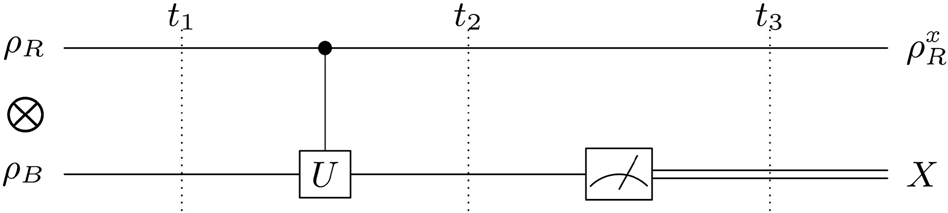
Initially, at time t1, Alice’s register R and Bob’s system B do not share any correlations. Then Alice makes a choice of the measured observable based on the state of the (possibly quantum) coin in R by performing a conditional rotation U on B. She then performs a measurement of the observable S on B to obtain the measurement outcome X. If the register R is classical, i.e. it is diagonal on the standard basis, then these two operations of Alice effectively perform a random measurement of S or T. If there is some non-zero coherence in register R, then the effective measurement can no longer be described as a random choice of one of the two observables. After that at time t3 Alice sends R to Bob. Bob then wants to guess Alice’s outcome X = x by trying to distinguish the states \(\{{\rho }_{R}^{x}\}\). Note that if R is classical, then the correlations between the two systems at time t2 can also only be classical and all the states \(\{{\rho }_{R}^{x}\}\) will be classical as well, implying that the optimal measurement of Bob corresponds to simply checking which one of the two observables Alice has chosen to measure. If R contains coherence, then quantum correlations between the two registers can arise at time t2 and Bob can better distinguish the states \(\{{\rho }_{R}^{x}\}\) by performing a measurement that takes this coherence into account. Figure taken from7 with modifications under the licenses/CC BY 3.0 https://creativecommons.org/licenses/by/3.0/.
