
Fig. 2: 3D volume reconstruction of fixed fluorescent samples.
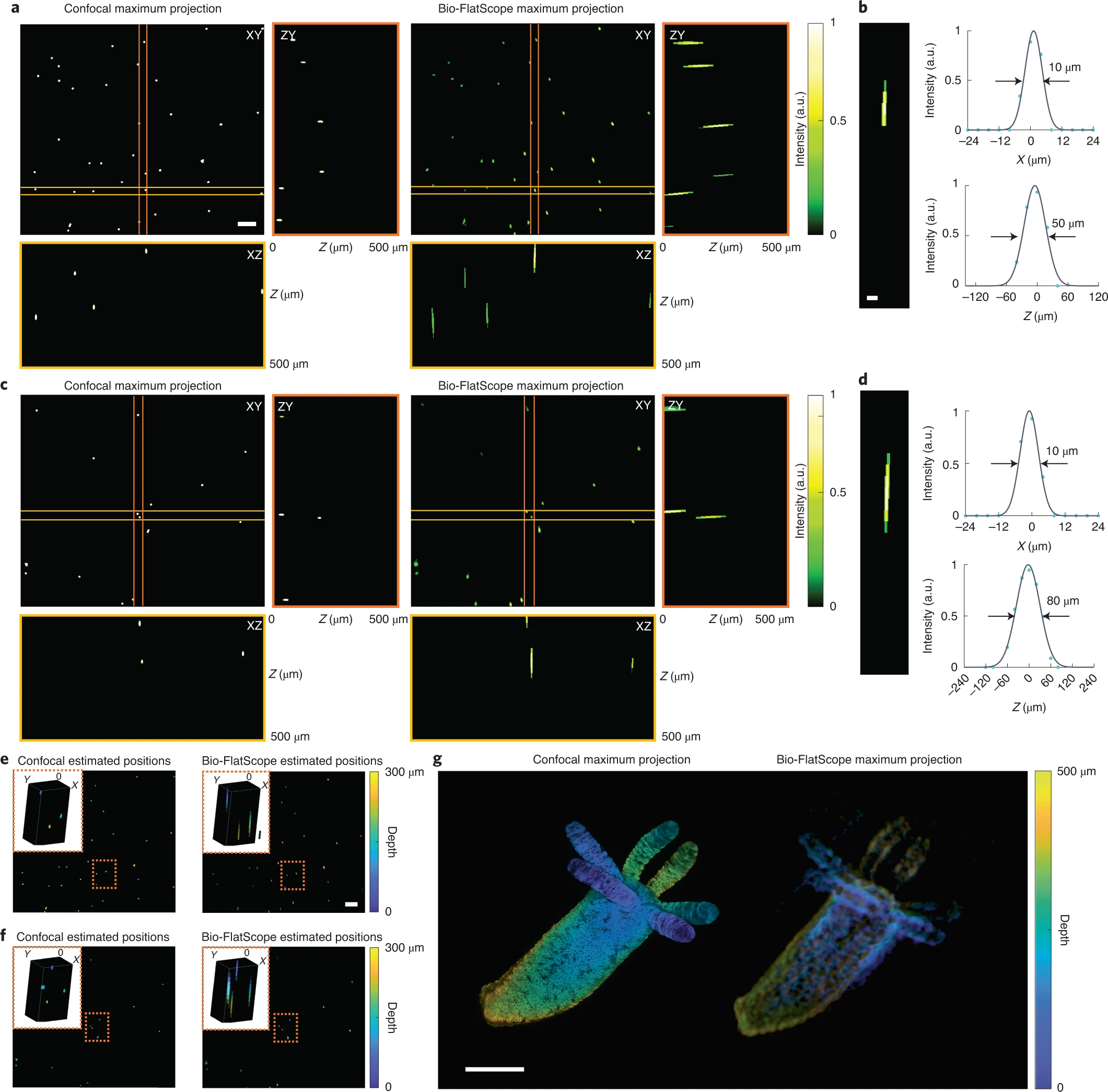
a, Bio-FlatScope reconstruction in non-scattering media as a maximum intensity projection along the Z axis as well as a ZY slice and an XZ slice, compared with the ground truth captured by confocal microscopy (×10 objective). Scale bar, 100 μm. b, Axial (XZ) profile (left), and corresponding X (top right) and Z (bottom right) profiles of a reconstructed bead in non-scattering media, showing lateral and axial resolution, respectively. Scale bar, 20 μm. c, Bio-FlatScope reconstruction in scattering media as a maximum intensity projection along the Z axis as well as a ZY slice and an XZ slice, compared with the ground truth captured by confocal microscopy (×10 objective). Scale bar the same as in a. d, Axial (XZ) profile (left), and corresponding X (top right) and Z (bottom right) profiles of a reconstructed bead in scattering media, showing lateral and axial resolution, respectively. Scale bar the same as in b. e, Depth-color-coded maximum projection of Bio-FlatScope reconstruction in non-scattering media, compared with the ground truth captured by confocal microscopy (×10 objective). Scale bar, 100 μm. Zoom-in shows a 3D volume of a selected area. Scale bar, 20 μm (Z axis). f, Depth-color-coded maximum projection of Bio-FlatScope reconstruction in scattering media, compared with the ground truth captured by confocal microscopy (×10 objective). Scale bar the same as in e. g, Depth-color-coded maximum projection of Bio-FlatScope reconstruction of a fixed Hydra sample, compared with the ground truth captured by confocal microscopy (×10 objective). Scale bar, 500 μm.
