
Fig. 3: Ithaca’s outputs.
From: Restoring and attributing ancient texts using deep neural networks
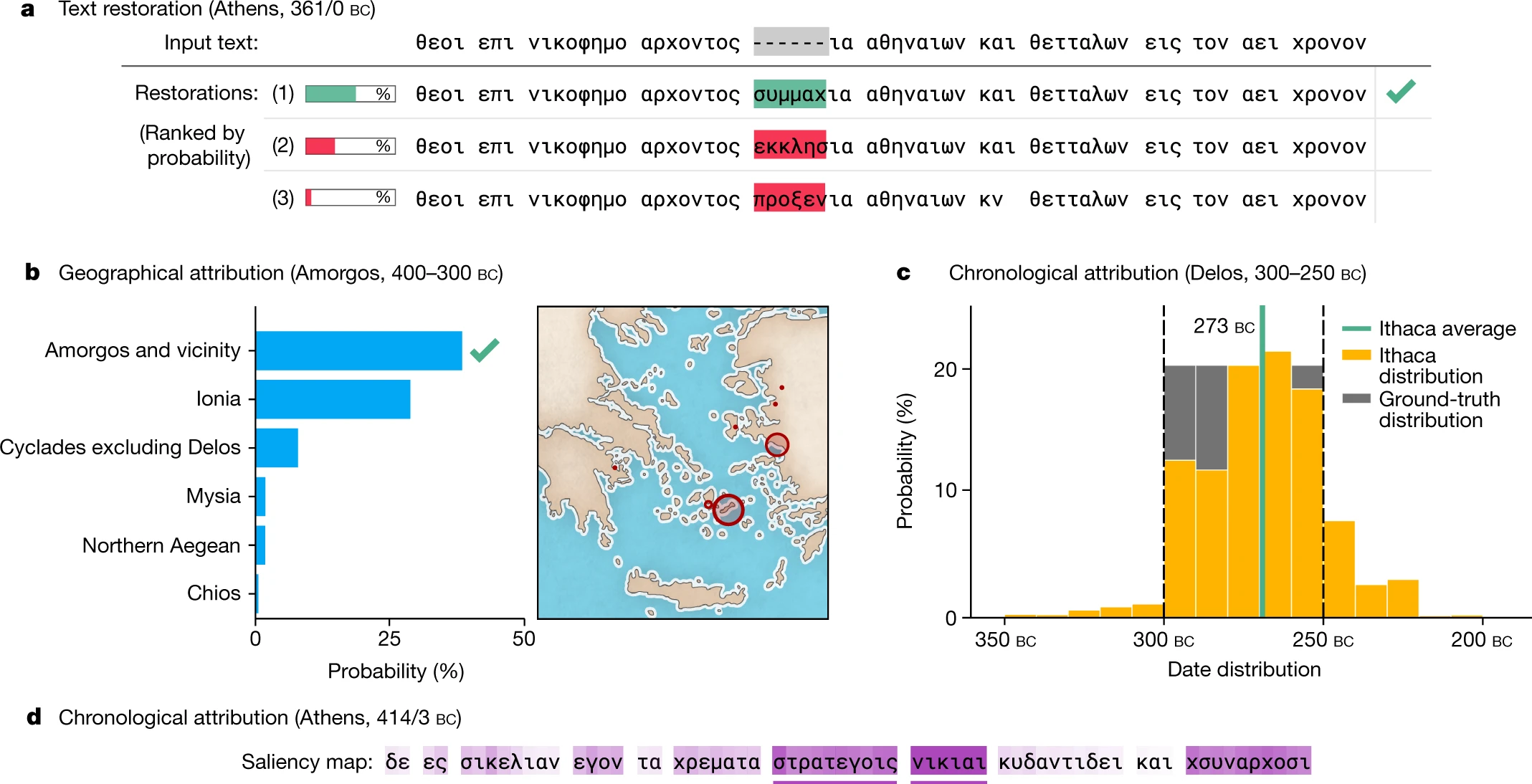
a, Restoration predictions for six missing characters (dashes) in an Athenian inscription (IG II² 116). The top restoration, in green, is correct (συμμαχία, ‘alliance’). Note how the following hypotheses (ἐκκλησία, ‘assembly’; and προξενία, ‘treaty between state and foreigner’), highlighted in red, typically occur in Athenian political decrees23, revealing Ithaca’s receptivity to context. b, Geographical attribution of an inscription from Amorgos (IG XII 7, 2). Ithaca’s top prediction is correct, and the closest predictions are neighbouring regions. c, Date distribution for an inscription from Delos (IG XI 4, 579). The ground-truth date interval 300–250 bc is shown in grey; Ithaca’s predicted distribution is shown in yellow and has a mean at 273 bc (green). Ithaca’s predictions show a higher confidence for the interval’s higher date margin, therefore potentially narrowing the broad ground-truth dating bracket. d, Chronological attribution saliency map for an Athenian inscription (IG I³ 371). The colour intensity illustrates the importance of each input. Ithaca focuses on the personal name (Νικίας, ‘Nikias’) and the Greek commanders’ rank (στρατεγοίς, ‘generals’). Nikias had a key role in the great Athenian expedition to Sicily24,25,26, the historical event to which this very inscription pertains. Ithaca dates the inscription to 413 bc, matching the exact range proposed by historians (414–413 bc).
