
Fig. 1: Spatial and temporal patterns of wood δ15N and N deposition across Sweden.
From: Rising atmospheric CO2 reduces nitrogen availability in boreal forests
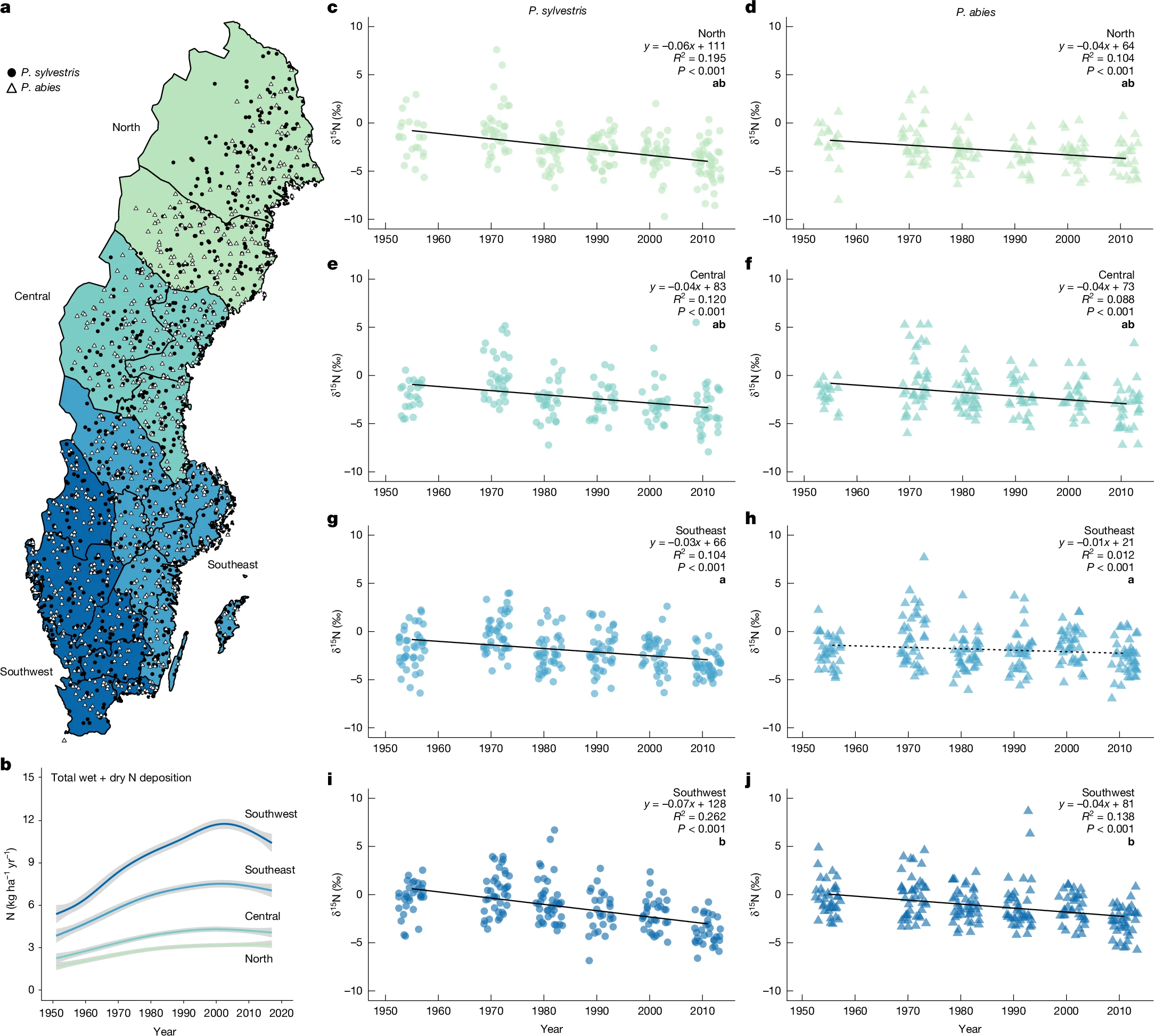
a, Spatial distribution of independent samples (n = 1609) across 4 Nr deposition regions spanning Sweden’s north–south gradient, representing increasing deposition rates from lowest (north) to highest (southwest). b, Temporal change in total wet plus dry N deposition (kg ha−1 yr−1) for samples across the regions. c–j, Temporal linear regression trends in stemwood δ15N (‰) for P. sylvestris (c,e,g,i) and P. abies (d,f,h,j) from 1951 to 2017 in each of the Nr deposition regions: north (c,d), central (e,f), southeast (g,h) and southwest (i,j). All relationships are significant (P < 0.001) except for P. abies in the southeast region (h), where the non-significant relationship is shown as a dashed line. Lowercase bold letters in c–j denote significant differences in regression slopes among regions, within each species (α = 0.05). Shading in b indicates the 95% confidence interval. A small horizontal offset was applied to time plots c–j to increase the visibility of points (see ‘Statistical methods’). Data sources are cited in Methods. Sweden boundary map in a from Lantmäteriet under a Creative Commons licence CC0 1.0.
