
Extended Data Fig. 8: Adhesion of Long COVID PBMCs to human brain endothelial cells.
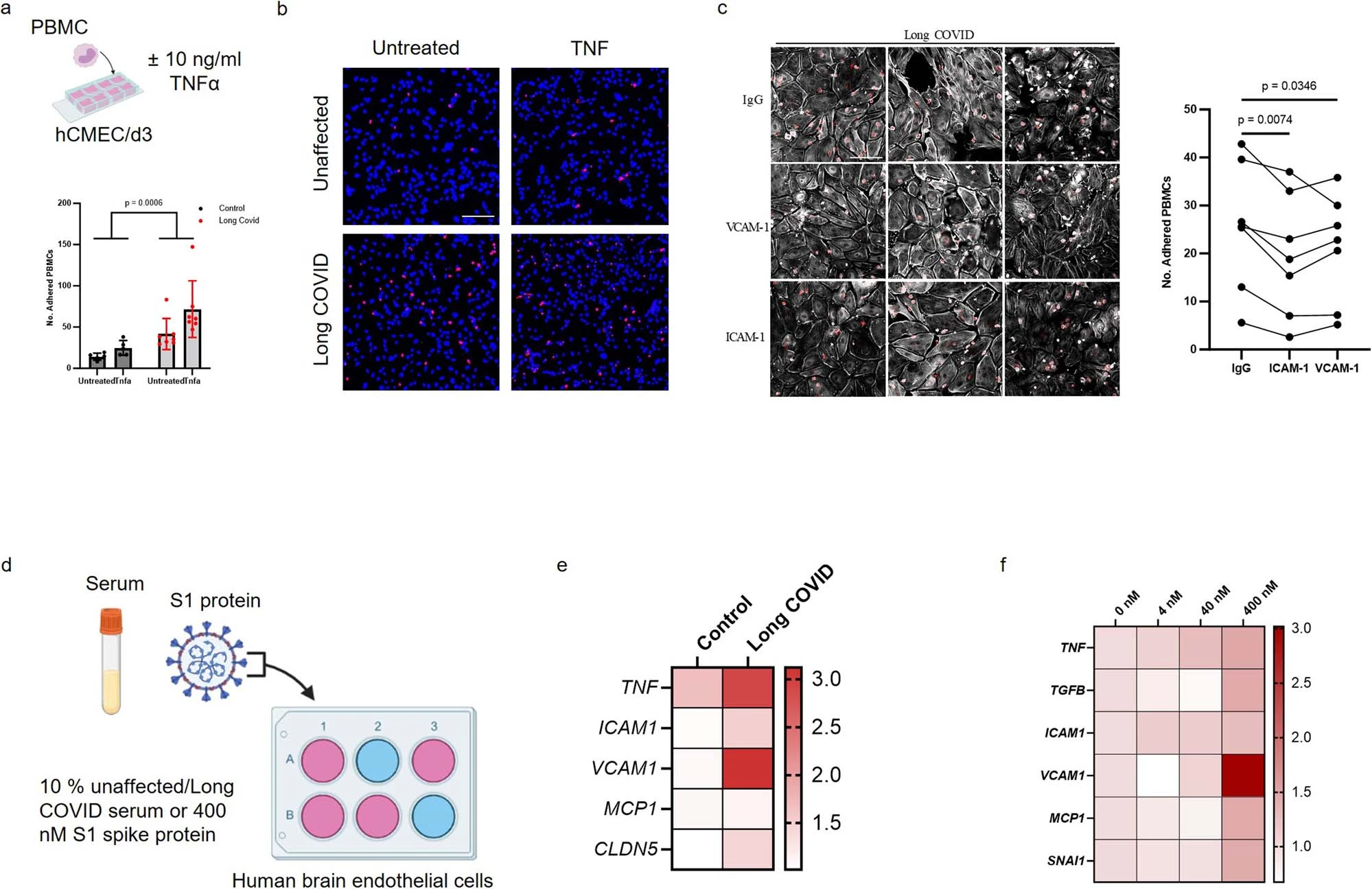
a, b) Peripheral blood mononuclear cells (PBMCs) from Long COVID participants show greater adherence to the human brain endothelial cell line, hCMEC/d3, in the presence or absence of 10 ng/ml TNFa (n = 5 Control, n = 7 Long COVID). Error bars are mean ± s.d. Data in a was analysed by two-way ANOVA with Tukey correction. Each datapoint represents one patient. c) PBMCs from long COVID patients in the presence of IgG, VCAM-1 or ICAM-1 blocking antibodies (n = 6 long COVID patients). Data was analysed by repeated measures one-way ANOVA with Tukey correction for multiple comparisons. Each datapoint represents one patient. d) Schematic of experiments to assess the effect of long COVID patient serum or spike protein on human brain endothelial cells. e) Exposure of hCMEC/d3 cells to 10 % serum from healthy or long COVID participants and quantification of gene expression changes by q-RT-PCR. Long COVID serum significantly increased TNF (P = 0.0006) and VCAM1 (P < 0.0001) vs control serum. f) Exposure of hCMEC/d3 cells to vehicle or 4, 40 or 400 nM S1 spike protein and quantification of gene expression changes by q-RT-PCR. 400 nM S1 spike protein significantly increased TNF (P = 0.024), TGFB1 (P = 0.0274), VCAM1 (P < 0.0001), MCP1 (P = 0.0269) and SNAI1 (P = 0.0389) vs vehicle. For e, n = 4 healthy serum samples and n = 8 long COVID serum samples were used. Scale bar – 50 µm. Schematics in a and d created with BioRender.com.
