
Fig. 4
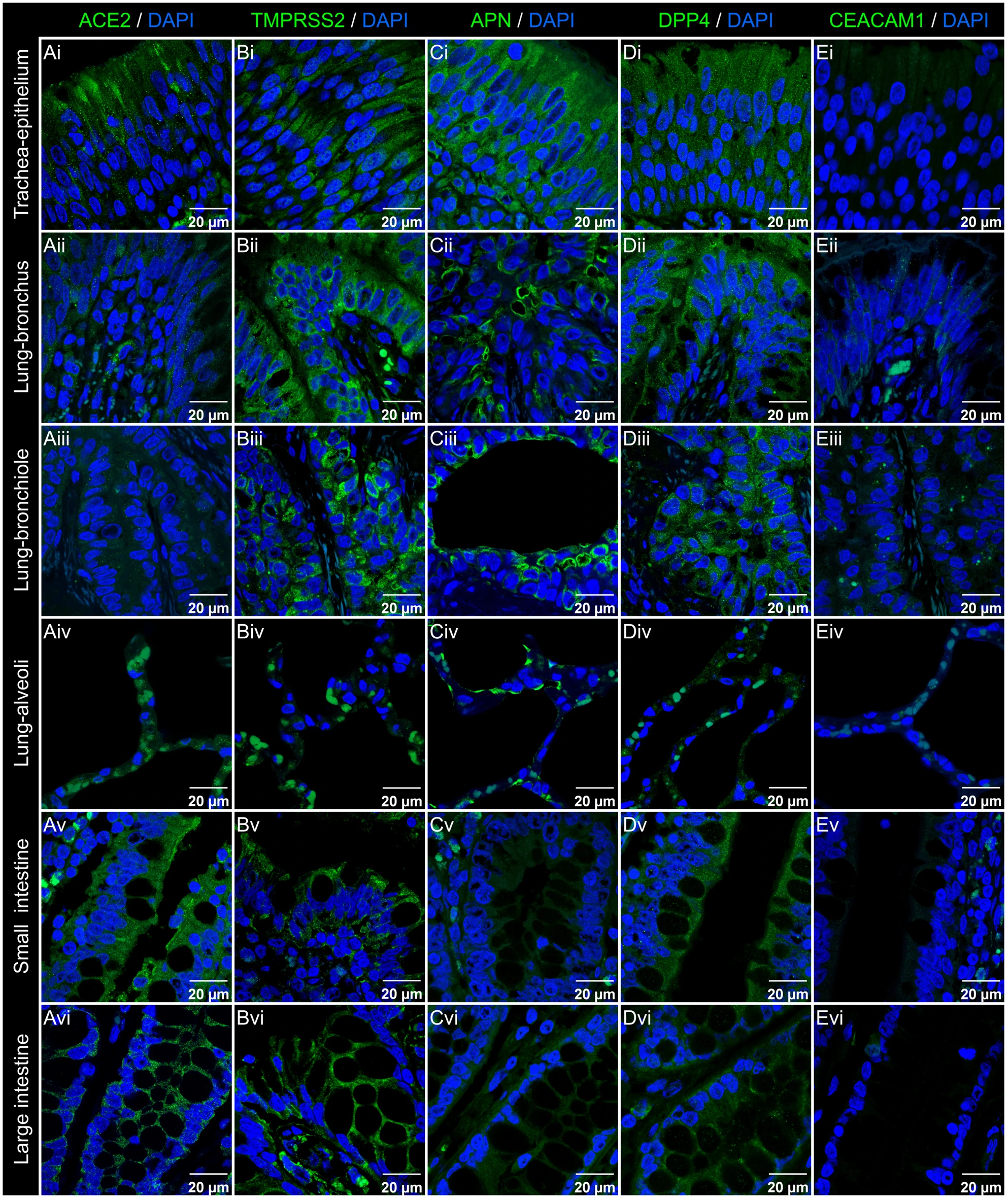
Coronavirus receptors in the respiratory tract and intestinal tracts of beef cattle. Confocal images showing angiotensin-converting enzyme 2 (ACE2, A), transmembrane protease serine 2 (TMPRSS2, B), aminopeptidase N (APN, C), dipeptidyl peptidase 4 (DPP4, D), and carcinoembryonic antigen-related cell adhesion molecule 1 (CEACAM1, E) expression following immunofluorescence staining. Primary antibodies, ACE2 (4 µg/ml, Cat# sc-390851), TMPRSS2 (0.2 µg/ml; Cat# sc-515727), APN (0.16 µg/ml; Cat# sc-166105), CEACAM1 (4 µg/ml; Cat# sc-166453), and DPP4 (1:50 dilution; Cat# BOV2078, Washington State University Monoclonal Antibody Center, Pullman, WA, USA); Secondary antibody, AffiniPure™ Donkey Anti-Mouse IgG (H + L) conjugated Alexa Fluor® 488 (15 µg/ml; Cat# 715-545-150). Blue represents nuclear staining using DAPI; scale bar = 20 µM. Representative images of coronavirus receptor expression across tissues are shown. The epithelial lining of the trachea (Ai), alveoli (Aiv), small intestine (Av), and large intestine (Avi) showed strong ACE2 expression compared to the bronchus (Aii) and bronchiole (Aiii). The respiratory epithelium showed extensive TMPRSS2, APN, and DPP4 expression with a multifocal expression on the alveoli (Bi–iv, Ci–iv, Di–iv). TMPRSS2 (Bv–vi) and DPP4 (Dv–vi) were detected uniformly on villi and crypt regions in the small and large intestine epithelia, while APN levels were comparatively low in both intestines (Cv–vi). With the exception of the bronchus (Eii) and bronchiole (Eiii), the levels of CEACAM1 were low to no detection on the epithelia of all the tissues assessed (Ei, Eiv–vi).
