
Fig. 1: Red-light cardiac control in Drosophila expressing ReaChR or NpHR.
From: Non-invasive red-light optogenetic control of Drosophila cardiac function
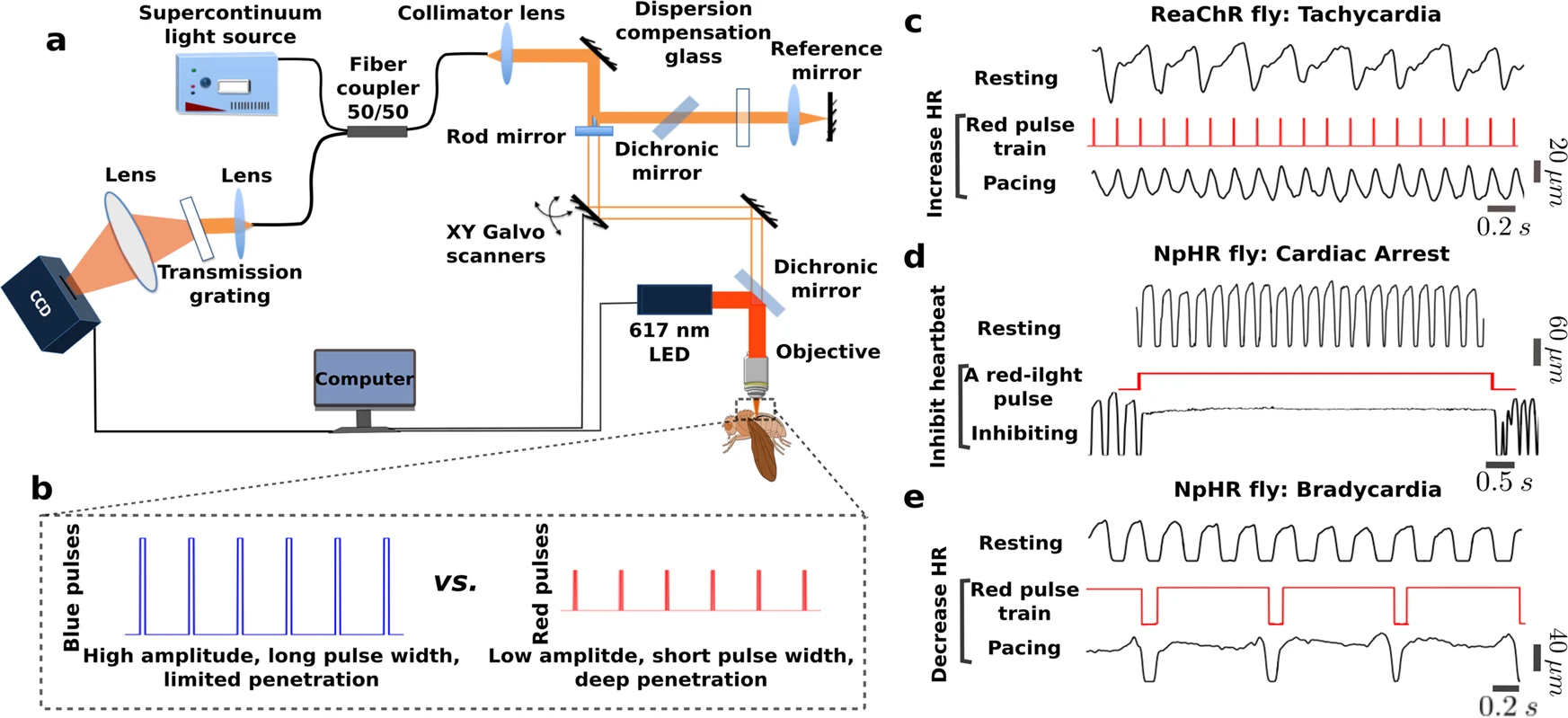
a Schematic illustration of the integrated red-light stimulation and OCM imaging system. b Comparison of red-light and blue-light pulses, showing that red light has a lower amplitude, shorter pulse width, and deeper penetration depth for achieving cardiac pacing in Drosophila melanogaster. c–e Three pacing strategies for red-light cardiac control. For each strategy, the upper trace shows the heart pulse change with time in the axial direction during rest. The middle trace shows the red-light pulse used for cardiac stimulation, and the lower trace shows heart pulse change with time in the axial direction with optical excitation. c The heart pulse changes with time show an increasing heart rate (HR), mimicing tachycardia through red-light pacing of a ReaChR fly. d Heart diameter changes with time to indicate inhibition of NpHR fly cardiac function for 10 s to mimic cardiac arrest through red-light excitation. e Heart pulse changes with time to demonstrate decreasing HR of a NpHR fly to simulate bradycardia through red-light excitation.
