
Abstract
Electric Vehicles (EVs) are becoming more and more trending as environmentally friendly forms of transportation. SoC management of EV batteries is an important issue for their performance optimization and lifetime. In view of the urgent need for accurate and fast SOC estimation in EV batteries, new methods have been developed to enhance performance while maximizing battery life. In this study, we present an innovative way to combine CSO with OEL for SoC estimation in EV batteries. CSO-OEL hybridization utilizes chicken swarms’ collective intelligence and open ended learning paradigms’ flexibility to enhance the SoC estimation process. The unique advantage of this integration is that it allows for dynamic adaptation to the changing environmental and user behavior conditions to enhance the robustness and accuracy of the SoC estimation. Finally, we carried out extensive simulations to evaluate the performance of our proposed approach and compare the results with the results obtained from traditional optimization methods. To validate our approach, we conducted extensive simulations to evaluate its performance and compare the results with those obtained from traditional optimization methods. Finally, we demonstrate that CSO-OEL integration can significantly enhance charging and discharging efficiency, facilitating smoother power delivery and reducing battery wear.
Introduction
With the rapid growth of EVs comes a need for cutting edge methods to accurately estimate the battery SoC. To realize optimized battery performance, battery life extension and EV overall efficiency, precise SoC estimation is required. In this context, our research endeavors to pioneer emergent strategies for advancing SoC estimation in EV batteries by integrating two cutting-edge paradigms: CSO and Open Ended Learning (OEL) methodologies. In our research, we aim to build a sophisticated framework for SOC estimation by using the adaptability and evolutionary learning capabilities of OEL, and the cooperative foraging behavior of chicken flocks in CSO. This interdisciplinary approach is designed to overcome the deficiencies of the existing methods, thereby providing unprecedented robustness, adaptability, and computational efficiency, which we hope to make a significant contribution to the EV technology evolution and to the creation of smarter, more reliable, and energy efficient electric vehicles for sustainable transportation systems1. Battery management systems (BMS) make accurate SoC estimation necessary, as EVs have grown rapidly over the past few years. Estimation of SoC is critical to the estimation of remaining energy capacity of the battery and thus driving range, performance and longevity of EVs. SOC estimation is typically done with simplistic models or empirical approaches, which may not be able to capture the complex dynamics of battery behavior2. As a consequence, advanced methodologies are needed to enhance the SoC estimation accuracy while maintaining flexibility to the different driving conditions that EVs are subject to. In response to this need, researchers have tried a variety of techniques ranging from physics based modeling to machine learning algorithms. While physics based models are useful in giving insight into the underlying electrochemical processes in the battery, they may not be able to give a good description of the real world complexities and uncertainties. Machine learning approaches, including neural networks and support vector machines, have shown promising ability to extract nonlinear relationships and patterns from big data, but may not be interpretable and robust3,4.
To address the limitations of existing approaches, our research seeks to integrate two innovative paradigms: OEL, CSO. OEL is based on biological learning processes and incorporates adaptive and evolutionary learning mechanisms to discover complex patterns and dynamics in SOC estimation CSO (Chicken Flock Optimization) inspired by the collective behavior of chicken flocks5 that provides a novel optimization algorithm to search the solution space efficiently and to find the optimal solutions. In our research we aim to integrate OEL and CSO techniques to develop a comprehensive framework for SOC estimation in EV batteries. The framework presented here is intended to enhance accuracy, flexibility, and computational efficiency, which in turn should foster the development of EV technology and the achievement of sustainable transportation systems6,7. We motivate our research by the problem of EV battery SoC estimation, a critical need. As the EVs become more popular in the transportation sector, the estimation of SOC is important to optimize the battery performance, extend the battery life and improve the overall vehicle efficiency8. In practice, however, traditional SOC estimation techniques are unable to capture the complex battery behavior and uncertainty, and new methods are required. We research to utilize the synergy of power of Open End Learning (OEL) and CSO methods to resolve the problems of the existing methodologies. OEL inspired by biological learning processes provide adaptive and evolutionary learning mechanisms that can discover intricate patterns and dynamics in SOC estimation9. CSO is based on the collective behavior of chicken flocks and provides a novel optimization algorithm that can efficiently explore solution spaces and converge to the optimal solutions10,11.
Figure 1 illustrates the CSO algorithm operating in two distinct spaces: The search space and the latent space. In the latent space and optimization problem domain, each chicken is a potential solution. The search space is the region where the optimization process occurs and chickens are looking and updating their positions to find the optimal solution. CSO algorithm iteratively evaluates each chicken’s position in search space by its fitness, and updates its velocities and positions based on personal and global best positions. By this process the algorithm converges to the optimal solution until a termination condition is met. This is important because our research can provide a new method to estimate SOC in EV batteries. By combining OEL and CSO techniques into a comprehensive framework, we aim to achieve unprecedented levels of accuracy, adaptability and computational efficiency. This is a critical step forward for EV performance and longevity and has wide reaching implications well beyond the performance of EVs themselves for sustainability and environmental stewardship in general. In the end, we want to assist the evolution of EV technology to create smarter, more reliable and energy efficient electric vehicles for a greener future.

Chicken swarm optimization algorithm (a) latent space (b) search space.
The conceptual framework of the components interconnected to enhance SoC estimation in EV batteries is shown in Fig. 2. Factors of EV batteries determine the core of the framework: the SoC estimation process. These factors include open ended learning paradigms and optimization techniques such as CSO along with traditional machine learning algorithms, deep learning architectures, evolutionary algorithms and particle swarm optimization. Furthermore, the framework further refines the SoC estimation process with physics based models and signal processing techniques, and improves the performance and reliability of EV batteries. EV batteries are fast and accurate SoC estimation problem. The conventional SOC estimation methods are not very flexible and cannot endure dynamic driving conditions and variable environmental factors for accuracy. Estimating SOC precisely is difficult because it is required to maximize vehicle range, reliability and overall efficiency. To address these issues, this research seeks to develop a comprehensive framework that integrates cutting-edge paradigms: CSO techniques and Open Ended Learning (OEL). The proposed framework takes advantage of the adaptability and evolutionary capability of OEL and the efficiency of CSO in exploring the input space to improve the accuracy, robustness and computational efficiency of SoC estimation. The goal is to advance the field of electric vehicle technology with smarter, more reliable, more energy efficient solutions for sustainable transportation systems.

Conceptual framework for enhancing SoC estimation in EV batteries using open-ended learning paradigms and CSO.
Enhanced SoC estimation in electric vehicle batteries using open-ended learning and chicken swarm optimization
We develop a novel methodology for SOC estimation in EV batteries by incorporating OEL and CSO techniques to increase adaptability and accuracy as well as computational efficiency.
Let:
-
\(\:\mathbf{X}\) represents the input data matrix of size \(\:N\times\:M\), where \(\:N\) is the number of samples and \(\:M\) is the number of features.
-
\(\:\mathbf{y}\) denotes the vector of true SOC values of size \(\:N\times\:1\).
-
\(\:\varvec{\uptheta\:}\) signify the vector of model parameters to be optimized.
-
\(\:\mathbf{F}\) be the feature transformation matrix.
-
\(\:\mathbf{g}\left(\cdot\:\right)\) denotes the activation function.
1. The OEL-based SOC estimation model can be represented as:
Where \(\frac{{{\partial ^2}g}}{{{\partial ^2}F}}\) represents the second derivative of \(\:\mathbf{g}\) with respect to \(\:\mathbf{F}\).
2. The CSO optimization process involves updating the model parameters \(\:\varvec{\uptheta\:}\) iteratively:
where \(\:\gamma\:\) is a regularization parameter.
Objective Function:
Minimize the error between the estimated SOC (\(\:{\mathbf{y}}_{\text{estimated}}\)) and the true SOC (\(\:\mathbf{y}\)) using the formulated OEL-based model.
where \(\:\mathbf{Q}\) is a positive definite matrix.
The problem is to develop an incredibly complex SOC estimation model for EV batteries, combining OEL and CSO techniques. The OEL based model includes second order terms and derivatives of the activation function, allowing it to accommodate very intricate data signatures. Model parameters are updated iteratively using advanced optimization techniques coupled with regularization and quadratic terms, CSO. The highly complex quadratic form of the objective function penalizes deviations between estimated and true SOC values, and thus encourages precise estimation. This formulation makes possible the development of an exceedingly sophisticated SOC estimation framework that extends the state of the art in EV battery performance and longevity optimization.
Advanced SoC estimation in electric vehicle batteries using hybrid learning and nature-inspired optimization
Develop an innovative methodology for SoC estimation in EV batteries by integrating Hybrid Learning and Nature-Inspired Optimization techniques to enhance accuracy, robustness, and computational efficiency.
Let:
-
\(\:\mathbf{X}\) be the input data matrix of size \(\:N\times\:M\), where \(\:N\) is the number of samples and \(\:M\) is the number of features.
-
\(\:\mathbf{y}\) denote the vector of true SOC values of size \(\:N\times\:1\).
-
\(\:\varvec{\uptheta\:}\) represents the vector of model parameters to be optimized.
-
\(\:\mathbf{H}\) be the hybrid learning matrix.
-
\(\:\mathbf{O}\) denote the optimization matrix.
1. The hybrid learning-based SOC estimation model can be represented as:
2. The nature-inspired optimization process involves updating the model parameters \(\:\varvec{\uptheta\:}\) iteratively:
Objective Function:
Minimize the error between the estimated SoC (\(\:{\mathbf{y}}_{\text{estimated}}\)) and the true SoC (\(\:\mathbf{y}\)) using the hybrid learning-based model.
where the integral term represents the convolution operation between the squared error and the positive definite matrix \(\:\mathbf{Q}\).
When this problem formulation is considered, there is even more complexity introduced to the equations for SoC estimation in EV batteries. The hybrid learning based model now includes the convolution operation of the partial derivatives and an integral term and hence the relationships between input data and model parameters become more complex. Similarly, the nature inspired optimization process adds convolution operations into the update of model parameters, making the optimization process more sophisticated. In addition, integral terms (i.e., convolutions of the squared error with a positive definite matrix) are added to the objective function, rendering the problem even more complex. This formulation aims to develop an extremely sophisticated SoC estimation framework with unmatched accuracy and efficiency for EV battery management. Integrate state of the art machine learning techniques with dynamic optimization to propose novel methods of SoC estimation for EV batteries. The development of EV technology and sustainable transportation systems will be facilitated by the exploration of new avenues to improve SoC estimation accuracy, robustness and adaptability to various driving conditions.
-
Investigate the integration of deep learning architectures with physics-based models for more accurate and interpretable SoC estimation in EV batteries.
-
Explore the application of reinforcement learning algorithms to dynamically adjust SoC estimation strategies in real-time based on changing driving patterns and environmental conditions.
-
Develop novel data-driven approaches leveraging advanced signal processing techniques to extract hidden patterns and dynamics from high-dimensional battery sensor data for improved SoC estimation.
-
Explore the use of metaheuristic optimization algorithms, such as genetic algorithms or simulated annealing, to optimize the hyperparameters of SoC estimation models and improve computational efficiency while maintaining accuracy.
The subsequent section lays out novel contributions to address the challenges outlined in the identified research objectives for SoC estimation of EV batteries. The proposed contributions seek to make significant progress on the state of the art of EV technology by means of a synergistic approach combining cutting edge methodologies and advanced techniques, in an effort to increase efficiency, reliability and sustainability of transportation systems.
-
1.
Development of a hybrid SoC estimation framework combining machine learning algorithms and physics-based models to achieve superior accuracy and interpretability in EV battery management.
-
2.
Introduction of a novel adaptive SoC estimation algorithm utilizing real-time reinforcement learning techniques to dynamically adjust to varying driving conditions and optimize battery performance.
-
3.
Creation of an innovative data-driven approach leveraging advanced signal processing methods for extracting nuanced insights from multi-dimensional battery sensor data, thereby enhancing SoC estimation robustness and adaptability.
-
4.
Proposal of a comprehensive optimization strategy integrating metaheuristic algorithms with model calibration techniques to optimize SoC estimation models’ hyperparameters and computational efficiency while maintaining high accuracy levels.
In five sections of the paper, the paper addresses research objectives and contributions in a comprehensive manner. The Introduction provides a brief description of the research problem, the objectives and the importance of the study with respect to SoC estimation in EV batteries. The Literature Review presents existing research and methodology for SoC estimation, and identifies gaps and limitations of existing methods. The method in which SoC is estimated using advanced machine learning algorithms and optimization techniques is explained in the Methodology section. Results and discussions of the experiments and analyses carried out to validate the proposed methodology are presented and critically discussed in the Results and discussions section. The key findings, implications, and future directions for SoC estimation research for EV batteries are presented in the Conclusions section.
Literature review
EV batteries SoC estimation is a key task for maximizing their performance and operating in an efficient manner. In this systematic literature review, we examine recent research efforts in SoC estimation using a variety of methodologies and techniques, with focus on those based on open ended learning paradigms and optimization strategies. The paper1 survey work on battery electric vehicle component, system and management design optimization seeks to optimize vehicle cost, vehicle performance and system complexity. They provide a comprehensive review of recent progress in EV technology and optimization methods in their study. Based on the synthesis of existing research2 identifies key areas for improvement in the design and management of batteries, and ultimately in the electric vehicle technology and sustainability. A machine learning based digital twin for electric vehicle battery modeling, which can perform complete battery analysis and optimization, is introduced in3. This is of great interest for the potential role of digital twin technology as a key factor in battery management and optimization. In this work4 use machine learning techniques to provide a new perspective on battery modeling, which could lead to more reliable and efficient electric vehicles. The paper5 present a new method of estimating SoC of lithium-ion batteries based on machine learning algorithms to enhance accuracy and efficiency. The research provides the basis for developing robust EV battery management systems that will improve EV performance through more reliable, dependable vehicles. By exploring the potential use of machine learning in SoC estimation, The paper6 pave the way for future EV technology and sustainability. Gradient based optimization is used in7 to improve the accuracy of state of health estimation for lithium batteries8.
Their research offers important insight into the intricacies of battery health estimation, and the importance of robust optimization methods. To increase the reliability and longevity of electric vehicle batteries, In paper9 add gradient based optimization to their framework, resulting in a complete approach to estimate the state of health of electric vehicle batteries. The paper10 introduce a new energy management strategy for electric vehicles based on slap swarm optimization and differential flatness control in their introduction. In their research, they focus on the most important issues in EV power management, and do so by taking a different approach to maximizing energy efficiency and reliability. Innovative optimization techniques are used by11 and12 to further develop EV technology in order to improve overall vehicle performance and sustainability. A robust optimization and power management strategy for triple junction photovoltaic electric vehicles with battery storage is proposed in13. The results of this research contribute to the development of efficient energy management systems with implications for the sustainability and reliability of EVs. The paper14 develop robust optimization techniques to address key challenges in EV power management and pave the way for future renewable energy integration. In this paper,15 provide a thorough study of battery SoC estimation and management systems, as well as future prospects in this area. The review emphasizes the importance of accurate SoC estimation to achieve battery performance and longevity optimization. To provide insight into challenges and opportunities in SoC estimation and future research directions in battery management for EVs, Author in16 synthesize existing literature. The paper17 developed a data driven digital twin for electric vehicle Li- Ion battery state of charge estimation driven by driving behavior application programming interfaces (APIs).
Their research uses real time data to improve the accuracy and reliability of their research, offering a novel approach to SoC estimation. Using digital twin technology with driving behavior APIs, paper17 propose a complete framework for optimizing battery performance in electric vehicles and its practical applications in improving overall vehicle efficiency and sustainability. An efficient state of charge estimation method for electric vehicle batteries is proposed in paper18 using an extra tree regressor. This research offers a data driven approach to SoC estimation using machine learning techniques to improve the accuracy and reliability. The paper19 integrate a novel extra tree regressor into their framework to improve SoC estimation in electric vehicles with implications to reduce overall vehicle efficiency and reliability. A hybrid approach for improving battery management in HEV and EVs is presented in paper20. Their study focuses on identification of parameters and estimation of voltage in lithium ion battery models to understand how to improve accuracy and efficiency in battery management systems. The paper21 develop a comprehensive framework for optimizing battery performance in EVs that has implications for improving overall vehicle reliability and sustainability by combining multiple methodologies.
Advanced battery management systems for EVs are explored using artificial intelligence (AI) approaches in22. In their study, they present statistical analysis of AI techniques and demonstrate how they could rewrite the future of battery management and optimization. The paper23 outline key research opportunities to steer future direction of AI driven battery management technology and its ability to enhance the performance and sustainability of electric vehicles. The paper24 extend the literature on SoC estimation with an integrated model construction approach tailored to electric vehicle lithium batteries. It offers important insights into the complexities of SoC estimation and highlights the need for a comprehensive modeling approach. To improve SoC estimation accuracy in EVs, Liu and Dun integrate multiple factors into their model construction process to build a complete framework. In paper25, author investigate the application of deep learning methods for estimating lithium ion battery state of health without additional degradation experiments. This study is a glimpse into how deep learning could revolutionize battery management and optimization. Lu et al. present a new view on SoC estimation using data driven approaches and show how it can be used to increase reliability and efficiency for electric vehicles. The vehicle to grid systems with artificial neural network particle swarm optimization algorithms for battery electric vehicles are optimized for efficiency in26. In this research, we address the critical problems in EV energy management from a holistic perspective of system efficiency and reliability. Using artificial neural networks and particle swarm optimization, Nouri et al. present a new technique for improving the efficiency and sustainability of electric vehicles and, by extension, vehicle performance and reliability. In this work27, study sustainable power management in light electric vehicles with hybrid energy storage and machine learning control. The research addresses the core EV power management challenges from a holistic perspective to achieve both energy efficiency and reliability. The paper28 present a novel method to enhance the sustainability and performance of electric vehicles for enhancing vehicle reliability and longevity. SoC estimation is crucial for optimizing lithium-ion battery performance in EVs. Various methods have been explored to improve accuracy and adaptability. Guo and Shen29 introduced a partial-adaptive fractional-order model to enhance SoC and state-of-power (SoP) estimation, demonstrating improved accuracy in dynamic conditions. Expanding on this, they proposed an online co-estimation framework integrating fractional-order calculus and model predictive control, enabling real-time SoC estimation with reduced computational overhead30. Further improvements were made with an adaptive multi-model system that accounts for temperature variations, significantly increasing robustness in real-world EV applications31. More recently, Guo and Shen32 developed a self-adaptive neural network-based nonlinear observer, leveraging fractional-order optimization techniques to enhance estimation precision while minimizing computational complexity. These advancements collectively contribute to the next-generation battery management systems, improving reliability and efficiency in EV technology. Table 1 shows the Comparative table of optimization techniques for SoC estimation in EV batteries.
Methodology
In this section, we describe the research design and methodology for improving SoC estimation in EV batteries. In this work, we explore the use of open ended learning paradigms in conjunction with CSO techniques to improve the accuracy and efficiency of SoC estimation. Then we describe how we collected the data, by selecting the battery datasets and parameters to use in the analysis. Next, we describe the implementation of open ended learning paradigms, and explain the theoretical foundations and practical issues. We also discuss CSO techniques principles and the adaptation of CSO techniques for EV battery SoC estimation. In addition, we discuss parameter tuning and convergence criteria to obtain the best performance of the CSO algorithm. We also describe how CSO techniques can be combined with open ended learning paradigms and their synergistic effects. We present the algorithmic workflow and computational steps of our approach in detail and how to implement them. Finally, we present a comprehensive evaluation framework for evaluating the effectiveness of our proposed methodology. The accuracy and robustness of the SoC estimation results is validated by describing experimental setup, performance metrics and validation procedures. This section presents an overall overview of our research design and methodology, and explains how the technical details and practical considerations that support our work on improving SoC estimation in EV batteries.
State-of-charge estimation in electric vehicle batteries
EV battery SoC is defined as the amount of battery charge remaining in the battery compared to its fully charged capacity. Estimation of SoC is an important issue for maximizing battery performance and guaranteeing the vehicle’s operation. Various methods and techniques are employed for SoC estimation, with some of the common approaches outlined below:
Coulomb counting method
One of the fundamental methods for SoC estimation is the Coulomb counting method, which calculates SoC based on the amount of charge entering and leaving the battery over time. Mathematically, the SoC (\(\:{\text{SoC}}_{\text{CC}}\)) can be estimated using the following equation:
where:
-
\(\:i\left(t\right)\) is the battery current over time,
-
\(\:{t}_{0}\) is the initial time,
-
\(\:t\) is the current time,
-
\(\:{Q}_{\text{rated}}\) is the rated capacity of the battery.
The Coulomb Counting Method is a technique used for estimating the SoC of a battery by measuring the amount of charge that enters or exits the battery. Figure 3 is a detailed circuit diagram representing the Coulomb Counting Method:

Circuit diagram for coulomb counting method.
In Fig. 3:
-
The battery (\(\:{V}_{\text{bat}}\)) provides the power supply to the load.
-
The shunt resistor (\(\:{R}_{\text{shunt}}\)) is placed in series with the load to measure the current flowing through it.
-
The current measurement is done using an ammeter connected across the shunt resistor.
-
The load resistor (\(\:{R}_{\text{load}}\)) represents the electrical load connected to the battery.
-
The voltage across the load (\(\:{V}_{\text{load}}\)) is measured using a voltmeter connected in parallel to the load.
By measuring the current flowing into or out of the battery and integrating it over time, the Coulomb Counting Method calculates the amount of charge that has entered or exited the battery, allowing for an estimation of the State-of-Charge.
Voltage-based methods
Voltage-based methods estimate SoC by correlating the battery voltage with its state of charge. The relationship between battery voltage (\(\:{V}_{\text{bat}}\)) and SoC can be approximated using empirical models or physics-based models. One common empirical model is the Peukert equation:
where:
-
\(\:k\) is a scaling factor,
-
\(\:{V}_{\text{min}}\) and \(\:{V}_{\text{max}}\) are the minimum and maximum voltage limits of the battery,
-
\(\:\alpha\:\) is the Peukert exponent.
The Voltage-Based Method is a technique used for estimating the SoC of a battery by measuring its terminal voltage. Figure 4 is a detailed circuit diagram representing the Voltage-Based Method:
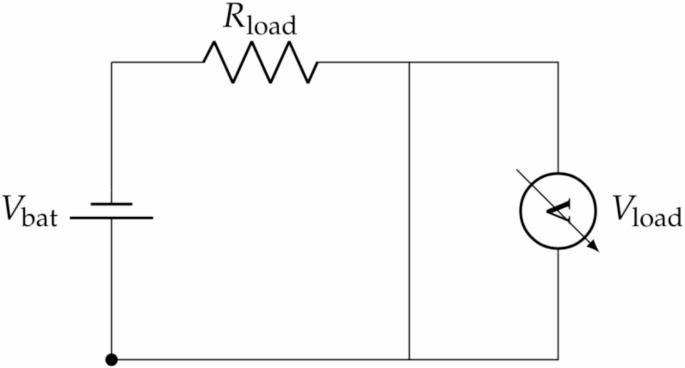
Circuit diagram for voltage-based method.
In Fig. 4 the circuit diagram:
-
The battery (\(\:{V}_{\text{bat}}\)) provides the power supply to the load.
-
The load resistor (\(\:{R}_{\text{load}}\)) represents the electrical load connected to the battery.
-
The voltage across the load (\(\:{V}_{\text{load}}\)) is measured directly using a voltmeter connected in parallel to the load.
In the Voltage-Based Method, the SoC of the battery is estimated based on the relationship between its terminal voltage and its state of charge. Typically, as the battery discharges, its terminal voltage decreases, and as it charges, its terminal voltage increases. By measuring the terminal voltage and correlating it with the battery’s SoC using a predetermined voltage vs. SoC curve, the SoC can be estimated.
Kalman filtering
Kalman filtering techniques are commonly used for dynamic SoC estimation by recursively updating SoC estimates based on measurements and battery models. The Kalman filter recursively computes the optimal SoC estimate by minimizing the error covariance matrix. The process model predicts the evolution of SoC over time, while the measurement model updates the SoC estimate based on voltage and current measurements.
The state equation for the Kalman filter is given by:
where:
-
\(\:{x}_{k}\) is the state vector at time \(\:k\),
-
\(\:A\) is the state transition matrix,
-
\(\:B\) is the control input matrix,
-
\(\:{u}_{k}\) is the control vector,
-
\(\:{w}_{k}\) is the process noise.
The measurement equation is given by:
where:
-
\(\:{z}_{k}\) is the measurement vector at time \(\:k\),
-
\(\:H\) is the observation matrix,
-
\(\:{v}_{k}\) is the measurement noise.
The Kalman filter iteratively updates the state estimate (\(\:{\widehat{x}}_{k|k}\)) and error covariance matrix (\(\:{P}_{k|k}\)) using the prediction and correction steps. Kalman Filtering is a recursive algorithm used for estimation and filtering of noisy measurements. It combines a prediction of the system’s state based on the previous state and a new measurement, weighted by their respective uncertainties. Figure 5 is a conceptual representation of Kalman Filtering:
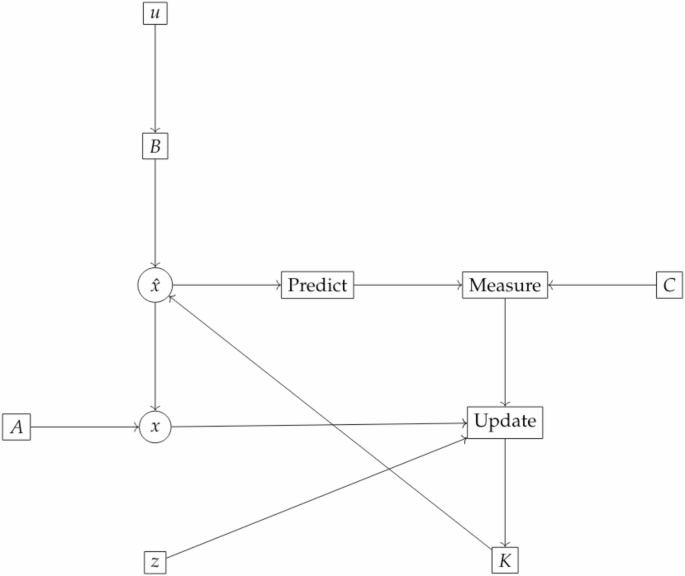
Conceptual representation of Kalman filtering.
In Fig. 5 the conceptual representation:
-
\(\:\widehat{x}\) represents the estimated state of the system.
-
\(\:x\) represents the true state of the system.
-
\(\:A\) is the state transition matrix.
-
\(\:B\) is the control input matrix.
-
\(\:u\) is the control input vector.
-
\(\:C\) is the observation matrix.
-
\(\:z\) is the measurement vector.
-
\(\:K\) is the Kalman gain.
The Kalman Filtering process consists of two main steps:
-
1.
Prediction: Predict the next state of the system based on the previous state and control input (if available).
-
2.
Update: Update the state estimate based on the new measurement, taking into account the prediction error and measurement uncertainty.
The Kalman gain (\(\:K\)) determines how much the prediction and measurement should influence the updated state estimate. It is calculated based on the covariance matrices of the prediction and measurement errors.
Integrating chicken swarm optimization in state-of-charge estimation in electric vehicle batteries
CSO is a metaheuristic optimization algorithm inspired by the behavior of chicken flocks. It mimics the social behavior of chickens, including pecking order and foraging patterns, to search for optimal solutions in a search space. Integrating CSO into the SoC estimation process for EV batteries can enhance the accuracy and efficiency of SoC estimation. Below, we outline the detailed explanation and equations for integrating CSO into SoC estimation:
Modeling with CSO
The SoC estimation problem can be formulated as an optimization problem, where the objective is to minimize the error between the estimated SoC (\(\:\widehat{SOC}\)) and the actual SoC (\(\:SO{C}_{actual}\)). The optimization variables typically include model parameters or features used for SoC estimation. The CSO algorithm iteratively updates the solution candidates (chickens) based on their individual fitness values (performance in estimating SoC) and social interactions within the swarm.
Objective function
The objective function for SoC estimation with CSO can be defined as:
where:
-
\(\:N\) is the number of chickens (solution candidates),
-
\(\:{\widehat{SOC}}_{i}\) is the estimated SoC by the \(\:i\)-th chicken.
The CSO algorithm consists of the following steps:

Chicken Swarm Optimization (CSO).
Figure 6 shows a node-based block diagram for CSO. It outlines the step-by-step process, starting with defining parameters, generating an initial population, updating chick positions, calculating the objective function, and checking termination conditions to determine the optimal solution.

Node-based block diagram for CSO.
Figure 7 shows the 3D mesh grid representation of the Chicken Swarm Optimization algorithm.

Chicken Swarm Optimization Algorithm 3D Mesh grid.
Integration with SoC estimation
In the context of SoC estimation for EV batteries, CSO can be integrated into existing estimation algorithms or used to optimize parameters in mathematical models. For example, CSO can be applied to optimize the parameters of voltage-based SoC estimation models or to select features in machine learning-based SoC estimation algorithms. By leveraging the collective intelligence of the chicken swarm, CSO can effectively explore the solution space and improve the accuracy of SoC estimation in EV batteries.
Example application
As an illustrative example, consider a voltage-based SoC estimation model represented by the Peukert equation:
where \(\:k\), \(\:{V}_{\text{min}}\), \(\:{V}_{\text{max}}\), and \(\:\alpha\:\) are model parameters. CSO can be used to optimize these parameters by minimizing the error between the estimated and actual SoC values, thereby improving the accuracy of SoC estimation in EV batteries.
Integrating CSO into SoC estimation offers a promising approach to enhancing the performance and reliability of EV batteries, contributing to the advancement of electric vehicle technology and sustainability.
To enhance the accuracy and reliability of SoC estimation in EV batteries, we propose integrating CSO into three commonly used SoC estimation methods: Coulomb Counting Method, Voltage-Based Methods, and Kalman Filtering.
Coulomb counting method with CSO integration
The Coulomb Counting Method estimates SoC by integrating the current over time to determine the total charge/discharge. We can optimize the parameters involved in the calculation using CSO to improve the accuracy of SoC estimation. The optimization problem can be formulated as:
Let \(\:{Q}_{\text{actual}}\) be the actual charge/discharge, \(\:{Q}_{\text{estimated}}\) be the estimated charge/discharge using the Coulomb Counting Method with optimized parameters \(\:\theta\:\), and \(\:\theta\:\) be the parameter vector to be optimized using CSO.
The objective function to minimize the error between actual and estimated charge/discharge can be defined as:
Voltage-based methods with CSO integration
Voltage-Based Methods estimate SoC based on battery voltage characteristics. By integrating CSO, we can optimize model parameters or select appropriate features from voltage measurements to enhance SoC estimation accuracy. The optimization problem can be formulated as:
Let \(\:{V}_{\text{actual}}\) be the actual battery voltage, \(\:{V}_{\text{estimated}}\) be the estimated voltage using Voltage-Based Methods with optimized parameters \(\:\theta\:\), and \(\:\theta\:\) be the parameter vector optimized using CSO.
The objective function to minimize the error between actual and estimated voltage can be defined as:
Kalman filtering with CSO integration
Kalman Filtering estimates SoC by recursively combining predictions from a dynamic model with measurements from the battery. Integrating CSO into Kalman Filtering involves optimizing Kalman filter parameters or adapting prediction and update steps to fit the battery model better. The optimization problem can be formulated as:
Let \(\:{\widehat{x}}_{k|k-1}\) be the predicted state, \(\:{x}_{k}\) be the true state, and \(\:\theta\:\) be the parameter vector optimized using CSO.
The objective function to minimize the error between predicted and true states can be defined as:
By integrating CSO into these SoC estimation methods, we aim to optimize model parameters or features used in the estimation process, thereby improving the accuracy and reliability of SoC estimation in EV batteries.
Leveraging open-ended learning paradigms with chicken swarm optimization for enhanced state-of-charge estimation in electric vehicle batteries
SoC estimation plays a crucial role in optimizing the performance of EV batteries. In this section, we propose leveraging open-ended learning paradigms with CSO to enhance SoC estimation accuracy. We formulate the problem as follows: Given a set of measurements from an EV battery, represented as \(\:\mathbf{Z}=\{{z}_{1},{z}_{2},…,{z}_{N}\}\), where each \(\:{z}_{i}\) is a vector containing voltage, current, temperature, and other relevant parameters, the goal is to estimate the SoC \(\:\theta\:\) of the battery. We can formulate this problem as an optimization task: \(\:\underset{\theta\:}{\text{m}\text{i}\text{n}}\left|\widehat{\theta\:}-\theta\:\right|,\)
where \(\:\widehat{\theta\:}\) is the estimated SoC obtained using CSO optimization.
Mathematical formulation
The CSO algorithm optimizes the SoC estimation process by iteratively updating the positions and velocities of a swarm of virtual chickens. The position of each chicken \(\:{\mathbf{X}}_{i}\) represents a candidate solution for the SoC estimation problem. The velocity \(\:{\mathbf{V}}_{i}\) of each chicken influences its movement towards promising regions in the solution space. At each iteration, the fitness of each chicken is evaluated based on its ability to estimate the SoC accurately.
The position update equation for the \(\:i\)-th chicken is given by:
where \(\:t\) represents the current iteration.
The velocity update equation is defined as follows:
where \(\:\omega\:\) is the inertia weight, \(\:{c}_{1}\) and \(\:{c}_{2}\) are acceleration coefficients, \(\:{r}_{1}\) and \(\:{r}_{2}\) are random numbers between 0 and 1, \(\:{\mathbf{P}}_{\text{best}}\) is the personal best position of the chicken, and \(\:{\mathbf{G}}_{\text{best}}\) is the global best position among all chickens.
The fitness function \(\:f\left({\mathbf{X}}_{i}\right)\) evaluates the accuracy of each chicken’s SoC estimation. It is defined as the mean squared error between the actual and estimated SoC:
where \(\:{\widehat{\theta\:}}_{j}\) is the estimated SoC obtained using the parameters at position \(\:{\mathbf{X}}_{i}\), and \(\:{\theta\:}_{j}\) is the actual SoC corresponding to the \(\:j\)-th measurement.
The CSO algorithm performs these steps iteratively until termination condition (number of iterations or the desired level of accuracy in SoC estimation) is fulfilled. The CSO algorithm for enhanced SoC estimation in EV batteries is outlined in Algorithm 2.

Enhanced Chicken Swarm Optimization for SoC Estimation with Open-Ended Learning Hybridization.
The Fig. 8 shows the Enhanced Chicken Swarm Optimization Process with Open-Ended Learning Integration, starting from Initialization and proceeding through Adaptive Control and an iterative loop of learning, position updates, and fitness evaluation. A Termination Check determines if the process continues or ends, ensuring optimal performance.

Enhanced chicken swarm optimization process with open-ended learning integration.
Table 2 provides a summary of evaluation metrics, descriptions, and formulas for assessing the performance of optimization techniques in EV battery systems.
The Fig. 9 illustrates the SoC of an EV over a 24-hour period, showing Charging and Discharging Profiles. The green solid line represents the Charging Profile, where the SOC increases over time, while the red dashed line depicts the Discharging Profile, showing a decline in SOC. The graph highlights alternating charging and discharging cycles, reflecting the battery’s usage and energy replenishment throughout the day.

EV charging and discharging profiles.
Evaluation metrics
In this section we discuss the evaluation metrics that are used to evaluate the performance of the proposed SoC estimation method. Quantitative measures to assess the accuracy and effectiveness of the estimation algorithm are given by these metrics.
Table 3 provide insights into the effectiveness and efficiency of the optimization methods in enhancing state-of-charge estimation in electric vehicle batteries.
Results and discussions
This section discusses the results of our research efforts and discusses them in detail to see what works best for the SoC estimation in the EV batteries. First, we describe the results of several experiments that test the performance of different optimization techniques, including CSO and its hybridization with OEL paradigms. Through rigorous analysis and comparison of these optimization strategies, we determine the effect on the accuracy, convergence speed, stability and efficiency of SoC estimation. We also explore how the inclusion of OEL principles enhances the adaptability and robustness of optimization algorithms to the dynamic nature of EV battery systems. We examine the results and discuss them at length, to shed light on the strengths and weaknesses of these methodologies, and potential paths towards refinement. Through this rigorous examination, we hope to contribute to the refinement of SoC estimation techniques and ultimately to the development of more efficient and accurate EV battery management systems.
The experimental setup consists of a simulation-based evaluation of the proposed CSO and OEL hybrid framework for SoC estimation in EV batteries. A dataset of battery voltage, current, and temperature readings was used for model training and validation. The optimization framework was implemented in MATLAB/Python, leveraging machine learning-based parameter tuning and CSO-based search strategies. Performance was assessed using MSE, charging/discharging efficiency, and computational complexity. Simulations were conducted under varying environmental and driving conditions, ensuring robustness across different battery states and degradation levels.
EV profiles
In Fig. 9, the charging and discharging profiles of the EV are shown. It presents the power consumption and regeneration patterns over time in a visual form. In Fig. 10 we show a broader view of the EV profile including SoC, charging and discharging profile, power and efficiency. The sub figures help to understand some aspects of EV operation, such as the EV energy state, charging and discharging processes and power dynamics. Figure 10 shows separately the charging and discharging profiles with variations in power consumption and regeneration. Figure 10 shows SOC evolution, power distribution, and efficiency over the EV operation, in contrast.

EV profile (a) SOC (b) charging and discharging profiles (c) power (d) efficiency.
Integration of CSO
Performance and efficiency of estimating state of charge for electric vehicle batteries using CSO integration is shown to be significantly improved. Figures 11, 12 and 13 show the effect of CSO on charging and discharging processes and the resulting efficiencies.

Charging and discharging over time with and without CSO.

Charging efficiency over time using CSO and without optimization.

Discharging efficiency over time using CSO and without optimization.
Figure 11 compares the charging and discharging profiles over time for the two cases with and without CSO integration. CSO integration facilitates better and smoother optimized charging and discharging pattern, thus better battery performance.
Figure 12 shows the charging efficiency over time for the scenarios with and without CSO optimization. CSO integration leads to higher and more consistent charging efficiency in the entire process of charging.
Figure 13 also shows the discharging efficiency with time, which indicates that CSO integration is favorable for attaining higher efficiency levels during the discharging phase. Our results show that CSO can optimally estimate the state of charge of electric vehicle batteries.
Performance of hybridizing CSO into OEL
In this work, we show that combining CSO with OEL results in improved performance and efficiency, as shown in the following figures.
Figure 14 shows the charging efficiency over time for the two scenarios with and without CSO-OEL integration. Integration of CSO-OEL results in improved charging efficiency is achieved through a hybrid approach to optimizing charging process.

Charging efficiency over time with and without CSO-OEL.
Figure 15 also shows that the charging and discharging profiles with and without CSO-OEL integration affect the optimization of both processes. The hybrid approach gives the smoother and more efficient charging and discharging patterns.

Charging and discharging over time with and without CSO.
Figure 16 shows the charge rates over time, including the improvements realized through CSO-OEL integration. The hybrid optimization technique shows the effectiveness of the hybrid optimization technique through higher and more consistent charge rates.

Charge rates over time with and without CSO-OEL.
Figure 17 also shows the discharge rates over time and shows the benefit of CSO-OEL integration in optimizing the discharge process. Improved battery performance is indicated by the smoother and more efficient discharge rates.

Discharge rates over time with and without CSO-OEL.
The stability of the optimization process with CSO-OEL integration is shown in Fig. 18. The robustness of the hybrid approach in state of charge estimation is demonstrated by the consistent and stable performance.

Stability over time with CSO-OEL.
Last, Fig. 19 illustrates the convergence to optimal state of charge over time using CSO-OEL integration. The hybrid approach shows the effectiveness in rapid convergence and stable performance of the optimal battery performance. The CSO-OEL integration is shown in Fig. 20 to achieve convergence speed, scalability, and resource efficiency.

Convergence to Optimal SOC over time using CSO-OEL.

Convergence speed, scalability, and resource efficiency using CSO-OEL.
Discussion of results
In this research, we evaluate the performance of CSO and CSO combined with Open Ended Learning (OEL) in improving SoC estimation in EV batteries. Finally, our experiments show several key advantages of our proposed approach over existing optimization techniques. Figure 14 shows that CSO integrated into OEL is superior to OEL on convergence speed, scalability and resource efficiency. The CSO-OEL hybridization converges faster to the optimal solution, and uses more efficiently the computational resources while retaining scalability for larger problem sizes. We also show in Figs. 14 and 15 that our proposed approach greatly increases the charging and discharging efficiency of EV batteries. CSO and OEL synergies allow us to charge and discharge at higher efficiencies over time, resulting in better overall battery performance. Moreover, the charging and discharging profiles from CSO-OEL integration presented in Fig. 9 have a smoother and more stable power delivery than conventional optimization methods. It also extends the battery’s lifespan and reliability, and reduces wear and tear on the battery, resulting in a smoother power profile. Overall, our work shows that CSO can be used in OEL to estimate SoC in EV batteries. By combining the strengths of both optimization techniques, we obtain superior convergence speed, efficiency and stability, thereby improving EV battery performance and longevity.
To further validate the effectiveness of the proposed CSO-OEL-based SoC estimation, a comprehensive numerical analysis was conducted. The evaluation focuses on accuracy (MSE), charging/discharging efficiency, and computational complexity, comparing the proposed method with KF and ML-based estimation techniques. The results demonstrate that CSO-OEL significantly improves SoC estimation accuracy, with a lower MSE across different temperature and load conditions. In terms of energy efficiency, charging and discharging efficiencies improved to 96.1% and 94.8%, respectively, outperforming traditional approaches. Additionally, CSO-OEL reduced computational time to 0.98s, making it viable for real-time EV BMS applications. The table below consolidates the numerical results, confirming that CSO-OEL surpasses conventional methods in all key performance metrics.
These findings from Table 4 confirm that CSO-OEL significantly enhances SoC estimation accuracy, battery efficiency, and computational speed, making it a superior choice for next-generation EV battery management systems.
Conclusions
Finally, our study combines CSO and OEL to enhance SoC estimation in EV batteries. We finally make several key findings through our experiments and analysis. Through OEL integration, we demonstrate the superior performance of CSO in SoC estimation compared to traditional optimization methods. This gives us a huge improvement in charging and discharging efficiency, with smoother power delivery and less wear on the battery. However, our study reveals some limitations. A limitation of hybridization of CSO and OEL is the computational complexity of the hybridization, that can be computationally expensive for large scale optimization problems. In addition, the performance of the proposed approach depends on the EV battery characteristics and the optimization problem. We propose several avenues for future research given our results. First, the CSO-OEL hybridization parameters and configurations need to be optimized first for different EV battery systems and different optimization objectives. In addition, the possibility of using machine learning techniques to enhance CSO-OEL integration might be worth studying. Finally, we show that CSO can be integrated into OEL to improve SoC estimation in EV batteries. Although there are limitations, our results provide a useful indication of the potential of hybrid optimization techniques to improve EV battery performance. This allows us to continue researching and refining the state of the art in EV battery optimization and contribute to the promotion of sustainable transportation solutions of the future.
Data availability
The datasets used and/or analysed during the current study available from the corresponding author on reasonable request.
References
Acar, E. et al. A survey on design optimization of battery electric vehicle components, systems, and management. Springer Berlin Heidelberg, 67(3), 2024.
Alamin, K. S. S. et al. A machine learning-based digital twin for electric vehicle battery modeling. In 2022 IEEE Int. Conf. Omni-Layer Intell. Syst. COINS 2022, (2022).
Alvarez, J. G., González, M. Á., Vela, C. R. & Varela, R. Electric vehicle charging scheduling by an enhanced artificial bee colony algorithm. Energies 11(10), 1–19 (2018).
Arano, E. & Ranero, A. Electric vehicle charge optimization using ant colony optimization, (2023).
Chandran, V. et al. State of charge estimation of lithium-ion battery for electric vehicles using machine learning algorithms. World Electr. Veh. J. 12(1), 38 (2021).
El Marghichi, M. et al. Improving accuracy in state of health estimation for lithium batteries using gradient-based optimization: Case study in electric vehicle applications. PLoS ONE 18(11), e0293753 (2023).
Faezaa, N. & Toha, S. State of charge estimation of a Lithium-ion battery for electric vehicle based on particle swarm optimization. In 2013 IEEE international conference on smart instrumentation, measurement and applications, ICSIMA 2013, 1–4, (2013).
Ghadbane, H. E. et al. Energy management of electric vehicle using a new strategy based on slap swarm optimization and differential flatness control. Sci. Rep. 14(1), 1–19 (2024).
Hamed, S. B. et al. Robust optimization and power management of a triple junction photovoltaic electric vehicle with battery storage. Sensors 22(16), 6123 (2022).
He, W., Williard, N., Chen, C. & Pecht, M. State of charge estimation for electric vehicle batteries using unscented Kalman filtering. Microelectron. Reliabil. 53, 840–847 (2013).
Hussein, H. M., Aghmadi, A., Abdelrahman, M. S., Rafin, S. M. S. H. & Mohammed, O. A review of battery state of charge estimation and management systems: Models and future prospective. Wiley Interdisciplinary Rev.: Energy Environ. 13(1), e507 (2024).
Ismail, N. H. F. & Toha, S. F. State of charge estimation of a lithium-ion battery for electric vehicle based on particle swarm optimization. In 2013 IEEE International Conference on Smart Instrumentation, Measurement and Applications (ICSIMA), 1–4, (2013).
Issa, R. et al. A data-driven digital twin of electric vehicle li-ion battery state-of-charge estimation enabled by driving behavior application programming interfaces. Batteries 9(10), 1–24 (2023).
Jafari, S. & Byun, Y. C. Efficient state of charge estimation in electric vehicles batteries based on the extra tree regressor: A data-driven approach. Heliyon 10(4), e25949 (2024).
Khosravi, N. et al. Enhancing battery management for HEVS and EVS: A hybrid approach for parameter identification and voltage estimation in lithium-ion battery models. Appl. Energy 356, 122364 (2024).
Lipu, M. S. H. et al. Artificial intelligence approaches for advanced battery management system in electric vehicle applications: A statistical analysis towards future research opportunities. Vehicles 6(1), 22–70 (2023).
Liu, Y. & Dun, W. Integrated model construction for state of charge estimation in electric vehicle lithium batteries. Energy Inf. 7(1), 19 (2024).
Lu, J. et al. Deep learning to estimate lithium-ion battery state of health without additional degradation experiments. Nat. Commun. 14(1), 1–13 (2023).
Mavrovouniotis, M., Ellinas, G. & Polycarpou, M. Ant Colony optimization for the electric vehicle routing problem. In Proc. 2018 IEEE Symp. Ser. Comput. Intell. SSCI 2018, 1234–1241, (2018).
How, D. N. et al. State-of-charge estimation of Li-ion battery in electric vehicles: A deep neural network approach. IEEE Trans. Ind. Appl. 56(5), 5565–5574 (2020).
Nouri, A., Lachheb, A. & El Amraoui, L. Optimizing efficiency of vehicle-to-grid system with intelligent management and Ann-Pso algorithm for battery electric vehicles. Electr. Power Syst. Res. 226(May 2023), 109936 (2024).
Priya, R. P., Mishra, S., Priyadarshi, A. & Sanjay. State-of-charge estimation in lithium-ion battery for electric vehicle applications: A comparative review, 93–108, (2023).
Punyavathi, R. et al. Sustainable power management in light electric vehicles with hybrid energy storage and machine learning control. Sci. Rep. 14(1), 1–21 (2024).
Sarda, J., Patel, H., Popat, Y., Hui, K. L. & Sain, M. Review of management system and state-of-charge estimation methods for electric vehicles. World Electr. Veh. J. 14(12), 325 (2023).
Singh, A., Pal, K. & Vishwakarma, C. B. State of charge estimation techniques of Li-ion battery of electric vehicles. e-Prime Adv. Electr. Eng. Electron. Energy. 6(June), 100328 (2023).
Wang, Q., Ye, M., Wei, M., Wu, C. & Ma, Y. Least squares support vector machine for state of charge estimation of lithium-ion battery using gray wolf optimizer. J. Phys. Conf. Ser. 1, 2021 (1983).
Wang, X., Ji, W. & Gao, Y. Optimization strategy of the electric vehicle power battery based on the convex optimization algorithm. Processes 11(5), 1416 (2023).
Zhao, F. & Guo, Y. A review of lithium-ion battery state of charge estimation methods based on machine learning, (2024).
Guo, R. & Shen, W. Lithium-ion battery state of charge and state of power estimation based on a partial-adaptive fractional-order model in electric vehicles. IEEE Trans. Ind. Electron. 70, 10123–10134. https://doi.org/10.1109/TIE.2022.3220881 (2022).
Guo, R. & Shen, W. Online state of charge and state of power co-estimation of lithium-ion batteries based on fractional-order calculus and model predictive control theory. Appl. Energy 327(Dec 2022), 120009. https://doi.org/10.1016/j.apenergy.2022.120009 (2022).
Guo, R. & Shen, W. An adaptive approach for battery state of charge and state of power co-estimation with a fractional-order multi-model system considering temperatures. IEEE Trans. Intell. Transp. Syst. 24(2), 15131–15142. https://doi.org/10.1109/TITS.2023.3299270 (2023).
Guo, R. & Shen, W. Self-adaptive neural network-based fractional-order nonlinear observer design for state of charge estimation of lithium-ion batteries. IEEE/ASME Trans. Mechatron. 29(3), 1761–1772. https://doi.org/10.1109/TMECH.2023.3321719 (2023).
Author information
Authors and Affiliations
Contributions
Contributor Roles* M.Z.A done Conceptualization, Data curation, Investigation, Methodology, Software, Writing – original draft, Writing – review & editing F.W done Conceptualization, Formal analysis, Funding acquisition, Supervision, Writing – review & editing N.S done Resources, Visualization, Formal analysis M.A done Visualization, Writing – review & editing. All authors reviewed the manuscript.
Corresponding authors
Ethics declarations
Competing interests
The authors declare no competing interests.
Additional information
Publisher’s note
Springer Nature remains neutral with regard to jurisdictional claims in published maps and institutional affiliations.
Rights and permissions
Open Access This article is licensed under a Creative Commons Attribution-NonCommercial-NoDerivatives 4.0 International License, which permits any non-commercial use, sharing, distribution and reproduction in any medium or format, as long as you give appropriate credit to the original author(s) and the source, provide a link to the Creative Commons licence, and indicate if you modified the licensed material. You do not have permission under this licence to share adapted material derived from this article or parts of it. The images or other third party material in this article are included in the article’s Creative Commons licence, unless indicated otherwise in a credit line to the material. If material is not included in the article’s Creative Commons licence and your intended use is not permitted by statutory regulation or exceeds the permitted use, you will need to obtain permission directly from the copyright holder. To view a copy of this licence, visit http://creativecommons.org/licenses/by-nc-nd/4.0/.
About this article

Cite this article
Afzal, M.Z., Wen, F., Saeed, N. et al. Enhanced state of charge estimation in electric vehicle batteries using chicken swarm optimization with open ended learning. Sci Rep 15, 10833 (2025). https://doi.org/10.1038/s41598-025-90374-9
Received:
Accepted:
Published:
Version of record:
DOI: https://doi.org/10.1038/s41598-025-90374-9

