Thank you for visiting nature.com. You are using a browser version with limited support for CSS. To obtain
the best experience, we recommend you use a more up to date browser (or turn off compatibility mode in
Internet Explorer). In the meantime, to ensure continued support, we are displaying the site without styles
and JavaScript.
Heterogeneous photo/electrochemical C–N coupling from small carbon substrates (i.e. CO2, CO and alcohols) and inorganic nitrogen (i.e. NH3, NOx and NOx-) has emerged as a promising synthesis method for high value compounds, such as urea, amines and amides. This approach can operate under mild, ambient conditions using renewable electricity, offering an environmentally friendly alternative to thermo-chemical processes. Moreover, its compatibility with a broad range of substrates enables the efficient synthesis of diverse nitrogen-containing products.
With this cross-journal Collection, the editors at Nature Communications, Communications Materials, and Scientific Reports invite manuscripts that highlight advances in the electrocatalytic and photocatalytic C-N coupling of inorganic nitrogen and simple carbon feedstocks. We encourage submissions, focusing on catalyst development, mechanistic insights, electrolyzer technology, and other related topics.
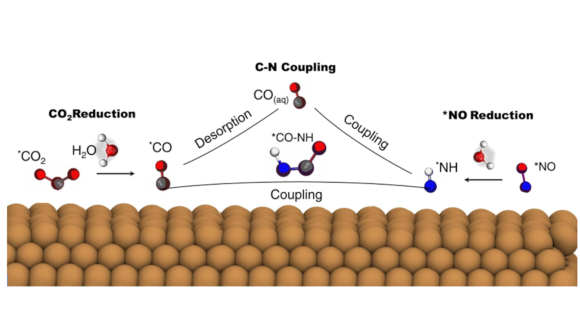
Electrocatalytic urea synthesis is an emerging alternative technology to the traditional urea synthesis protocol. Here, a CuWO4 catalyst with native bimetallic sites achieves efficient co-reduction of carbon dioxide and nitrate to urea by stabilizing intermediates of *NO2 and *CO for C–N coupling.
Electrochemical urea synthesis is promising but struggles with high production rates and Faradaic efficiency. Herein, the authors report in-situ engineered Cu/Cu2O for CO2 and nitrate co-reduction with high urea yield and selectivity.
Electrochemical co-reduction of nitrate and carbon dioxide is a promising approach for urea synthesis. Here, the authors report a sequential co-reduction strategy for catalyst design that can dynamically adjust the competition between the two reduction processes, resulting in a high selectivity towards urea.
Electrochemical urea synthesis presents a promising alternative to conventional synthesis methods, yet the elusive mechanism hindered its development. Here, the authors take copper as an example to explore the potential and electric double-layer effect in electrocatalytic urea synthesis, and reveal two essential strategies to promote the efficiency of urea synthesis.
Conversion into high-value-added organic nitrogen compounds through electrochemical C-N coupling reactions is considered a sustainable strategy to achieve carbon neutrality. Herein, we report the selective electrosynthesis of formamide from carbon monoxide and nitrite using Ru1Cu single-atoms catalyst.
Electrocatalytic C-N coupling of carbon dioxide and nitrate offers a sustainable alternative to traditional urea production. Here the authors report amino substitution in copper phthalocyanine for enhanced urea electrosynthesis.
This study explores N–heterocyclic carbene copper complexes toward selective electrocatalytic reduction of acetylene to ethylene. The electron–rich copper sites were found to facilitate acetylene adsorption and ethylene desorption and achieved high activity and selectivity for ethylene production.
Artificial photosynthesis of urea from NH3 and CO2 remains difficult to achieve. Herein, by three altering the number of heterocyclic N atoms within a series of covalent organic frameworks, the authors report an increase in urea photosynthesis yields and efficiencies.