
Thank you for visiting nature.com. You are using a browser version with limited support for CSS. To obtain the best experience, we recommend you use a more up to date browser (or turn off compatibility mode in Internet Explorer). In the meantime, to ensure continued support, we are displaying the site without styles and JavaScript.

Volume 9 Issue 6, June 2025

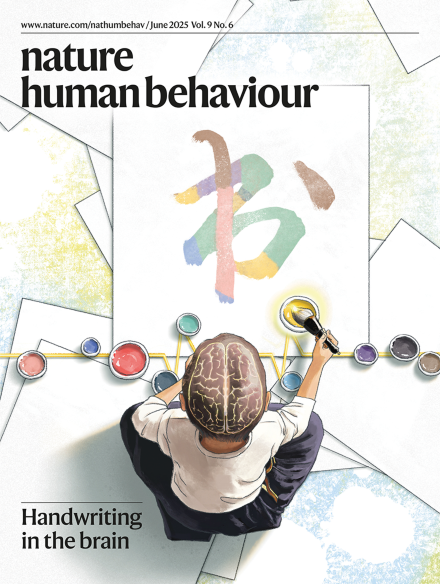
Handwriting in the brain

How does the brain encode complex movement sequences, such as those involved in handwriting? Qi et al. reveal that the brain decomposes sequences into temporal states, each corresponding to a small movement fragment, with motor cortex neurons dynamically altering their encoding across states.

See Qi et al. See also Research Briefing

Image: Yu Qi, Xinyun Zhu, Yu Han, Chaoyang Zhao. Cover design: Bethany Vukomanovic
Correspondence

  • Advertisement

Top of page ⤴

Comment & Opinion

  • Postnatal brain development is important for individual and societal outcomes. We need large-scale cohort studies from diverse populations to generate generalizable insights into the factors that affect children’s brain development. Here we discuss the contribution of the Chinese Child Brain Development project.

    • Liang Zhang
    • Gui Xue
    Comment
Top of page ⤴

Research Briefings

  • How humans perform fine motor movements such as handwriting efficiently and accurately is an unsolved mystery in neuroscience. Our results suggest that the brain encodes handwriting in motor cortex by breaking it down into a series of small movement segments.

    Research Briefing
  • Two nationwide randomized controlled trials in England with over 4 million participants found that text messages that highlighted that people had reached the ‘top of the queue’ increased COVID-19 vaccination rates. As a result, this ‘top of queue’ message was subsequently rolled out as the standard text reminder.

    Research Briefing
Top of page ⤴

Reviews

Top of page ⤴

Research

Top of page ⤴

Search

Quick links