Volume 3
-
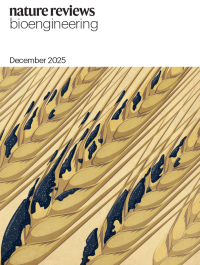
No. 12 December 2025
Heavy metal contamination in crops poses serious risks to food safety and human health owing to bioaccumulation through the food chain. To address this challenge, integrated strategies, such as crop bioengineering, microbiome manipulation and nanotechnology, are being explored to develop scalable, eco-friendly bioremediation solutions. See Ravi Naidu et al
-
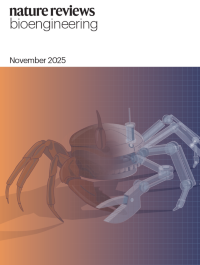
No. 11 November 2025
Nature’s energy-efficient movement strategies offer insights for designing resilient autonomous robots with low energy consumption. By analyzing how animals and plants move across terrain, soil, underwater and air, bioinspired principles can be identified to expand the operativity of robots. See Barbara Mazzolai et al
-
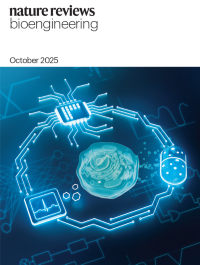
No. 10 October 2025
Smart closed-loop drug delivery systems enhance dosage precision and ensure timely administration by integrating real-time biosensing with automated delivery mechanisms. This approach enables dynamic and personalized drug delivery in wearable and implantable devices. See Marco M. Paci et al
-
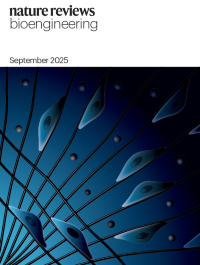
No. 9 September 2025
Structural anisotropy, the spatially aligned patterning of cells and extracellular matrix, dictates tissue-specific mechanical properties and functions. In damaged tissues, anisotropic scaffolds can provide biochemical signals and contact cues to guide alignment and migration of cells offering a pathway to long-term tissue regeneration and restoration of structure-function properties. See Dylan Mostert et al.
-
No. 8 August 2025
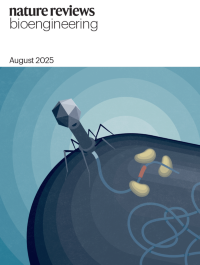
CRISPR–Cas systems enable targeted genome editing of pathogenic and commensal bacteria in situ. Delivered by bacteriophages or through plasmid conjugation, CRISPR–Cas tools can kill or modify specific bacteria, offering pathways for the treatment of infections and microbiome modulation. See Fabienne Benz et al.
-
No. 7 July 2025
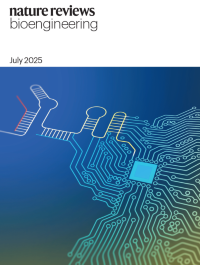
DNA-based biocomputing units, such as switches, logic gates, amplifiers and neurons, can be integrated into circuits that use molecular interactions to process information. These DNA biocomputing circuits offer high parallelism and biocompatibility, making them well-suited for a range of biomedical applications. See Sisi Jia et al.
-
No. 6 June 2025
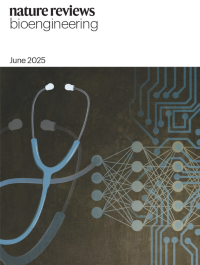
Large language models (LLMs) are transforming medical AI; however, a systematic understanding of their development and clinical utility is lacking. Key developmental considerations include model architecture, data scale and performance across tasks, alongside challenges in deployment, evaluation and integration into healthcare systems. See Fenglin Liu et al.
-
No. 5 May 2025
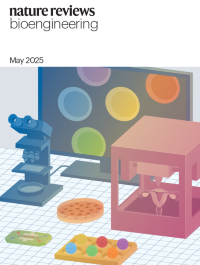
Inclusive experimental design is essential to evidence-based science, requiring diverse resources to consider factors, such as age, race, ethnicity and gender. Accounting for inclusion and diversity can fuel advances in bioengineering that are central to biomedical research and to closing gaps in scientific knowledge. See Amy Hinterberger
-
No. 4 April 2025
RNA-based therapeutics are typically based on linear RNAs. However, circular RNAs offer distinct advantages over their linear counterparts, including enhanced stability during storage and delivery, as well as prolonged therapeutic effects due to their circular structure. These properties make circular RNAs promising candidates for the development of stable, efficient and low-immunogenic RNA-based therapies. See Xiaofei Cao et al.
-
No. 3 March 2025
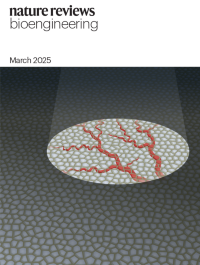
Photoacoustic imaging, also known as optoacoustic imaging, integrates optics and ultrasound to overcome the inherent penetration depth limitations of optical imaging, providing high-resolution images much deeper than optical microscopy. Therefore, photoacoustic imaging systems are being explored to diagnose and monitor disease by visualizing morphological and functional features in biological tissue. See Jeongwoo Park et al.
-
No. 2 February 2025
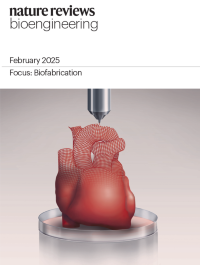
This focus issue delves into advancements in biofabrication technologies, showcasing how they are transforming our capacity to create complex biological structures with unmatched precision, control and speed. See Editorial
-
No. 1 January 2025
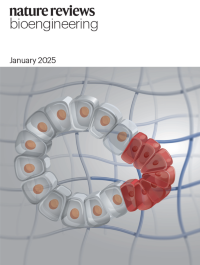
Stem cell-based embryo models can recapitulate symmetry breaking, pattern formation and tissue morphogenesis during early development. To control and guide their in vivo-like cellular organization and architecture, bioengineering approaches can be applied, including biomaterials, additive manufacturing, microphysiological models and synthetic biology. See Xufeng Xue et al.